
Choosing a golf driver involves more than looking for the longest shot or the newest model. Launch, spin, forgiveness, adjustability, and the golfer’s natural swing all influence how a driver performs on the course. The Titleist GTS2 vs GTS3 vs GTS4 comparison centres on these differences and how each design may suit a particular playing style.
Titleist GTS2 vs GTS3 vs GTS4: Amazing Driver Review
 Written byJustin Wilcox, Founder and editorLast updated September 30, 2026
Some links in this review earn us a commission at no cost to you. It never changes what we recommend.
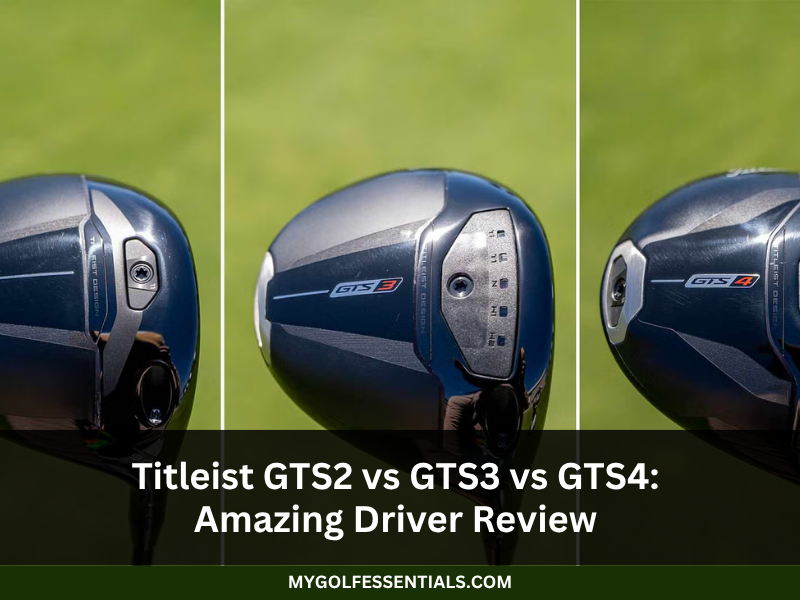
The three models are intended to offer distinct performance characteristics rather than a single solution for every golfer. One may appeal to players who value stability and a more forgiving response, while another may suit golfers seeking greater control over ball flight. A lower-spin option can also be relevant for players who generate sufficient launch and want to manage excessive spin.
This review examines the Titleist GTS2 vs GTS3 vs GTS4 through design, playability, fitting considerations, and practical performance. Individual results will depend on swing speed, strike location, shaft choice, loft, and setup. A fitting session and on-course testing remain important before making a purchase.
Titleist GTS2 vs GTS3 vs GTS4: Key Differences
The central distinction in the Titleist GTS2 vs GTS3 vs GTS4 comparison is the type of performance each model is intended to support. The GTS2 is positioned around stability and accessible playability, the GTS3 focuses more on adjustability and shot control, and the GTS4 is associated with a lower-spin, more specialised profile.
| Feature | GTS2 | GTS3 | GTS4 |
| General design focus | Stability and forgiveness | Control and adjustability | Lower-spin performance |
| Likely appeal | Golfers seeking consistent results | Players who want to fine-tune ball flight | Players managing excess spin |
| Main fitting consideration | Launch and consistency | Strike pattern and shot shape | Launch, spin, and delivery |
| Potential trade-off | May offer less specialised shot shaping | Requires thoughtful setup | May be less forgiving on mishits |
| Best evaluation method | Test dispersion and launch | Compare settings and shot patterns | Measure spin and carry |
These descriptions explain the intended distinctions, not guaranteed results for every golfer. Final specifications, available lofts, and adjustment features should be checked against the exact regional model and manufacturer information before purchase.
Titleist GTS2 Driver Review
The GTS2 is the model to examine when consistency and a stable overall experience are priorities. In the Titleist GTS2 vs GTS3 vs GTS4 comparison, it represents the more accessible direction for golfers who want dependable driver performance without making extensive adjustments to influence every shot.
A driver that helps maintain useful launch and predictable dispersion can be valuable for players who do not always find the centre of the face. However, forgiveness is not a guarantee that every off-centre strike will travel straight or retain its full distance. The actual outcome depends on the location and severity of the miss, as well as the club’s setup.
Design and Stability
The GTS2’s intended role centres on balanced performance. Golfers evaluating it should pay attention to how the head looks at address, how confidently it can be aligned, and whether its feel encourages a repeatable swing. Comfort at address matters because a driver can have suitable technical characteristics but still feel difficult for an individual player to use consistently.
Stability should be evaluated through shot patterns rather than a single successful drive. A useful test compares centred strikes with common mishits and records both carry distance and lateral dispersion. If the GTS2 produces a tighter pattern for a golfer, that consistency may be more valuable than a small increase in peak distance from another head.
Who Should Consider the GTS2?
The GTS2 may suit golfers who prioritise a predictable launch and a straightforward fitting process. It is worth testing for players who regularly miss the centre of the face or prefer a driver that does not require frequent setting changes.
That does not mean it is exclusively a high-handicap option. Golfers with established swings can also value stability, especially when their main goal is to keep the ball in play. In the Titleist GTS2 vs GTS3 vs GTS4 assessment, the GTS2 should be judged by its dispersion, launch, and feel for the individual golfer not by handicap alone.
Titleist GTS3 Driver Review
The GTS3 is aimed at golfers who want to explore a more adjustable approach to driver fitting. Rather than focusing only on general playability, the GTS3’s appeal lies in the opportunity to fine-tune the setup to better match a player’s delivery and preferred ball flight.
In the Titleist GTS2 vs GTS3 vs GTS4 comparison, the GTS3 sits between a more broadly accessible profile and a more specialised low-spin option. Its suitability depends on whether the available adjustments meaningfully improve the golfer’s launch, strike consistency, and shot pattern.
Design and Adjustability
Adjustability can help golfers and fitters test how setup changes affect ball flight. Loft and lie settings, where available on the exact model, can influence launch conditions and directional tendencies. Some driver designs also provide ways to alter weight distribution. The precise options should be verified for the specific GTS3 version being considered.
Adjustability is useful when it solves a real performance issue. For example, a player who consistently launches the ball too high or produces a predictable miss may benefit from testing alternative settings with a qualified fitter. Changing settings without measuring the result, however, can create confusion rather than improvement.
A structured fitting compares one variable at a time. The golfer can then identify whether a change produces a measurable difference in carry, spin, launch, or dispersion.
Who Is the GTS3 For?
The GTS3 may appeal to golfers who strike the ball reasonably consistently and want more control over their driver setup. Players who enjoy testing different configurations may also appreciate its adjustability, provided the changes lead to useful results.
It is not necessary to be a low-handicap golfer to benefit from fitting options. The important factor is whether the golfer has a repeatable enough strike pattern to identify a meaningful improvement. Within the Titleist GTS2 vs GTS3 vs GTS4 range, the GTS3 deserves consideration when control and setup flexibility are priorities rather than goals in themselves.
Titleist GTS4 Driver Review
The GTS4 is associated with a more specialised performance profile, particularly for golfers looking to manage spin. Excessive driver spin can reduce distance for some players, but reducing spin is not automatically beneficial. The golfer still needs sufficient launch and carry to achieve a useful overall result.
The Titleist GTS2 vs GTS3 vs GTS4 comparison therefore requires a careful look at ball-flight conditions. A low-spin design may provide a useful option for a player whose measured launch data shows that spin is consistently higher than suitable for their swing.
On-Course Performance: Forgiveness, Distance, and Control
A driver’s performance becomes meaningful when it produces useful shots repeatedly. The Titleist GTS2 vs GTS3 vs GTS4 should be compared using a consistent set of measures: launch, spin, ball speed, carry, total distance, dispersion, and the golfer’s confidence at address.
Forgiveness: Forgiveness refers to how well a club maintains useful ball speed and direction when impact misses the centre. It does not eliminate the effects of poor contact. Golfers should test their common mishits, particularly heel and toe strikes, to understand which head produces the most manageable misses.
Distance and launch: Distance depends on more than ball speed. Launch angle and spin influence how efficiently the ball carries and rolls. A golfer may find that a driver with a slightly lower peak ball speed still produces better overall distance because its launch conditions are more suitable. Comparing average carry across multiple shots helps reduce the influence of outliers.
Accuracy and feel: Dispersion shows how widely shots finish around the intended target line. A driver that reduces large misses can make approach shots easier, even if it does not produce the longest individual drive. Feel is subjective, but it still matters: confidence in the club’s appearance, sound, and response can support a repeatable pre-shot routine.
For a fair Titleist GTS2 vs GTS3 vs GTS4 test, golfers should use the same ball, similar environmental conditions, and comparable shaft specifications where possible. Each model should receive enough shots to establish a representative pattern. A single swing or a few unusually good strikes cannot provide a reliable comparison.
What Are the Key Differences Between the Titleist GTS2 and GTS3 Drivers?
The main distinction is the emphasis of each design. The GTS2 is generally framed around stable, accessible performance, while the GTS3 places greater attention on adjustability and the ability to tune the driver’s setup. Both may suit a range of abilities, but they should be compared according to the golfer’s actual launch and dispersion needs.
A player who wants a consistent feel and a simple setup may prefer to begin testing with the GTS2. A player who has a repeatable miss or a clear ball-flight objective may find it useful to test the GTS3’s adjustment options. Neither model should be selected based on its label alone.
The most useful comparison involves measured carry, spin, launch, and dispersion. If the GTS3’s settings produce a clear improvement, the flexibility may be valuable. If the results remain similar, the GTS2 may offer the desired performance without requiring additional setup decisions.
Is an Upgrade to the GTS Range Worth Considering?
An upgrade makes sense when the new driver produces a measurable benefit that matters to the golfer. That benefit might be improved carry, tighter dispersion, more suitable launch, better strike consistency, or a more comfortable feel. A newer model is not automatically better for every swing.
Golfers using an older driver should first establish a baseline. A launch-monitor session can record ball speed, launch angle, spin, carry, and dispersion. The same measurements can then be collected with the GTS2, GTS3, and GTS4 under comparable conditions.
The Titleist GTS2 vs GTS3 vs GTS4 comparison may reveal that a different profile helps a golfer, but the improvement should be large enough to justify the cost and adjustment period. If the performance is similar, keeping the current driver may be a reasonable choice. Used-club condition, warranty coverage, shaft compatibility, and return policies should also be considered.
Specifications and Price Considerations
Specifications and prices can vary by market, release configuration, shaft, loft, condition, and retailer. Before buying, golfers should confirm the exact model year, available lofts, head characteristics, adjustment options, stock shaft, and whether the club is new or pre-owned. Manufacturer documentation and authorised retailer listings are the appropriate references for exact details.
The price of a GTS2 or GTS3 may also differ substantially between new and used examples. A lower listing price does not necessarily represent better value if the shaft is unsuitable, the club has visible wear, or the seller provides limited return protection.
For a fair Titleist GTS2 vs GTS3 vs GTS4 purchase comparison, the total cost should include any fitting session, shaft upgrade, grip replacement, or adjustment service. A properly fitted club that produces repeatable results may provide more practical value than a cheaper driver that does not match the golfer’s swing.
Final Thoughts
The Titleist GTS2 vs GTS3 vs GTS4 comparison is ultimately about matching a driver’s intended performance profile to the golfer’s swing. The GTS2 offers a starting point for players focused on stability and consistency, the GTS3 gives greater attention to adjustability and control, and the GTS4 is aimed at golfers exploring lower-spin performance.
These distinctions can guide a shortlist, but they cannot replace testing. Launch, spin, carry, dispersion, shaft fit, and personal confidence should all influence the final choice. A side-by-side fitting session can reveal whether one model produces a meaningful improvement or whether the differences are minor for a particular player.
Rather than choosing by model number or claims of distance alone, golfers can use the Titleist GTS2 vs GTS3 vs GTS4 comparison to identify the characteristics that matter most. The most useful driver is the one that supports repeatable tee shots and helps the golfer approach each hole with a reliable ball flight.
Key Takeaways
- The GTS2, GTS3, and GTS4 are designed around different driver performance priorities.
- The GTS2 is worth testing when stability and consistent playability matter most.
- The GTS3 may suit golfers who want more control over their setup.
- The GTS4 is a specialised option for golfers assessing lower-spin performance.
- Forgiveness should be measured through common mishits and overall shot dispersion.
- Distance depends on launch, spin, strike quality, and ball speed together.
- Adjustability helps most when it addresses a clearly identified fitting need.
- Shaft selection can influence performance as much as the driver head.
- A launch-monitor comparison provides more insight than judging isolated long drives.
- The most suitable model is the one that fits the golfer’s measured swing.
Frequently Asked Questions
1. What Are the Key Differences Between Titleist GTS3 and GTS4 Drivers?
The GTS3 is associated with control and setup adjustability, while the GTS4 is positioned toward a more specialised, lower-spin profile. The practical difference depends on the golfer’s launch conditions and strike pattern. A fitting can show whether the GTS4’s spin characteristics improve carry and dispersion or whether the GTS3 provides a more suitable overall flight.
2. Is the GTS3 Forgiving?
Yes, the GTS3 can offer forgiveness, but its real-world performance depends on impact location, shaft fit, and setup. Forgiveness does not mean that mishits lose no distance or direction. Golfers should compare heel, toe, and low-face strikes alongside centred contact to understand how consistently the GTS3 performs for their individual swing.
3. Is the Titleist GTS2 Driver Forgiving?
Yes, the GTS2 is intended to provide stable and accessible performance, which may benefit golfers who value consistency. However, the degree of forgiveness varies with strike location and delivery. A golfer should test the GTS2 using a representative set of shots and compare its dispersion and carry with other drivers before deciding whether it suits their needs.
4. How Much Is a GTS2 Driver?
The price of a GTS2 driver depends on the market, retailer, shaft configuration, and whether the club is new or used. Custom fitting or upgraded components may add to the total cost. Since prices change over time, buyers should check current manufacturer or authorised retailer listings and compare the complete package rather than the head price alone.
5. What’s the Easiest Titleist Driver to Hit?
There is no single easiest Titleist driver for every golfer. The most playable option depends on swing speed, strike consistency, launch, spin, and preferred feel. A fitting can compare suitable head profiles and shafts using carry and dispersion data. The driver that produces a reliable pattern and comfortable setup for an individual golfer may be the easiest for that player to hit.