The latest driver is not always the one that belongs in the bag. That is worth remembering when comparing Cobra’s Darkspeed family with the newer DS-Adapt range. DS-Adapt brings a more adjustable hosel and a broader choice of forgiving heads, but those changes do not mean every golfer will hit it farther or straighter.
Cobra Darkspeed vs DS-Adapt: Which Driver Should You Buy?
 Written byJustin Wilcox, Founder and editorLast updated October 1, 2026
Some links in this review earn us a commission at no cost to you. It never changes what we recommend.
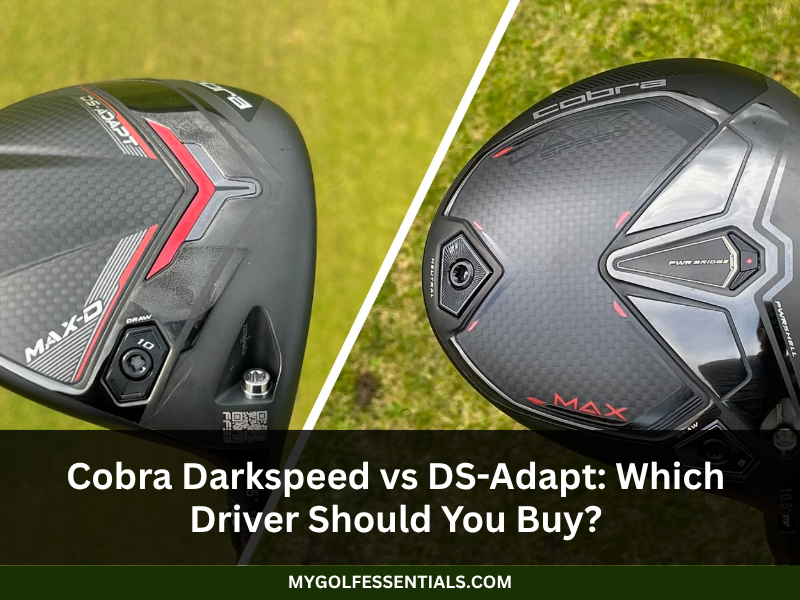
The decision is less about choosing a generation and more about finding the head that matches the way a golfer delivers the club. A player who already gets a reliable flight from Darkspeed may have little reason to change. Someone still working on launch, spin, or a persistent miss may find that the extra fitting options in DS-Adapt are useful.
Both families cover a wide range of players. Darkspeed comes in LS, X, and MAX versions. DS-Adapt keeps LS and X, then splits the more forgiving end into MAX-K and MAX-D. That split is one of the clearest differences between the lineups: MAX-K is built around stability, while MAX-D adds draw bias.
| Darkspeed | DS-Adapt | |
| Generation | 2024 | 2025 |
| Models | LS, X, MAX | LS, X, MAX-K, MAX-D |
| Notable technology | Carbon construction, H.O.T. Face, PWR-Bridge | FutureFit33 adjustable hosel |
| Forgiving options | MAX | MAX-K (stability), MAX-D (draw bias) |
| Main consideration | Potential value as an older generation | More fitting combinations and head choices |
What actually changed?
Darkspeed’s design story includes lightweight carbon construction, Cobra’s H.O.T. Face technology, and a PWR-Bridge weighting structure. These are intended to support ball speed and manage mass within the head. They are part of the design, though the presence of a technology name by itself does not tell a golfer what will happen to their own numbers.
DS-Adapt’s headline feature is FutureFit33, a hosel system that provides 33 loft-and-lie settings. That gives a fitter more combinations to try when dialing in launch and direction. It is a fitting tool, not a promise of extra yards. A setting only helps if it better suits the player’s delivery and impact pattern.
The expanded MAX choice is also worth noting. Darkspeed MAX combines forgiveness with draw-oriented characteristics. DS-Adapt separates those priorities somewhat: MAX-K emphasizes stability, while MAX-D is designed to encourage a draw. Golfers can therefore start with a more specific goal when testing the newer range.
Distance: Newer does not automatically mean longer
Driver distance is shaped by several things at once: clubhead speed, strike location, launch, spin, shaft, and the conditions in which the ball is hit. That makes isolated numbers useful as examples, but weak as universal predictions. Reviews that use different golfers or setups cannot establish a clean head-to-head winner.
In a Golfer Geeks review, a tester using the DS-Adapt MAX-K had a reported clubhead speed of about 100 mph. With a 9-degree head and Project X Denali Blue 60 stiff shaft, the review reported around 148 mph ball speed, 234 yards of carry, 3,153 rpm of spin, a 1.47 smash factor, and a 63-foot peak height. Those figures describe that golfer and configuration; another player could see a different launch window and result.
A MyGolfSpy forum discussion gives a contrasting, more personal example. A golfer with a 14 handicap and a reported swing speed around 91–96 mph compared a Darkspeed X with a DS-Adapt MAX-K. The golfer reported a 233-yard carry when retesting the Darkspeed X and described variable DS-Adapt results depending on settings, ultimately preferring the Darkspeed X. The shafts and head designs were different, so this is not a controlled comparison. It does, however, underline why an upgrade should be tested rather than assumed.
For anyone weighing Cobra Darkspeed vs DS-Adapt, the useful question is not which one produced the biggest number in someone else’s review. It is whether a properly fitted DS-Adapt improves average carry, ball speed, or dispersion compared with the driver already in the bag.
Forgiveness and accuracy
Forgiveness can mean a few different things. A head may retain more ball speed on an off-centre strike, twist less at impact, or help a golfer keep more shots in a playable area. These are related, but they are not interchangeable measures. A driver that feels stable may not necessarily tighten every player’s dispersion.
Darkspeed MAX is the forgiving, draw-oriented option in its family. DS-Adapt MAX-K is positioned around high stability, while MAX-D is aimed at golfers looking for draw assistance. That distinction can help narrow the test list. A player whose main concern is mishit stability may want to try MAX-K; someone looking for help with a fade or slice may also want to test MAX-D.
Neither design should be treated as a cure for poor contact or a swing flaw. Face angle, club path, strike location, and delivery all influence shot shape. The available review and forum examples are individual experiences, not proof that one head is more accurate for every golfer.
Launch, spin, and flight
The LS heads in both generations are aimed at golfers looking for a lower-spin flight and more workability. The X heads offer a more versatile profile, while the MAX options put more emphasis on forgiveness and, depending on the model, draw bias or stability.
FutureFit33 gives DS-Adapt more ways to adjust loft and lie. Those changes can affect how the club sits and launches, but the result depends on the golfer’s delivery. A lower-spin head is not automatically better: too much spin can cost distance for some players, while too little can make it harder for others to maintain carry.
The MAX-K review’s 3,153 rpm figure is specific to its test setup. It should not be treated as the expected spin rate for all MAX-K golfers or used on its own to conclude that it spins more or less than Darkspeed MAX. A launch monitor session that records averages across several reasonable strikes will offer a more useful picture.
Feel, sound, and looks
Numbers do not tell the whole story. The shape of the head at address, the sound at impact, and the feel through the strike can all affect confidence. Those preferences are personal, and they can change with shaft, grip, strike location, and even what a golfer is used to seeing behind the ball.
The Golf Monthly comparison of DS-Adapt MAX-D and Darkspeed MAX included observations on feel and sound, and its reviewer preferred the Darkspeed MAX’s appearance. That is a subjective response rather than a performance finding, but it is a reminder to put both clubs down behind the ball before making a decision. A head that looks comfortable can help a golfer swing with fewer doubts.
How the individual models compare
Darkspeed LS vs DS-Adapt LS
Both LS heads are intended for golfers who want a lower-spin profile and the ability to shape shots. DS-Adapt LS adds the FutureFit33 system, which may help a fitter refine the setup. That added adjustment range is worth trying if launch or direction has been difficult to dial in, but it does not guarantee more distance. A golfer already performing well with Darkspeed LS should look for a measurable improvement before replacing it.
Darkspeed X vs DS-Adapt X
The X models sit between the more demanding LS profile and the forgiveness-focused MAX options. They may suit golfers who want a versatile driver without making low spin the only priority. The forum comparison mentioned earlier was between Darkspeed X and DS-Adapt MAX-K, not DS-Adapt X, so it cannot settle the direct X-versus-X question. A side-by-side fitting with comparable lofts and suitable shafts would be more informative.
Darkspeed MAX vs DS-Adapt MAX-K
Darkspeed MAX offers forgiveness with draw-oriented characteristics. DS-Adapt MAX-K places a clearer emphasis on stability. The MAX-K review provides useful data for one tester, but it does not prove that it will be more forgiving or accurate than Darkspeed MAX for every swing. Golfers who already hit Darkspeed MAX consistently may find the difference modest; others may benefit from testing the newer head.
Darkspeed MAX vs DS-Adapt MAX-D
These two heads have some overlap because both sit in the forgiving part of their respective families, but DS-Adapt MAX-D is specifically positioned around draw bias. Golf Monthly’s comparison offers subjective comments on feel, sound, and appearance, rather than a universal performance verdict. Golfers seeking a more right-to-left flight can include MAX-D in a fitting, while keeping in mind that equipment alone cannot reliably eliminate a slice.
Is upgrading worth the money?
The case for DS-Adapt is strongest when its extra adjustability or different head design solves a real fitting problem. A golfer who has struggled to find a suitable launch window, or who wants to compare a stability-focused MAX-K with a draw-biased MAX-D, has a practical reason to test the range.
The case for keeping Darkspeed is straightforward too: if it already produces a repeatable flight, there may be little to gain from changing generations. As the older line, Darkspeed may also be discounted, although actual prices depend on retailer, region, stock, and shaft configuration. Compare the full fitted cost rather than relying on launch prices or headline discounts.
During a fitting, pay attention to average carry rather than the single longest shot. Record ball speed, launch, spin, and dispersion, and use the same ball and a consistent routine where possible. Also compare feel and appearance. If the newer head shows a clear and repeatable improvement, the upgrade has a stronger case. If the numbers are nearly identical, price and personal preference can reasonably decide it.
Which one should different golfers test?
| Priority | Models to put on the shortlist |
| Lower spin and shot-shaping | Darkspeed LS or DS-Adapt LS |
| Versatile performance | Darkspeed X or DS-Adapt X |
| Stability on mishits | DS-Adapt MAX-K; compare with Darkspeed MAX |
| Draw assistance | DS-Adapt MAX-D or Darkspeed MAX |
| More fitting adjustments | DS-Adapt range with FutureFit33 |
| Potentially lower purchase cost | Darkspeed, depending on local availability and price |
Higher handicap alone is not enough to select a head. A golfer who launches the ball well but misses the centre may have different needs from someone who struggles to get the ball airborne or tends to miss in one direction. Testing a suitable MAX model is a reasonable starting point for many golfers seeking forgiveness, but the launch monitor and actual ball flight should guide the final choice.
Final Thoughts
DS-Adapt gives Cobra golfers more ways to tune a driver, especially through FutureFit33 and the separate MAX-K and MAX-D heads. Those additions make the newer family worth testing for players who are still searching for the right launch, stability, or shot shape. They do not make Darkspeed obsolete.
A well-fitted Darkspeed can still be the right club, particularly if it is available at a lower price. The deciding evidence should come from a comparison of the specific heads and shafts that suit the golfer not from the year printed on the sole.
Key points to remember
· DS-Adapt adds fitting flexibility, but its newer release does not guarantee better results.
· FutureFit33 offers 33 loft-and-lie settings for fine-tuning the driver’s setup.
· Darkspeed remains a relevant choice when it already delivers consistent performance.
· DS-Adapt MAX-K emphasizes stability, while MAX-D is designed around draw bias.
· LS models target lower-spin performance; X models offer a more versatile profile.
· Review figures reflect individual golfers and should not be treated as universal outcomes.
· Shaft, loft, strike location, and delivery can materially change driver performance.
· A discounted Darkspeed may offer better value if fitting results are comparable.
· Forgiveness, launch, and shot shape should be evaluated separately rather than treated as one quality.
· A side-by-side fitting is more useful than choosing by model year alone.
Frequently asked questions
Is the Cobra DS-Adapt suitable for high-handicap golfers?
Some DS-Adapt models may suit higher-handicap golfers, particularly MAX-K for stability or MAX-D for draw bias. Handicap by itself does not identify the right head. Launch, strike pattern, speed, and common miss should shape the fitting decision.
Can DS-Adapt help with a slice?
The MAX-D is draw-biased and may help some golfers produce a more right-to-left flight. It cannot guarantee that a slice will disappear, since shot shape is also affected by face angle, path, strike location, and delivery. A fitting can assess whether the head helps.
Which DS-Adapt model should be tested first?
That depends on the ball flight being sought. LS is aimed at lower spin and workability, X is the versatile option, MAX-K emphasizes stability, and MAX-D is draw-biased. A fitter can narrow the choice by looking at launch and dispersion.
Which Darkspeed driver is most forgiving?
Darkspeed MAX is the forgiveness-focused head in the Darkspeed family and includes draw-oriented characteristics. It is worth testing for golfers who want a more playable profile, although actual results depend on strike and delivery.
Should a Darkspeed owner upgrade to DS-Adapt?
An upgrade makes sense when testing shows a repeatable improvement in distance, dispersion, launch, or consistency or when DS-Adapt’s adjustment range solves a fitting issue. If the existing Darkspeed already performs well and the numbers are close, there may be little practical reason to change.