
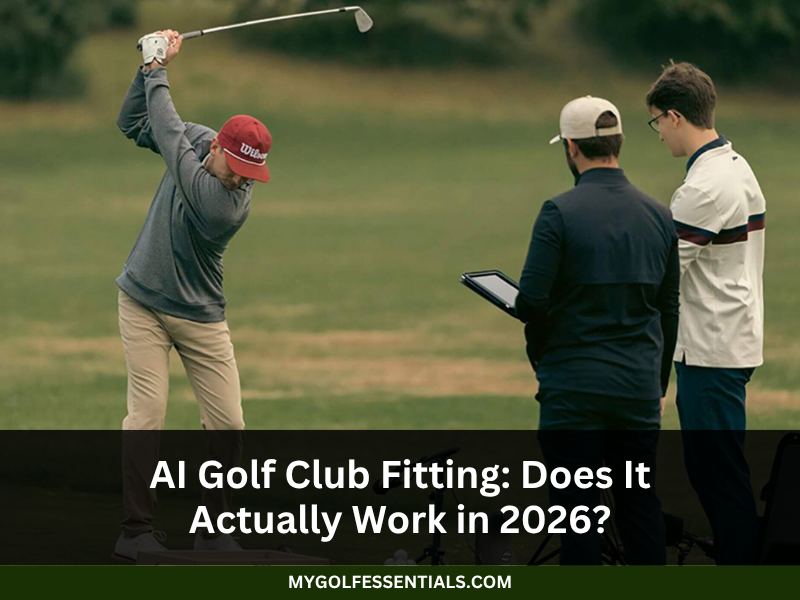
AI Golf Club Fitting: Does It Actually Work in 2026?
 Written byJustin Wilcox, Founder and editorLast updated October 2, 2026
Some links in this review earn us a commission at no cost to you. It never changes what we recommend.
AI Golf Club Fitting: Does It Actually Work in 2026?
Golfers rarely need another number to chase. What they need is a club that helps them produce a predictable shot when it matters. That is part of the appeal behind ai golf club fitting: software can take swing and ball-flight measurements that are difficult to interpret at a glance and turn them into equipment options worth investigating.
AI golf club fitting refers to software-assisted analysis that uses a golfer’s swing information, ball-flight results and equipment details to suggest club specifications. For example, ELDRICK describes an online approach that uses golfer-submitted launch data and equipment-catalogue information to generate fitting guidance. Wilson’s FitAi is presented as a tool used in fitting centres with professional support.
For AI golf club fitting, the central point is simple: software can only work with the information it receives. If the data is inaccurate, incomplete or unrepresentative of the golfer’s normal shots, the recommendation may be misleading even if the analysis itself is performed consistently.
How Does AI Golf Club Fitting Work in 2026?
AI golf club fitting has no single workflow used by every provider. In a fitting centre, measurements may be collected during a supervised session and reviewed alongside a fitter’s observations. An online service may instead ask the golfer to upload figures from a compatible launch monitor or enter existing results. The equipment catalogue and the club category being fitted also shape what the system can recommend.
From Swing Data to Equipment Recommendations
A recommendation engine looks for a plausible match between the golfer’s measurements and the characteristics of available equipment. Different launch and spin profiles, for instance, may lead to different loft or shaft options being considered. The software uses these comparisons to focus attention, not to declare that one specification is correct for every swing with similar numbers.
This is where ai golf club fitting can save time. Instead of starting with every possible head and shaft, the player or fitter can begin with a shorter list. The next step is to hit the actual combinations, compare repeatable results and consider feel. A shortlist is most useful when it makes testing more focused without closing off reasonable alternatives.
Does AI Golf Club Fitting Actually Work?
It can work as a decision-support tool. When the measurements are reliable and the system’s method is clear, AI-assisted analysis can organize performance information, compare equipment specifications and identify options worth trying. That may be particularly useful for golfers who find technical club data difficult to interpret or who want a starting point before visiting a fitter.
For AI golf club fitting, the phrase “actually work,” however, can mean several things. Producing a plausible equipment shortlist is one outcome. Helping a golfer hit more consistent shots is another. Demonstrating that the change improves scoring over time is a further step. A software recommendation alone cannot guarantee any of those results, and claims about better golf should be judged separately from claims about data analysis.
In AI golf club fitting, measurement quality is part of the issue. The supplied article refers to a 2026 comparison of the FlightScope Mevo+ and TrackMan 4 launch monitors. It reports that the devices showed moderate to excellent consistency for many variables, while agreement differed for some measurements; angle of attack showed particularly poor agreement in certain club categories. The practical lesson is to be cautious when comparing figures from different devices, especially for variables where agreement is weaker.
There is also a difference between validating a measuring device and validating a fitting recommendation. Evidence that a launch monitor records a variable consistently does not, by itself, prove that software using that variable will select the ideal club or lower a golfer’s handicap. To establish that, the recommendations would need to be tested against meaningful outcomes, not just the appearance of a detailed report.
What Research Reveals About AI Fitting Accuracy
When reviewing an AI golf club fitting service, it is useful to ask what its system measures, which data sources it accepts, how it generates recommendations and which equipment options are included. A provider’s description can explain how the service is intended to work, but company statements should not be mistaken for independent performance testing.
Does Golf Club Fitting Really Make a Difference?
More distance is not automatically the best outcome. A driver that produces one particularly long shot but scatters the rest may be less useful than a setup that gives up a little distance and keeps more shots in play. With irons, predictable carry gaps and a trajectory the golfer can control may matter more than the longest number recorded during a session.
A useful AI golf club fitting session compares multiple shots with different configurations. Carry, launch, spin, dispersion, strike quality and feel can all contribute to the decision. The player’s common miss and the courses typically played may also affect the trade-offs. For example, a golfer who struggles to hold greens may have different priorities from one who wants to reduce a recurring left miss.
AI golf club fitting can identify configurations that appear promising from the data, but the result still needs to be checked with the actual club. A specification that looks right in a report might feel awkward or produce inconsistent contact. Equipment is used by a person, not by an algorithm, so comfort and confidence belong in the evaluation.
AI Fitting vs Traditional Golf Club Fitting
AI-supported and traditional fittings often use similar measurements, including launch-monitor data and equipment specifications. The difference is mainly in how the information is interpreted and how much direct interaction is part of the process.
| Aspect | AI-supported fitting | Traditional in-person fitting |
| Data collection | May use uploaded, entered or launch-monitor data | Often measures shots during a live session |
| Recommendations | Uses software, models or fitting rules | Combines measurements, observation and fitter judgment |
| Convenience | Some services can be used remotely | Usually requires an appointment or fitting location |
| Equipment testing | Depends on service and club access | Often includes testing different combinations |
| Personal feedback | May rely on submitted preferences | Fitter can ask questions and observe comfort |
| Main limitation | Depends on input quality and system coverage | Depends on fitter, process and available equipment |
An online AI golf club fitting service may suit a golfer who already has reliable data and wants an initial shortlist. A live session may be more useful when the player needs to compare how clubs feel, has an unusual shot pattern or is unsure which specifications are comfortable. Neither format is automatically superior; the process and evidence behind the recommendation matter.
A combined approach is possible. AI golf club fitting can help identify options to try, while an in-person fitter can observe the player and assess the results. In that arrangement, software helps organize the search and real-world testing helps decide whether the recommendation makes sense.
Main Benefits of AI Golf Club Fitting
One practical benefit of AI golf club fitting is organization. Club catalogues can include many combinations of head design, shaft weight, flex, loft, lie and length. A data-led tool may narrow that field so the golfer has fewer options to investigate. This does not make the decision effortless, but it can give the fitting process a clearer starting point.
Convenience may matter as well. Some online services accept existing launch-monitor figures, allowing golfers to explore possible specifications without beginning with a full in-person session. That can be helpful for someone who has access to suitable data but limited access to fitting facilities. It is less useful when the player has no reliable measurements to provide.
Where AI Falls Short
A data-only system may miss details that are difficult to enter into a form. A golfer might find a shaft tiring over a full round, feel uneasy looking down at a particular head, or make small compensations because a club seems too long. These experiences can affect performance even when launch-monitor figures look promising.
Data can also be distorted by a small or unusual sample. Swing patterns may shift with fatigue, practice, weather or pressure. If only a few shots are used, one mishit or unusually good strike may influence the result more than it should. A sensible process considers typical performance and repeats comparisons under similar conditions.
Why AI Cannot Assess Every Aspect of a Golf Swing
An in-person fitter can ask about those experiences, watch the golfer set up and respond to what happens during testing. Direct observation does not guarantee a perfect fitting, but it can reveal context that a remote questionnaire or data upload may leave out. This is especially relevant when contact is inconsistent, the swing is changing or comfort is a concern.
AI golf club fitting can still contribute in these situations, but its output should be treated as a hypothesis to test. The golfer’s response to the equipment is part of the evidence, not a distraction from it.
How Far Should a 20 Handicap Golfer Hit a 7 Iron?
There is no single 7-iron distance that applies to every golfer with a 20 handicap. Carry depends on swing speed, strike quality, launch conditions, age, physical strength and the loft of the club itself. Two players with the same handicap can produce very different distances, so a chart should not be treated as a fitting target.
A more useful question is whether the golfer has dependable gaps between clubs. Carry distance is helpful for that purpose because total distance can change with wind, turf, landing angle and rollout. During a fitting, repeated shots can help establish a realistic average and show how consistently the club performs.
For ai golf club fitting, handicap alone is not enough to recommend an iron. Launch-monitor measurements and the player’s typical ball flight offer a better starting point. The aim is a useful, repeatable shot pattern—not matching an arbitrary distance associated with a handicap.
Who Can Benefit from AI Golf Club Fitting?
AI golf club fitting may be useful for golfers who have reliable launch-monitor data and want help turning it into a manageable list of equipment options. It can also support players researching a new set, replacing older clubs or preparing questions before a fitting appointment.
Experienced players may use the results to focus a later fitting on a few shaft, launch or gapping questions. By contrast, someone with little trustworthy data, persistent contact problems or discomfort may need supervised testing and feedback. In those cases, the technology can be part of the process, but it should not be expected to diagnose every issue on its own.
Is AI Golf Club Fitting Worth the Money?
Whether ai golf club fitting is worth paying for depends on the service and what the fee includes. Some online offerings provide guidance based on data the golfer already has; other tools are included in a fitting-centre session. A price alone cannot show whether the result will be useful for a particular player.
Before paying, check what data is required, which club categories and products are supported, and whether the result is a broad specification or a shortlist of actual models. It is also worth asking whether testing is available, whether the fitting fee is separate from the clubs and whether follow-up adjustments are included.
What Should Be Checked Before Paying for a Fitting?
A service should be clear about what it measures and what it cannot determine. Look for information about the source of the data, the number of shots considered, the equipment catalogue and how recommendations can be reviewed after testing. A detailed report is useful only if its assumptions and limits are understandable.
Golfers should also confirm whether the final specifications can be shared with another fitter or club builder. If possible, test the suggested setup before committing to a purchase. The practical question is not whether the software produced a confident answer, but whether the equipment performs well enough to justify the cost.
The Future of AI Golf Club Fitting
AI-supported fitting is being used in different parts of the process, from online analysis of existing data to tools used alongside professionals in fitting centres. As launch-monitor data and digital equipment catalogues become more connected, these systems may become easier to use and better at explaining the options they identify.
For now, ai golf club fitting is best viewed as a way to support measurement and decision-making. The most useful technology will be the kind that makes information clearer without obscuring the golfer’s own feedback or the value of testing.
Final Thoughts
AI golf club fitting can turn swing and ball-flight information into equipment options worth exploring. It may make the first stage of the search more convenient and help reduce a large catalogue to a focused shortlist. Its limits become clear when data is incomplete, the golfer’s needs are difficult to quantify or there is no opportunity to try the recommended club.
In the end, a club is not a good fit simply because an algorithm selected it. It has to work for the golfer’s swing, preferences and on-course requirements.
Key Takeaways
1. AI golf club fitting uses swing and ball-flight data to suggest equipment specifications for individual golfers.
2. It can help compare clubheads, shafts, lofts, lie angles and other equipment characteristics.
3. The technology can make early equipment research more organized, convenient and data-informed.
4. Reliable measurements and representative shots help recommendations reflect a golfer’s typical performance.
5. Launch-monitor measurements can differ between devices, so data sources and limitations deserve attention.
6. AI-generated recommendations are starting points, not guarantees of longer shots, lower scores or consistency.
7. The approach may suit golfers who already have access to trustworthy launch-monitor data.
8. In-person testing can assess comfort, confidence, strike quality and factors software may not capture.
9. Before paying, golfers should review supported equipment, data requirements, pricing and follow-up options.
10. AI can support equipment decisions, while golfer feedback and real-world testing remain important.
Frequently Asked Questions
Do expensive golf clubs really make a difference?
No, not for every golfer. Premium clubs may use different materials, construction methods or adjustment features, but price alone does not show that a club will perform better for a particular player. A suitable fit, consistent contact and confidence can matter more than the price tag. Testing alternatives helps establish whether the extra cost brings a useful benefit.
How many balls do you hit in a club fitting?
No fixed number applies to every session. The total depends on the club being fitted, the golfer’s consistency, the combinations tested and the fitter’s process. There should be enough representative shots to compare results, but not so many that fatigue changes the swing. The aim is to identify dependable patterns rather than simply increase the ball count.
How much should I pay for a golf club fitting?
No single fee applies to every fitting. Costs vary by location, session length, club category, technology and whether the fee is credited toward a purchase. Online guidance may differ from supervised testing with multiple club options. Before booking, confirm what the fee covers, whether clubs cost extra and whether follow-up support is available.
If I hit my 7 iron 140 yards, what is my swing speed?
No exact swing speed can be calculated from distance alone. Carry also depends on loft, strike quality, launch angle, spin, ball characteristics and conditions. Two golfers can hit a similar distance with different swing speeds and launch profiles. A launch monitor can measure speed directly and provide context for interpreting the shot.
What percent of golfers drive 300 yards?
No single percentage applies across all golfers or measurement methods. The figure depends on whether distance means carry or total, and whether the data represents recreational golfers or competitive players. A 300-yard drive is not a meaningful target for everyone. Equipment choices are more useful when based on an individual’s goals and repeatable performance.