
If you have ever stood over a 7 iron and wondered, “how far should I hit my 7 iron?” you are not alone. It is one of the most common questions golfers ask, and for good reason. The 7 iron is the club most golfers reach for on approach shots, and knowing your real distance with it can transform your entire game.
How Far Should I Hit My 7 Iron? (Complete Guide for Every Golfer)
 Written byJustin Wilcox, Founder and editorLast updated April 6, 2026
Some links in this review earn us a commission at no cost to you. It never changes what we recommend.
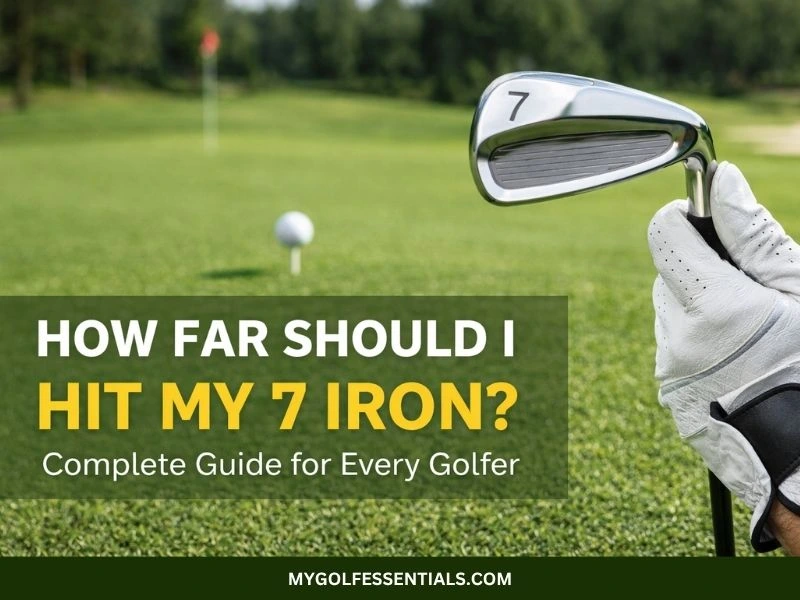
This guide breaks down everything, from average distances by skill level to what actually affects how far the ball flies, and how to start hitting it more consistently. Whether you are a beginner or a seasoned golfer, knowing your honest 7 iron distance is the first step to making smarter decisions on the course.
What Is the Average 7 Iron Distance for Every Skill Level?
The average male recreational golfer carries a 7 iron between 130 and 160 yards. Most club golfers land somewhere around 140 to 150 yards of carry. Women typically carry the same club between 90 and 120 yards, with the average sitting around 105 yards.
Here is the thing, though. These are averages, not targets. Your number depends on your swing speed, contact quality, and equipment. A 150-yard 7 iron is solid for most golfers, but a beginner hitting 110 yards is not doing anything wrong.
| Golfer Type | Average Carry (Men) | Average Carry (Women) |
| Beginner | 100-120 yards | 70-90 yards |
| Intermediate | 130-150 yards | 90-110 yards |
| Advanced/Low Handicap | 155-175 yards | 110-130 yards |
| Tour Professional | 175-195 yards | 140-165 yards |
Beginner Golfers
A beginner should expect to carry a 7 iron between 100 and 120 yards. That is a realistic and honest target for someone still developing their swing mechanics. Many new golfers swing hard but make poor contact, which kills distance fast.
The biggest mistake beginners make is scooping the ball. They try to lift it into the air instead of compressing it downward. A descending strike adds 10 to 20 yards instantly, even without changing swing speed. Common beginner distance killers include:
- Scooping or flipping at impact
- Poor ball position (too far forward in the stance)
- Weak grip causing an open clubface at impact
- Lack of weight transfer through the shot
Fix your contact first. Distance will follow naturally once you do.
Intermediate Golfers
Intermediate golfers, typically those shooting in the 85 to 100 range, carry a 7 iron between 130 and 150 yards. At this level, swing mechanics are more consistent, and ball striking has improved enough to produce repeatable distances round after round.
The key difference at this stage is consistency. An intermediate golfer may occasionally pure a 7 iron to 155 yards, but their average is far more reliable than a beginner’s. That reliability matters more than one great shot per round. What separates intermediate golfers from beginners:
- Better compression and forward shaft lean at impact
- More consistent contact on the center of the face
- Improved tempo and rhythm throughout the swing
- More reliable weight shift and body rotation
Professional Golfers
Professional golfers carry a 7 iron between 175 and 195 yards on the PGA Tour. Some long hitters push past 200 yards under the right conditions. LPGA Tour professionals average around 140 to 165 yards with the same club.
Here is what matters, though. Tour pros do not just hit it far. They control spin, trajectory, and landing angle with real precision. Distance without control at that level means nothing. Tour professionals practice distance control just as much as they practice their swing mechanics.
How Far Should You Hit a 7 Iron Based on Your Handicap?
Your handicap is the most honest reflection of where your game actually stands. Knowing your expected 7 iron carry distance based on your handicap gives you a much clearer benchmark than a generic average ever could. Here is how the numbers break down across every level.
| Handicap Range | Average Carry (Men) | Average Carry (Women) |
| Scratch (0) | 170-185 yards | 130-145 yards |
| Low Handicap (1-9) | 155-170 yards | 115-130 yards |
| Mid Handicap (10-18) | 135-155 yards | 100-115 yards |
| High Handicap (19-28) | 115-135 yards | 85-100 yards |
| Beginner (28+) | 100-115 yards | 70-85 yards |
Keep in mind these are carry averages, not total distance. A scratch golfer hitting 180 yards of carry with a 7 iron has typically spent years building consistent ball striking and swing speed together. That distance does not come from effort alone.
The most important thing to take from this table is not where you rank. It is whether your current 7 iron distance matches your handicap range. If you are a 12 handicap carrying the ball only 120 yards, your distance is costing you shots. If you are a 20 handicap already carrying 150 yards, your contact and consistency likely need more work than your speed does.
Distance and handicap do not always move together. But understanding where you should be gives you a clear, honest starting point for improvement.
Should You Focus on Carry Distance or Total Distance?
Carry distance is the number that matters most for course management. Total distance includes rollout, which varies wildly with conditions. When you plan an approach shot, you need to know how far the ball flies through the air, not where it finishes after bouncing twice.
Tour professionals use carry numbers exclusively for club selection on approach shots. They know their exact carry and plan accordingly. The rollout is secondary because it depends on the firmness of each individual green that day.
Most recreational golfers overestimate their distances. They remember their best shots and forget their misses. Knowing your honest average carry, not your best carry, leads to smarter decisions and genuinely lower scores over time.
What Factors Affect How Far You Hit Your 7 Iron?
Several factors determine your 7 iron distance. Here is how each element plays a role across the following areas.
1. Swing Speed and Carry Distance
Swing speed is the single biggest driver of iron distance. A golfer swinging at 80 mph will carry a 7 iron roughly 130 to 140 yards. Someone swinging at 95 mph may push that number past 160 yards.
Every 1 mph increase in swing speed adds roughly 1.5 to 2 yards of carry with a 7 iron. That relationship is well established through launch monitor testing across thousands of amateur golfers.
Swing Speed vs. Estimated Carry Distance
| Swing Speed (mph) | Estimated 7 Iron Carry |
| 65-70 | 100-110 yards |
| 75-80 | 120-135 yards |
| 85-90 | 145-160 yards |
| 95-100 | 165-180 yards |
| 100+ | 180-195+ yards |
2. Ball Striking Quality
Off-center hits cost you serious distance, even with a fast swing. A strike half an inch off the sweet spot can reduce carry by 10 to 20 yards on a 7 iron.
Gear effect and face flex work best when you find the center of the clubface. Toe or heel strikes produce weaker ball flights, lower ball speeds, and more sidespin. You can swing at 90 mph and still produce only 130-yard carries if your contact is consistently off-center.
3. Club Loft
Modern 7 irons are much stronger in loft than older designs. A traditional 7 iron carried around 34 to 36 degrees of loft. Many game-improvement irons today feature lofts of 28 to 31 degrees.
That means a modern 7 iron may perform more like an old 5 iron. If you have recently switched to a new set and are suddenly hitting your 7 iron 20 yards further, the loft change is the likely reason, not a sudden improvement in your swing.
4. Shaft Type and Flex
The shaft affects both distance and accuracy. Here is a simple breakdown of what to know:
- Steel shafts are heavier, produce lower spin, and suit faster swingers
- Graphite shafts are lighter, generate more clubhead speed, and suit slower swingers
- Shaft flex must match your swing speed. Too stiff loses distance; too flexible reduces accuracy and consistency
A golfer with a slower swing speed using a stiff steel shaft may leave 10 to 15 yards on the table every single round. Getting fitted costs less than most golfers expect and pays off immediately.
5. Weather Conditions
Weather plays a bigger role than most golfers expect. Cold air is denser, which creates more drag and reduces carry. On a cold day below 45 degrees Fahrenheit, expect to lose around 5 to 8 yards compared to a warm summer round.
Wind is the most immediate factor. A 10 mph headwind can reduce carry by 10 to 15 yards. A 10 mph tailwind may add 8 to 12 yards. Humidity has a smaller effect but does slightly reduce air density, which marginally helps distance in warm, humid conditions.
6. Course Elevation and Firmness
Higher elevation reduces air density, which means the ball travels further. For every 1,000 feet of elevation gain, expect roughly 2 to 3 extra yards of carry. Playing at altitude, like in Denver, Colorado, can add 10 to 15 yards to your 7 iron.
Firm fairways produce more rollout and increase total distance beyond carry. Soft, wet conditions absorb energy on landing, so tracking carry distance becomes even more important for accurate club selection.
How Do You Measure Your True 7 Iron Distance?
Knowing your real carry distance is more valuable than knowing your best-ever shot. Here is how to find it accurately across three different methods.
1. Tracking Distance on the Driving Range
Hit 10 to 15 shots with your 7 iron at a steady, controlled pace. Ignore the best two and the worst two. Average the remaining shots for your true carry number. Use range markings or a GPS app to track where each ball lands, not where it rolls to a stop.
Do this on a calm day with no wind for the cleanest possible data. Range conditions are not perfect, but consistent conditions give you reliable and repeatable averages to work from.
2. Using a Launch Monitor
A launch monitor gives you the most accurate distance data available. Key numbers to track include:
- Carry distance – how far the ball flies before it hits the ground
- Ball speed – measures your strike quality directly at impact
- Launch angle – optimal is around 16 to 18 degrees for a 7 iron
- Spin rate – aim for 6,000 to 7,500 rpm for maximum carry efficiency
Many golf retailers offer free sessions on launch monitors. Even a session on a portable Garmin or Bushnell device gives you far better data than guessing from memory after a round.
3. Tracking Distance During an Actual Round
Use a GPS watch or rangefinder to measure carry on real approach shots during your round. Note the distance, club used, and result after each shot. After 5 to 10 rounds, you will have real-game data that reflects your actual carry numbers under pressure.
This method accounts for adrenaline, course conditions, and your real swing. It is more honest than a perfect, calm range session on a relaxed Tuesday morning.
How Can You Increase Your 7 Iron Distance?
You do not need a massive swing overhaul to add yards. Focus on these specific areas and you will see real results.
1. Improving Your Ball Striking
Purer contact adds distance faster than anything else you can work on. Try these simple drills:
- Towel drill: Place a towel two inches behind the ball. Strike the ball without hitting the towel to train a descending, forward-leaning strike
- Impact tape: Stick impact tape on your clubface for one range session to see exactly where you are making contact
- Slow motion swings: Practice half-speed swings focusing entirely on forward shaft lean at the moment of impact
2. Increasing Swing Speed Safely
Speed training works, but only when done correctly and consistently. Swinging overspeed clubs builds fast-twitch muscle patterns over time. Even 20 minutes of speed work three times a week can add 3 to 5 mph over two months of consistent practice.
Stretching your hip flexors and thoracic spine also helps considerably. Mobility directly affects your ability to rotate fully and create clubhead speed without strain or compensation.
3. Setup Changes That Add Distance
Check these setup fundamentals before your next round:
- Ball position one ball-width inside your left heel
- Stance shoulder-width apart for a stable base
- Weight balanced 50/50 at address before the swing begins
- Hands slightly ahead of the ball to promote forward shaft lean
- Grip pressure at a 5 out of 10 (light and relaxed, never tight)
Small setup changes produce immediate results on the course. Most golfers are genuinely surprised by how much ball position alone affects their strike quality and distance.
Final Thoughts
The question of how far should I hit my 7 iron does not have one universal answer for every golfer. Your distance is your distance. A beginner at 110 yards and a scratch player at 175 yards are both playing correctly for their level.
What matters most is knowing your honest average carry, building consistent ball striking, and using that number to make smarter decisions on the course. Track your real distances, practice with purpose, and your whole game will improve around that one benchmark club.
Key Takeaways
- The average male golfer carries a 7 iron between 130 and 150 yards; women average 90 to 120 yards
- Beginners should realistically expect 100 to 120 yards of carry, not the distances they see on TV
- Your handicap is a more honest benchmark for expected 7 iron distance than generic skill labels
- Swing speed is the single biggest distance factor, adding roughly 1.5 to 2 yards per mph increase
- Off-center contact can cost you 10 to 20 yards even at high swing speeds, making ball striking the priority
- Modern 7 irons have stronger lofts than older designs, which naturally inflates your distance numbers
- Carry distance matters more than total distance when planning approach shots on the course
- Cold weather, wind, and high altitude all have a measurable impact on how far your 7 iron travels
- Fixing ball position and grip pressure are the fastest and simplest ways to add yards immediately
- Tracking 10 to 15 shots on a calm day gives you your honest average carry, not your best-case number
FAQs
What is a good 7 iron distance for a mid-handicapper?
A mid-handicapper typically carries a 7 iron between 130 and 150 yards. Anything in that range is completely solid for an 85 to 95 shooter. Focus on hitting that distance consistently rather than chasing extra yards. Consistent approach distances will lower your scores far faster than extra power alone.
Why do I hit my 7 iron and 6 iron the same distance?
This usually means your 6 iron has a similar or stronger loft than your 7 iron, which is common in modern game-improvement sets. It can also signal poor contact on one club. Get your set lofts checked at a fitting center. Proper loft gaps between irons should be around 4 degrees each for consistent distance separation.
Is 150 yards a good 7 iron distance?
Yes, 150 yards is a solid 7 iron carry for most recreational male golfers. It sits right in the middle of the average range and suggests decent contact quality and reasonable swing speed. Players at this distance can manage most par-4 approach shots effectively from inside 200 yards on a standard course.