Four grams does not sound like much. It is roughly the weight of a small coin, yet that is about the difference in effective head-end mass represented by two swing-weight points. That raises an obvious question for golfers comparing clubs: can a change from D0 to D2 actually be felt? The short answer is yes for some golfers, while others may barely notice it.
That distinction matters. Swing weight is not the same thing as total club weight, and D2 is not simply a club that weighs more than D0. The measurement describes how the club’s mass is distributed around a 14-inch fulcrum, giving an indication of how head-heavy the club feels during the swing.
That is where the discussion around Swing Weight D2 vs D0 gets interesting. On paper, the change looks small. In the hands, it can alter head awareness, transition, release and impact feel. But whether that change produces better shots is a different question.
D0 and D2 Are About Balance, Not Simply Weight
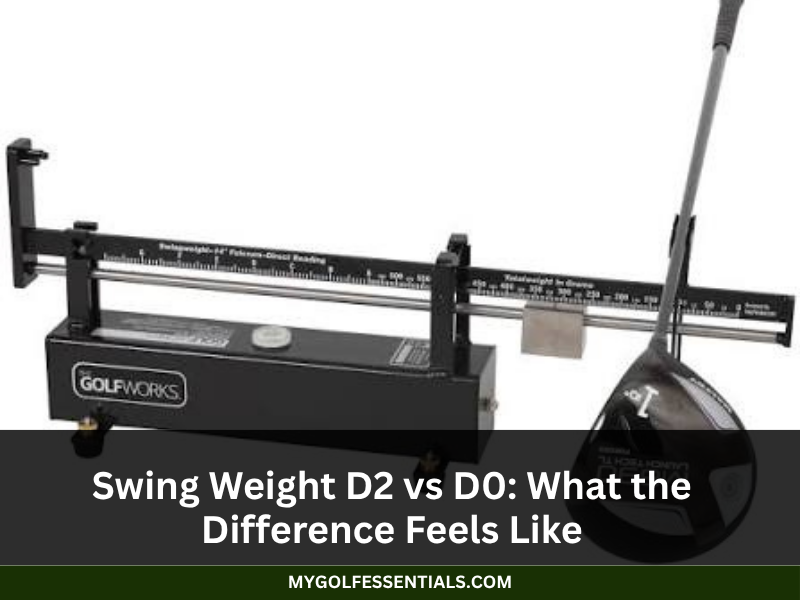
The first thing to clear up is what a swing-weight number actually represents. A swing-weight scale uses a fulcrum positioned about 14 inches from the butt end of the grip. The measurement reflects the torque created by the club around that reference point. A higher number means more effective mass is being felt toward the clubhead end. That means a D2 club is not automatically two points heavier in total mass than a D0 club. Two clubs can have similar total weights and different swing weights, or different total weights and similar swing weights, depending on the shaft, grip, head and length.
This is one reason Swing Weight D2 vs D0 can become confusing when golfers compare clubs from different manufacturers. The commonly used clubmaking approximation is about 2 grams of effective head-end mass for each swing-weight point. On that basis, moving from D0 to D2 represents roughly 4 grams of additional effective mass at the head end. Mitchell Golf uses approximately 2 grams per swing-weight point in its explanation of the scale. That does not mean a D2 iron contains exactly four more grams of metal in its head.
It means the balance measurement changes by an amount equivalent to roughly four grams of effective head-end weight. That distinction is important because the sensation comes from where the mass is located, not simply from the number on a kitchen scale.
What Is the Difference Between a D0 Swing Weight and a D2 Swing Weight?
The simplest difference is head feel. D0 feels lighter at the head end, while D2 feels slightly more head-present. The two specifications are separated by two swing-weight points, which corresponds to roughly 4 grams of effective head-end mass using the common 2-gram-per-point approximation. The physical change is small, but the sensation does not necessarily scale directly with the number of grams.
A golfer who is sensitive to club balance may notice D0 and D2 immediately. Another golfer may need several swings, or even a blind comparison, before identifying a consistent difference. That is why Swing Weight D2 vs D0 cannot be settled simply by looking at the specifications. The hands have to experience the clubs.
Some Golfers Notice It. Others Don’t.
Golfers tend to have surprisingly different opinions about swing weight. The Team Titleist discussion on swing weight illustrates that point. One participant described D2 as a preferred feel and said lower swing weights felt too light. Another contribution in the same discussion suggested that most recreational golfers may not need to worry excessively about small swing-weight differences, particularly when the clubs remain reasonably close in specification.
GolfWRX discussions show a similar pattern. Golfers comparing D2 and D0 irons describe noticeably different sensations, but the comments vary depending on the player’s equipment, shaft, tempo and personal sensitivity. These forum discussions are useful for showing how golfers describe the sensation, but they are anecdotal rather than controlled scientific evidence.
That disagreement is actually useful. It prevents the comparison from becoming too simple. If every golfer responded identically to Swing Weight D2 vs D0, club fitting would be much easier. Instead, the same two-point change can feel obvious to one player and almost irrelevant to another.
What Research Says
The most useful controlled evidence comes from a 2005 study by T. E. Harper, J. R. Roberts and R. Jones. The researchers tested 30 skilled golfers, with each golfer hitting ten tee shots using four drivers with different swing-weight conditions. The study measured clubhead speed and impact location while also examining whether golfers could perceive changes in swing weight. The overall result was not dramatic. The researchers found that changes in weight distribution had little effect on performance and that golfers generally struggled to perceive small changes in swing weight.
That finding adds an important qualification to Swing Weight D2 vs D0. A measurable specification change does not automatically create a measurable performance change. The study involved drivers rather than irons, so it should not be treated as a direct experiment on a D0-versus-D2 iron comparison. Still, it provides useful evidence against the idea that every small swing-weight adjustment necessarily produces a major change in ball striking.
There is also an important difference between controlled performance and subjective feel. A golfer can genuinely prefer the feel of D2 without producing better launch-monitor numbers. Likewise, a golfer can prefer D0 without seeing a meaningful increase in speed.
Feeling Better Does Not Necessarily Mean Playing Better
This is where equipment conversations often go off track. Feel is real. It matters. But feel is not the same as performance. A golfer may pick up a D2 iron and immediately say it feels more stable. That statement can be completely genuine. It still does not prove that the club will produce tighter dispersion. The reverse is also true. A D0 iron may feel quicker and easier to release, yet the resulting shots could have no measurable advantage.
That distinction is central to Swing Weight D2 vs D0 because the human body responds to feedback while the golf ball responds to impact conditions. A launch monitor can measure clubhead speed, ball speed, launch, spin, carry, total distance and dispersion. It cannot directly measure whether a golfer simply likes the sensation of the club. Both forms of information have value, but they answer different questions.
Does Swing Weight Actually Matter?
Yes, swing weight can matter, but its importance depends on the golfer, the club and the size of the change. The main influence is usually feel rather than some guaranteed performance boost. Swing weight can affect how strongly the clubhead is perceived during the motion and how the golfer reacts to that sensation.
The Stix guide makes a similar point, noting that swing weight affects feel and that a club that feels too heavy or too light can interfere with rhythm and consistency. It also notes that personal preference and physical capability play major roles.
Mitchell Golf likewise emphasizes that swing weight is about the distribution of mass and head feel rather than total club weight. That makes Swing Weight D2 vs D0 worth testing, particularly when a golfer already knows that a certain balance feels comfortable. It becomes less useful when treated as an isolated number.
The Problem With Comparing D0 and D2 on Different Clubs
A direct D0-versus-D2 comparison only tells part of the story if the clubs are otherwise different. Shaft weight can change the overall mass and balance. Shaft length has a particularly large effect on swing weight because it changes the leverage between the head and the hands. Grip weight can also move the swing-weight reading by shifting mass toward or away from the hands. Head design matters too.
Two irons can both measure D2 while having different head shapes, center-of-gravity locations and moments of inertia. They may not feel identical. The same applies to shafts. A 100-gram shaft and a 120-gram shaft can create very different overall club sensations even when the swing-weight readings are close. This is why Swing Weight D2 vs D0 should be treated as one variable within a club specification, not as the entire explanation for how a club feels.
Does D0 Create More Speed and D2 More Control?
There is no reliable rule that assigns those outcomes so neatly. A lighter swing weight can make a club feel easier to accelerate. That may help some golfers produce speed. A heavier swing weight can provide more head awareness, which may help another golfer maintain rhythm. But the relationship is individual.
Stix notes that lower swing weights may help some golfers swing faster, while higher swing weights can provide a stronger sense of control. It also stresses that the ideal specification depends on the golfer’s swing, physical capability and preferences.
The Harper study provides another reason to be cautious. In its controlled driver test, changing swing weight had little overall effect on measured player performance. So the more accurate explanation is that Swing Weight D2 vs D0 can change the way a club is experienced. Whether that experience translates into better shots depends on what the golfer does with it.
How to Test D0 vs D2 Properly
A proper comparison should remove as many variables as possible. Ideally, the two clubs should have the same head, loft, shaft, length and grip. The swing weight should be the main specification being changed. A golfer can then hit a reasonable sample of shots with each version rather than judging the difference from one or two swings.
A useful test might include:
· Ten to fifteen shots with each swing weight.
· A short warm-up before recording results.
· Alternating between D0 and D2 instead of hitting one specification exclusively.
· Recording clubhead speed, ball speed, carry and dispersion.
· Paying attention to transition and release feel separately from ball-flight results.
· Using a blind comparison when possible.
The blind element can be surprisingly revealing. If the golfer knows which club is D2, expectations can influence the assessment. If the labels are hidden, the result becomes more about the actual sensation.
The best test also includes subjective notes. A golfer might record that D0 feels quicker but less stable, while D2 feels more connected but slightly slower. Those observations can then be compared with the launch-monitor numbers. That is a much more useful way to evaluate Swing Weight D2 vs D0 than deciding from the specification alone.
What the Difference Ultimately Comes Down To
The D0-to-D2 change is small in physical terms but potentially noticeable in feel. D0 tends to produce a lighter head sensation. D2 places slightly more effective mass toward the head and generally produces greater head awareness. The difference can influence how a golfer experiences transition, release and impact, but it does not dictate performance. Research also puts the size of the effect into perspective. The controlled driver study found little overall performance impact from swing-weight changes and reported that golfers generally struggled to perceive small differences.
At the same time, club-fitting sources and golfer discussions show why the specification remains relevant. Players do not all respond to equipment in the same way, and some golfers clearly have stronger preferences for particular balance points. So the real lesson from Swing Weight D2 vs D0 is not that one number is universally correct. It is that two points can change the conversation between the golfer and the club.
Final Thoughts
Swing weight looks complicated until the measurement is stripped back to its basic idea: where the club’s mass is felt during the swing. The difference between D0 and D2 is not enormous. It represents only two swing-weight points, or roughly four grams of effective head-end mass by the common clubmaking approximation. Yet that small change can alter the sensation of the clubhead enough for some golfers to notice. Others may not notice much at all. That is not a contradiction. It is simply part of how golf equipment works.
Swing Weight D2 vs D0 is ultimately a question of interaction between the club and the golfer. A D0 specification may feel quick and easy for one player, while D2 may provide the head awareness another player wants. Neither response automatically produces better golf. The strongest approach is therefore straightforward: measure the clubs, control the other variables, hit enough shots to see a pattern, and separate feel from measurable performance. For a two-point swing-weight change, that is where the useful answer usually begins.
Key Takeaways
1. Swing Weight D2 vs D0 describes a difference in club balance, not simply total club weight.
2. D0 and D2 are separated by two swing-weight points on the standard scale.
3. Each swing-weight point represents roughly 2 grams of effective head-end mass.
4. Moving from D0 to D2 therefore represents roughly 4 grams of effective head-end mass.
5. D0 generally produces a lighter and less head-aware sensation during the swing.
6. D2 generally creates more noticeable clubhead awareness throughout the swing motion.
7. Individual golfers can perceive the same two-point change very differently.
8. Research has found small swing-weight changes can have limited measurable performance effects.
9. Shaft, grip, length and head design can all influence swing-weight measurements and feel.
10. Testing both specifications under controlled conditions provides the most useful comparison.
FAQs
Is D2 a good swing weight?
Yes, D2 is a common swing-weight specification, particularly in men’s irons, but it is not automatically the right choice for every golfer. Mitchell Golf places D2 within the standard men’s range and describes it as providing noticeable head feel. The right specification depends on club type, shaft, length, grip, tempo and individual preference rather than the D2 label alone.
What swing weight do most pros use?
No, professional golfers do not all use one swing weight. Tour equipment varies by player and club type. Mitchell Golf reports typical tour ranges that can move from roughly D1-D3 in drivers to higher values in irons and wedges. Those figures should be treated as broad equipment patterns, not a universal professional specification.
How can a golfer tell if swing weight is too heavy?
Yes, there are practical signs, although none proves that swing weight alone is responsible. A club may feel sluggish, difficult to accelerate or increasingly tiring over a round. A golfer may also notice timing problems compared with a lighter version. A controlled comparison is more useful than judging the club from a single poor shot.
What is the best swing weight for senior golfers?
No, there is no single swing weight that suits every senior golfer. Age alone does not determine the ideal balance. Swing speed, strength, tempo, shaft weight, club length and personal preference all matter. Lighter specifications may suit some golfers, while others may prefer additional head awareness. Testing remains more useful than choosing a number based solely on age.
What is Rory McIlroy’s swing weight?
No, there is not a single reliably documented public swing-weight specification that can be used as a general benchmark for Rory McIlroy’s entire set. Professional equipment can change between clubs, seasons and setups, and publicly reported specifications are not always complete. A tour player’s number therefore should not be treated as a universal target for recreational golfers.