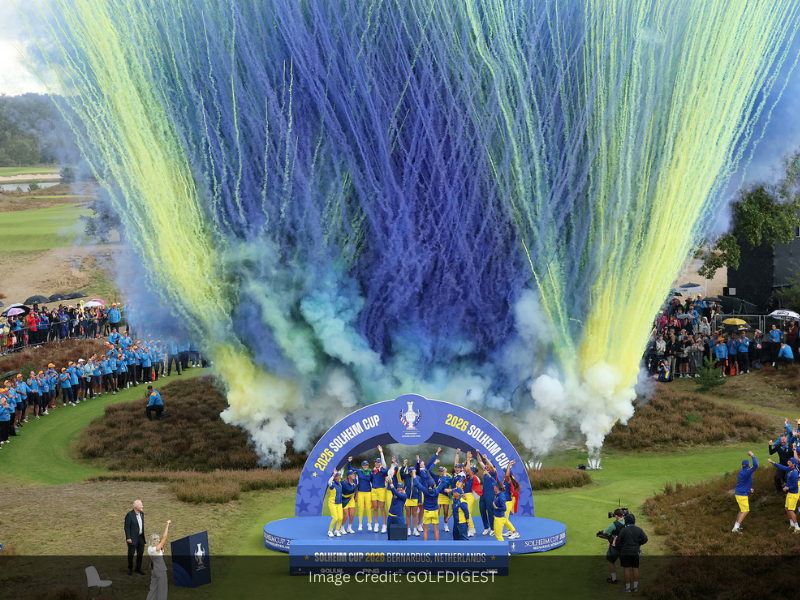
American team golf is facing renewed questions about preparation, analytics and decision-making after the United States surrendered the 2026 Solheim Cup to Europe in another 15-13 defeat. Europe secured the trophy at Bernardus Golf in the Netherlands on Sunday, September 13, after entering the final day tied 8-8. The Americans were unable to maintain their momentum in singles as Europe won six of the first eight matches and ultimately completed a 15-13 victory.
The result has intensified scrutiny around American team golf, particularly because similar concerns emerged after the United States lost the 2025 Ryder Cup by the same score.
American Team Golf And The Preparation Problem
U.S. Solheim Cup captain Angela Stanford acknowledged that preparation had not been good enough, particularly when it came to putting and adapting to the slower greens. Stanford also revealed that her team did not have the same level of match-by-match strokes-gained information that had been available during the previous Solheim Cup in Spain. The lack of detailed statistical support has become an important part of the post-tournament discussion.
Stanford also credited Europe for its performance and accepted responsibility for preparing the American players. Her comments therefore pointed to frustration and shortcomings within the U.S. setup rather than simply dismissing the defeat as bad luck. For American team golf, however, the recurring issue is whether lessons from these tournaments are being converted into changes before the next competition.
The Ryder Cup Comparison
The parallels with the 2025 Ryder Cup are difficult to ignore. At Bethpage Black, Europe built an 11½-4½ advantage before the United States mounted a dramatic comeback. Europe eventually held on for a 15-13 victory. One of the most debated decisions involved Harris English and Collin Morikawa. The pair was selected for foursomes despite Data Golf ranking the combination 132nd among 132 possible U.S. pairings before the event. They subsequently lost to Rory McIlroy and Tommy Fleetwood 5&4 on Friday.
Despite that result, captain Keegan Bradley used English and Morikawa again in Saturday’s foursomes. The American duo lost to McIlroy and Fleetwood again, this time 3&2. Those decisions became a symbol of the wider debate surrounding American team golf: how much weight should captains give statistical models, player relationships, course conditions and personal judgment when making team selections?
Analytics Move Back Into Focus
The issue has already prompted changes ahead of the 2027 Ryder Cup. Jim Furyk, the next U.S. Ryder Cup captain, has spoken about improving the application of analytics rather than simply collecting more numbers. He has emphasized that statistics need to be translated into practical decisions involving partnerships, playing order and course strategy.
That approach could become increasingly important for American team golf as European teams continue to develop sophisticated analytical systems. The PGA of America has also changed the 2027 Ryder Cup qualification system, placing greater emphasis on recent performance and introducing a revised points structure for qualifying players.
A Narrow Score, A Wider Debate
The identical 15-13 results should not obscure the differences between the two competitions. The Ryder Cup defeat came after Europe established a huge early lead at Bethpage, while the Solheim Cup was tied heading into the final singles session. Still, the repeated scoreline has provided an easy reference point for critics examining American team golf.
The central question is not whether the United States can produce enough talented players. The country has enormous depth in both men’s and women’s professional golf. Instead, the debate concerns how that talent is assembled, prepared and deployed when the competition becomes a team event.
European success has frequently been associated with continuity, established partnerships and detailed preparation. The United States has increasingly looked toward analytics and organizational changes as it tries to close that gap.
What Comes Next
For American team golf, the next major test will be the 2027 Ryder Cup at Adare Manor in Ireland from September 17-19. Furyk has already indicated that improving organization, communication and the practical use of analytics will be priorities. The Solheim Cup defeat adds another layer to that conversation. Stanford’s admission that her team lacked some of the statistical resources available in previous years demonstrates how small organizational details can become significant during a tightly contested competition.
The United States still has time to respond. The challenge for American team golf will be turning the latest defeat into specific changes in preparation, data analysis and decision-making before the next opportunity arrives. For now, Europe has claimed another major team-golf victory, while the United States is left to examine why similar questions have surfaced again.