The Ping Eye 2 irons hit the market in 1982 and instantly changed what average golfers expected from their equipment. For the first time, recreational players could get real forgiveness and consistent ball striking without spending a fortune.
Decades later, these clubs still appear on used equipment racks worldwide, and golfers still ask whether they belong in a modern bag. This review covers the design, specs, and real-world performance so you can make that call with confidence.
What Are Ping Eye 2 Irons?
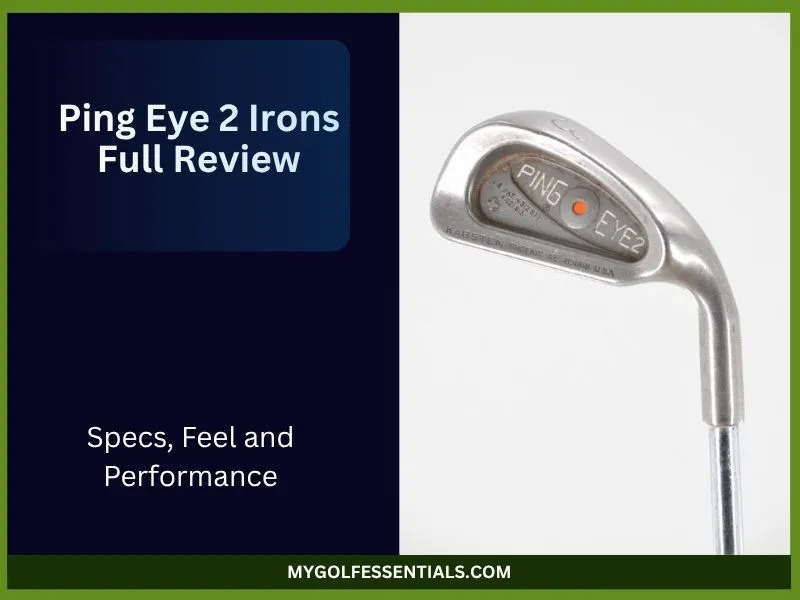
Ping released the Eye 2 in 1982 as a cavity-back iron set built around perimeter weighting technology. Karsten Solheim, Ping’s founder, understood that most golfers hit off-center more often than not. He moved mass toward the outer edges of the clubhead to expand the sweet spot and reduce the penalty for mishits.
Golfers at every skill level found the Eye 2 far more consistent than the blade irons that dominated that era. Sales took off, and these clubs became one of the best-selling iron sets in golf history. The design principles they introduced still influence game-improvement irons manufactured in 2026.
In the decades since, they have become a used equipment staple. Budget golfers, beginners, and seniors continue to pick them up because the core design still delivers. Few clubs from that era can say the same thing.
How Are the Ping Eye 2 Irons Built and Designed?
The construction details reveal exactly what Ping prioritized with this iron. Each element serves a specific purpose for the target golfer.
1. Clubhead Shape and Look at Address
The Eye 2 features strong offset at the hosel and a wide, thick topline. That offset positions the leading edge slightly behind the shaft at address. It gives your hands extra time to square the face at impact, which directly reduces the slice that plagues so many recreational players.
The thick topline creates a confident, reassuring visual when you look down at the ball. It communicates forgiveness before you even swing. This is not the thin, minimalist profile of a player’s iron.
2. Construction and Materials
Ping manufactured the Eye 2 from cast 17-4 stainless steel. Cast construction allowed for precise cavity shaping and targeted weight distribution throughout the head. The result is a consistently manufactured club built to hold up across decades of regular play.
Ping also produced a beryllium copper (BeCu) version alongside the standard model. BeCu is a softer alloy that delivers a warmer, more satisfying feel at impact. These models carry a distinctive bronze-gold finish and consistently command higher prices on the used market.
3. Groove Design and Rule Considerations
The Eye 2 used square U-shaped grooves, which generated exceptional spin and control from difficult lies in the rough. The USGA moved to restrict square grooves in 1990 under new equipment rules. Ping sued, arguing the rule change was unfair and improperly applied to equipment already in widespread use.
The parties reached a legal settlement. Pre-April 1990 Ping Eye 2 irons received a permanent exemption from all USGA groove restrictions under that agreement. The exemption covers all competitive levels, including professional tour play, which remains unique to this specific model.
What Are the Key Features of the Ping Eye 2 Irons?
Several design features work together to explain why these irons earned their iconic status. Each one addresses a real performance problem for mid and high handicap golfers.
- Perimeter weighting: Redistributes mass to the outer clubhead edges, expanding the effective hitting area well beyond traditional designs
- Cavity back design: Hollowed rear section reduces twisting on mishits and keeps ball flight consistent
- Progressive offset: Decreases from the long irons through to the short irons, balancing forgiveness with natural shot control
- Wide sole: Lowers the center of gravity, promotes clean turf interaction, and supports an easy, high launch
- High-launch design: Low CG gets the ball airborne quickly, even on less-than-ideal strikes
- Durable cast construction: 17-4 stainless steel holds up through decades of regular use without structural wear
Did You Know? The perimeter weighting concept the Eye 2 brought to mainstream golf became the foundational design template for virtually every game-improvement iron manufactured in the years that followed.
What Are the Full Specs of the Ping Eye 2 Irons?
Getting into the numbers sets realistic expectations before you commit to a purchase. Below is a complete breakdown across every major specification category.
Set Composition
A standard Ping Eye 2 set runs from the 2-iron through the 9-iron, plus a pitching wedge and sand wedge. Some configurations also include a 1-iron. Exact availability depends on the seller, the production era, and whether the set is complete or missing individual clubs.
Loft, Lie, and Length
The Ping Eye 2 irons follow a traditional loft structure. Modern game-improvement irons often use much stronger lofts to inflate distance numbers, but the Eye 2 sticks to classic measurements..
| Club | Loft (°) | Lie (°) | Length (inches) |
| 1 Iron | 16° | 58° | 39.75″ |
| 2 Iron | 18.5° | 58.5° | 39.25″ |
| 3 Iron | 21.5° | 59.5° | 38.75″ |
| 4 Iron | 25° | 60° | 38.25″ |
| 5 Iron | 28.5° | 61° | 37.75″ |
| 6 Iron | 32° | 61.5° | 37.25″ |
| 7 Iron | 36° | 62.5° | 36.75″ |
| 8 Iron | 40° | 63° | 36.25″ |
| 9 Iron | 45° | 64° | 35.75″ |
| PW | 50.5° | ~64° | 35.5″ |
| SW | 57.5° | ~64.5° | 35.25″ |
| LW | 61° | — | 35″ |
Note: Specs can vary slightly depending on production year and any original custom fitting applied at purchase.
Shaft Options
Ping offered the Eye 2 in both steel and graphite configurations. Steel shafts provide more feedback and directional control, making them the natural choice for players who prioritize precision.
Graphite shafts reduce vibration at impact and support slightly faster swing speeds for golfers with slower tempos. Most used sets found today still carry the original steel shafts installed from new.
How Do the Ping Eye 2 Irons Perform on the Course?
These clubs tell a different story across each performance category, so it pays to know what you are getting into.
1. Distance
Distance is where traditional lofts create a clear gap against modern irons. The 7-iron carries 36 degrees of loft, while many current game-improvement 7-irons sit between 28 and 31 degrees.
You will hit the Ping Eye 2 irons measurably shorter than any current set at a similar price point. The yardage gaps between clubs stay consistent, though, which simplifies club selection once you know your numbers.
2. Forgiveness
Forgiveness remains the strongest selling point of these clubs in 2026, and it still holds up impressively. The perimeter weighting and cavity back absorb energy from off-center strikes and keep ball flight straight with workable distance.
Heel and toe hits that would badly punish a traditional blade barely affect the Eye 2. For anyone shooting in the 90s or higher, that safety net translates directly into better scores.
3. Accuracy
The offset and wide sole make these irons naturally accurate for recreational golfers. Offset helps square the face through impact automatically, reducing weak fades and slices for players who struggle with timing.
Directional consistency is one of the most underrated Eye 2 qualities, and it stays just as relevant in 2026 as it was in 1985.
4. Ball Flight
Expect a high, climbing trajectory with a soft landing angle. The low center of gravity launches the ball off the face quickly.
Classic loft angles send it on a steep enough arc to hold greens reliably on approach shots. A strong headwind can expose this high ball flight as a limitation, but in typical conditions it serves recreational golfers well.
5. Feel and Sound
Cast stainless steel delivers firm, solid feedback at impact. You know immediately where you made contact, which actually helps golfers improve over time.
The BeCu version steps this up considerably, providing a warmer and more satisfying response closer to what forged iron players expect. If feel matters significantly to you, hunt specifically for a BeCu set when browsing the used market.
Are Ping Eye 2 Irons Still Good in 2026?
Yes, these irons remain genuinely worth using in 2026 for the right golfer. The fundamentals still deliver. Perimeter weighting still expands the sweet spot. The wide sole still promotes clean contact. The high launch still benefits players who struggle to get the ball consistently airborne. These qualities do not expire.
Here is the honest reality, though. Modern iron technology has moved well ahead on distance. Hollow body constructions, multi-material faces, and stronger lofts push today’s game-improvement irons significantly farther. If raw distance drives your buying decision, current models will outperform these. Distance-first golfers will notice that gap immediately and often find it frustrating.
What still holds up strongly:
- Off-center forgiveness that competes with many modern options
- Consistent, predictable ball flight for recreational play
- Exceptional durability built to perform across decades of use
- Easy, reliable launch for slower or inconsistent swing speeds
Where they fall short of modern clubs:
- Shorter distances due to traditional loft structure
- No modern face technology to enhance ball speed on strikes
- Limited fitting and customization options through the used market
- Elite amateur competition groove rules require verification before tournament play
Who Should and Should Not Use Ping Eye 2 Irons?
These clubs are not a universal fit, and knowing the difference saves you time and money. The breakdown below makes that distinction clear.
Golfers who will get the most from these irons:
- Beginners: Forgiving design reduces penalty shots and builds early confidence in ball striking
- High handicappers (18+): Off-center forgiveness and directional correction produce measurable scoring improvement
- Budget golfers: A complete set for $50 to $200 delivers genuine performance at unbeatable cost
- Senior players: Graphite-shafted versions reduce vibration and support easier swing speeds comfortably
Golfers who should consider modern alternatives:
- Low handicappers: They need workability and shot shaping that the Eye 2’s offset actively limits
- Distance-focused players: Modern loft structures and face technology deliver significantly more yards
- Elite competitive amateurs: Groove conformance must be verified before formal tournament play
- Players wanting custom fitting: Modern irons offer far more shaft and head configuration options
Pros and Cons of Ping Eye 2 Irons
Pros
- Exceptional off-center forgiveness that still impresses by 2026 standards
- Easy, consistent launch from the wide sole and low center of gravity
- Extremely durable cast stainless steel construction designed to last decades
- Highly affordable on the used market, typically $50 to $200 for a full set
- Pre-April 1990 models carry a permanent USGA exemption from groove restrictions at all competitive levels
Cons
- Traditional lofts produce noticeably less distance than modern game-improvement irons
- Firm cast stainless steel feel lacks the softness of forged or BeCu alternatives
- Limited customization and fitting options available through the used market
- Some elite amateur competitions may restrict square groove models without a verified exemption
- Dated aesthetic compared to sleeker, more modern iron designs
Price and Value of Ping Eye 2 Irons in 2026
Used Ping Eye 2 irons sell for $50 to $200 for a complete set in 2026. Condition, shaft type, and model version drive that range considerably. Standard stainless steel sets in solid condition typically land between $50 and $150. BeCu versions in excellent condition reach $200 or more, and pristine examples sometimes command higher prices from collectors.
Compare that to new game-improvement iron sets from major brands, which run from $700 to over $1,400. The Eye 2 delivers a large portion of that real-world performance at a fraction of the investment. For a beginner, returning golfer, or budget-conscious player, that value is genuinely hard to beat anywhere in 2026.
Listen: you will find used sets on eBay, Facebook Marketplace, and local golf shops. Always check groove sharpness, inspect for shaft rust near the hosel, and confirm the production date before committing to a purchase.
Final Verdict
The Ping Eye 2 irons are not the most technologically advanced clubs on the market in 2026. They cannot compete with modern designs on distance, face technology, or fitting flexibility. But they do not need to win every category to be the right choice for a specific golfer.
Beginners, high handicappers, budget golfers, and seniors seeking forgiving clubs at a low price will find real value here. The forgiveness and ease of launch still hold up. Carrying these irons in your bag puts you at no disadvantage during recreational play, and in many cases they will outperform what a new budget iron would offer for the same money.
The Eye 2 might not be the best irons in 2026. For the right golfer, though, they remain one of the smartest purchases available anywhere on the used market.
Key Takeaways
- The Ping Eye 2 irons launched in 1982 and established perimeter weighting as a cornerstone of game-improvement iron design
- Cast stainless steel construction and a beryllium copper (BeCu) option define the two primary build versions available
- Ping Eye 2 irons made before April 1, 1990, carry a permanent USGA exemption from square groove restrictions at all competitive levels
- Traditional loft specs produce shorter distances than modern irons with aggressively strengthened lofts
- Off-center forgiveness and directional accuracy remain genuine strengths, even by 2026 standards
- Wide sole and low center of gravity produce a high, consistent ball flight well suited to recreational play
- BeCu versions deliver noticeably softer, warmer feedback at impact compared to standard stainless steel builds
- Complete used sets typically sell for $50 to $200, representing outstanding value for budget-conscious golfers
- Beginners, high handicappers, seniors, and budget-conscious players benefit most from this iron set
- Low handicappers and distance-focused players will find better-suited options in modern iron designs
FAQs
Are Ping Eye 2 Irons Forgiving?
Yes, the Ping Eye 2 irons are highly forgiving. The perimeter-weighted cavity back expands the effective sweet spot well beyond traditional blade designs. Off-center strikes lose less distance and stay on line more reliably
Are Ping Eye 2 Irons Legal for Tournament Play?
Ping Eye 2 irons manufactured before April 1, 1990, are permanently legal for all competitive levels, including professional tour play, due to a 1990 legal settlement between Ping and the USGA. Models produced after that date must meet standard groove conformance requirements.
Why Are Ping Eye 2 Irons So Popular?
The Ping Eye 2 irons became popular by making golf genuinely easier for recreational players. Perimeter weighting, a wide sole, and a high-launch design helped golfers hit straighter, more consistent shots than the blade irons of that era. Their reputation for durability and forgiveness, paired with low used market prices, continues to drive demand decades after release.
What Handicap Are Ping Eye 2 Irons Best For?
The Ping Eye 2 irons suit golfers with a handicap of 15 or higher most effectively. The offset, wide sole, and cavity back actively help higher handicappers produce straighter, more consistent ball flights.