
Looking to add more power and consistency to your golf swing in 2025? Medicine ball exercises might be the missing piece in your training routine. These simple yet effective movements can help you build rotational strength, improve core stability, and boost your overall performance on the course.
In this article, we’ll explore the top 7 medicine ball exercises every golfer will love to help you hit longer drives, enhance your balance, and minimize the risk of injury. Plus, you won’t need any fancy equipment or a gym membership!
Let’s get started!
Why Medicine Ball Exercises Are Important for Golf
Golf might seem like a low-impact sport, but behind every powerful drive and smooth swing is a body working in harmony, especially the core, hips, and shoulders. That’s where medicine ball exercises come in. These simple yet highly effective movements can make a noticeable difference in your golf performance.
Here’s why they matter:
- Core Strength: A strong core is the engine of your golf swing. Medicine ball exercises target your abdominal and lower back muscles, helping you generate more power and maintain control during your swing.
- Rotational Power: Golf is all about controlled rotation. Movements like medicine ball rotational throws mimic the twisting motion of a golf swing, building strength in the obliques and hips. This translates to more clubhead speed and longer drives.
- Injury Prevention: A balanced, well-conditioned body is less prone to injury. Medicine ball exercises improve stability, strengthen weak areas, and help you move more efficiently, reducing strain on your lower back, shoulders, and joints.
- Functional Movement Training: Medicine ball drills involve multiple muscle groups working together, just like a golf swing. This improves movement coordination and teaches your body to fire in sequence, leading to smoother, more consistent shots.
In short, medicine ball training bridges the gap between the gym and the golf course. It conditions your body to move the way it needs to during play, making your swing more powerful, stable, and efficient.
How Medicine Ball Exercises Help Your Golf Game
Medicine ball exercises offer targeted benefits that directly support and improve your golf performance. Whether you’re looking to hit the ball farther, swing more consistently, or reduce fatigue, these exercises can deliver real results on the course.
1. Core Strength and Stability
Your core acts as the foundation of every swing. A strong, stable core helps you:
- Maintain a solid posture throughout your swing.
- Stay balanced during setup, backswing, and follow-through.
- Generate controlled power without over-relying on arms or shoulders.
Golfers with weak core muscles often struggle with swing consistency and are more prone to back pain. Medicine ball drills like rotational throws and sit-up throws specifically build deep core strength.
2. Improved Rotational Power
Golf is a rotational sport. The more efficiently you can twist through your hips and torso, the more power you’ll deliver to the ball. Medicine ball exercises improve:
- Torso rotation speed.
- Hip mobility and separation.
- Coordination between upper and lower body.
This means more clubhead speed and longer drives, without swinging harder or losing control.
3. Better Balance, Coordination, and Injury Prevention
Medicine ball training often includes dynamic, full-body movements. This develops:
- Better balance, especially in one-legged or staggered-stance positions.
- Improved coordination between muscle groups.
- Stronger joints and stabilizers reduce injury risk.
By reinforcing balance and stability, you’ll be less likely to sway, over-rotate, or lose posture, common issues that affect both distance and accuracy.
Top 7 Medicine Ball Exercises for Golfers
Medicine ball exercises are a game-changer for golfers looking to boost performance through strength, speed, and stability. These seven exercises specifically target the muscles used during the golf swing, helping you build the rotational power, core control, and explosive movement required to improve your game.
Below are the top 7 medicine ball exercises every golfer should include in their training plan:
1. Medicine Ball Rotational Throws
Medicine Ball Rotational Throws are a dynamic exercise that closely mimics the twisting motion of a golf swing. This move helps golfers develop explosive rotational power by training the core, hips, and shoulders to work together in a coordinated way. It’s excellent for building the kind of strength and speed needed to drive the ball farther and with more control.
Main Muscles Worked:
- Obliques
- Core (rectus abdominis and transverse abdominis)
- Hip rotators
- Shoulders
Secondary Muscles Engaged:
- Glutes
- Lower back
- Quadriceps
- Forearms
Equipment Needed:
- Medicine ball (6 to 10 pounds recommended).
- Wall or partner to throw against.
How to Do It:
- Stand sideways about 2 to 3 feet from a sturdy wall or partner, feet shoulder-width apart.
- Hold the medicine ball with both hands at chest height, elbows slightly bent.
- Rotate your torso away from the wall (backswing motion), loading your hips and core.
- Explosively rotate your body toward the wall while throwing the ball with force.
- Catch the ball on the rebound or have your partner catch it.
- Reset and repeat for the desired reps, then switch sides.
Form Tips:
- Keep your feet planted firmly and avoid shifting your weight too much.
- Engage your core throughout the movement to protect your lower back.
- Use your hips to initiate the rotation, not just your arms.
- Maintain a neutral spine and avoid rounding your shoulders.
Common Mistakes to Avoid:
- Using a medicine ball that is too heavy, reducing speed and control.
- Twisting too quickly and losing balance.
- Throwing mainly with your arms instead of rotating through the core.
- Leaning forward or backward excessively during the throw.
Reps and Sets Recommendation:
- Perform 3 sets of 8–10 throws per side.
- Rest 30–60 seconds between sets.
Why It’s Effective for Golf:
This exercise trains the core and hips to rotate explosively and efficiently, key to generating more clubhead speed and distance on your drives. It also improves coordination between your upper and lower body, helping you maintain balance and control throughout your swing.
2. Medicine Ball Slam
The Medicine Ball Slam is a powerful, full-body exercise that develops explosive strength and builds core power essential for an effective golf swing. By combining a forceful overhead lift with a controlled slam to the ground, this move improves your ability to generate force quickly, translating to stronger, more powerful shots on the course.
Main Muscles Worked:
- Core muscles (abs and lower back)
- Shoulders
- Upper back
- Hip extensors
Secondary Muscles Engaged:
- Quadriceps
- Glutes
- Forearms
- Calves
Equipment Needed:
- Medicine ball (6 to 12 pounds recommended)
- Open space or mat to absorb impact
How to Do It:
- Stand with feet shoulder-width apart, knees slightly bent, holding the medicine ball overhead with both hands.
- Engage your core and raise the ball fully above your head, extending through your hips and knees.
- Explosively slam the ball down onto the ground as hard as you can, using your entire body.
- Squat slightly as you follow the ball down to catch it on the bounce or pick it up.
- Reset your stance and repeat for the desired reps.
Form Tips:
- Keep your back straight and avoid arching during the lift.
- Use your hips and legs to generate power, not just your arms.
- Land softly on your knees when you squat to catch or pick up the ball.
- Breathe out forcefully during the slam for better power output.
Common Mistakes to Avoid:
- Using too heavy a ball, which can compromise speed and form.
- Slamming only with the arms without engaging the core and hips.
- Rounding your back or hunching your shoulders.
- Not controlling your landing when picking up the ball, risking injury.
Reps and Sets Recommendation:
- Perform 3 sets of 10–12 slams.
- Rest 45–60 seconds between sets.
Why It’s Effective for Golf:
Medicine Ball Slams build total-body explosiveness, especially in the core and hips, which are crucial for increasing clubhead speed and power. This movement also trains your body to transfer force quickly, improving your ability to drive the ball farther and with more control.
3. Staggered-Stance Chest Throw
The Staggered-Stance Chest Throw focuses on developing upper body power and core stability while encouraging proper weight transfer, key components of an efficient golf swing. By adopting a staggered stance, this exercise mimics the stance golfers use during their swing, helping improve balance and coordination.
Main Muscles Worked:
- Chest (pectorals)
- Shoulders (deltoids)
- Core (especially obliques)
- Triceps
Secondary Muscles Engaged:
- Glutes
- Quadriceps
- Upper back muscles
Equipment Needed:
- Medicine ball (4 to 8 pounds recommended)
- Wall or partner to throw against
How to Do It:
- Stand in a staggered stance with one foot forward and the other foot back, knees slightly bent.
- Hold the medicine ball at chest level with both hands, elbows bent.
- Rotate your torso slightly toward the back foot, loading your core and hips.
- Explosively push the ball forward from your chest toward the wall or your partner, fully extending your arms.
- Catch the ball on the rebound or have your partner return it.
- Reset and repeat for desired reps, then switch stance and sides.
Form Tips:
- Keep your core engaged and spine neutral throughout the movement.
- Use your hips and legs to generate power, not just your arms.
- Maintain a stable base by keeping feet firmly planted.
- Avoid leaning too far forward or backward during the throw.
Common Mistakes to Avoid:
- Throwing primarily with the arms without engaging the core.
- Losing balance by shifting weight unevenly.
- Using a medicine ball that is too heavy to maintain control.
- Neglecting to fully extend the arms on the throw.
Reps and Sets Recommendation:
- Perform 3 sets of 8–10 throws per side.
- Rest 30–60 seconds between sets.
Why It’s Effective for Golf:
This exercise strengthens the muscles responsible for pushing and stabilizing during your swing while reinforcing proper weight transfer and stance. It helps golfers generate more forward power and maintain balance through impact, leading to more accurate and powerful shots.
4. Golf Posture Rotational Throw
The Golf Posture Rotational Throw is designed to train your body to maintain the ideal golf posture while building rotational power. This exercise simulates the torso rotation and hip turn of a golf swing, helping improve your swing mechanics and power generation without compromising balance.
Main Muscles Worked:
- Core (especially obliques and transverse abdominis)
- Hip rotators
- Shoulders
- Lower back
Secondary Muscles Engaged:
- Glutes
- Quadriceps
- Upper back
Equipment Needed:
- Medicine ball (6 to 10 pounds recommended)
- Wall or partner to throw against
How to Do It:
- Stand with your feet shoulder-width apart and bend slightly forward at the hips, keeping your spine straight(This is your golf posture).
- Hold the medicine ball at chest level with both hands.
- Rotate your torso away from the target side, loading your core and hips, while maintaining the golf posture.
- Explosively rotate toward the target side, throwing the medicine ball against a wall or to your partner.
- Catch the ball on the rebound or have your partner return it.
- Reset and repeat for the desired reps, then switch sides.
Form Tips:
- Keep your back flat and avoid rounding your shoulders.
- Maintain a slight knee bend to support balance and power.
- Engage your core to control the rotation smoothly.
- Focus on rotating through your hips, not just your shoulders.
Common Mistakes to Avoid:
- Letting your posture collapse or spine round during rotation.
- Over-rotating or twisting beyond a comfortable range.
- Throwing mainly with the arms instead of using your core and hips.
- Using a medicine ball that’s too heavy, affecting speed and form.
Reps and Sets Recommendation:
- Perform 3 sets of 8–10 throws per side.
- Rest 30–60 seconds between sets.
Why It’s Effective for Golf:
This exercise reinforces the correct golf posture while building rotational power, essential for a strong and consistent swing. It helps you generate more force from your hips and core, improving clubhead speed and shot accuracy.
5. Chest Pass
The Chest Pass is a straightforward but powerful exercise that builds upper-body strength and explosive power, both vital for a strong golf swing. By focusing on pushing the medicine ball directly from the chest, this move enhances your ability to generate force quickly while maintaining core stability.
Main Muscles Worked:
- Chest (pectorals)
- Shoulders (deltoids)
- Triceps
- Core
Secondary Muscles Engaged:
- Upper back
- Glutes
- Quadriceps
Equipment Needed:
- Medicine ball (4 to 8 pounds recommended).
- Wall or partner to throw against.
How to Do It:
- Stand with feet shoulder-width apart, knees slightly bent, and hold the medicine ball at chest level with both hands.
- Engage your core and keep your spine neutral.
- Explosively push the ball straight forward from your chest toward the wall or your partner, fully extending your arms.
- Catch the ball on the rebound or have your partner return it.
- Reset and repeat for the desired reps.
Form Tips:
- Keep your core tight and avoid arching your back.
- Maintain a stable stance with feet planted firmly.
- Fully extend your arms on the throw for maximum power.
- Control your breathing. Exhale during the push.
Common Mistakes to Avoid:
- Using momentum instead of muscle engagement.
- Leaning backward or forward during the throw.
- Throwing too slowly or without full arm extension.
- Using a medicine ball too heavy to control.
Reps and Sets Recommendation:
- Perform 3 sets of 10–12 passes.
- Rest 30–45 seconds between sets.
Why It’s Effective for Golf:
The Chest Pass builds explosive upper-body strength and reinforces core stability, both crucial for driving the ball powerfully and maintaining control throughout the swing. It trains the muscles used in the forward pushing motion of impact.
6. Squat to Press
The Squat to Press combines lower-body strength with upper-body power, making it an excellent full-body exercise for golfers. This move builds explosive leg drive and shoulder strength while reinforcing core stability, helping you generate more power and maintain control during your swing.
Main Muscles Worked:
- Quadriceps
- Glutes
- Shoulders (deltoids)
- Core
Secondary Muscles Engaged:
- Hamstrings
- Triceps
- Lower back
Equipment Needed:
- Medicine ball (6 to 10 pounds recommended)
- Open space or mat
How to Do It:
- Stand with feet shoulder-width apart, holding the medicine ball at chest level with both hands.
- Lower into a squat by bending your knees and pushing your hips back, keeping your chest up and back straight.
- From the squat position, explosively rise up, extending your legs and pressing the medicine ball overhead.
- Lower the ball back to chest level as you prepare for the next squat.
- Repeat for the desired number of reps.
Form Tips:
- Keep your knees aligned with your toes during the squat.
- Engage your core to protect your lower back.
- Maintain a neutral spine throughout the movement.
- Press the ball straight overhead without arching your back.
Common Mistakes to Avoid:
- Letting knees cave inward during the squat.
- Rounding your back or leaning forward.
- Pressing the ball with uneven arm extension.
- Using too heavy a ball, which can reduce control.
Reps and Sets Recommendation:
- Perform 3 sets of 10–12 reps.
- Rest 45–60 seconds between sets.
Why It’s Effective for Golf:
This exercise builds leg and shoulder power simultaneously, key for a strong and stable golf swing. It helps golfers develop the explosive strength needed to generate force from the ground up, improving drive distance and swing control.
7. Lunge with Twist
The Lunge with Twist combines lower-body strength training with rotational core work, making it perfect for golfers who need power, balance, and mobility in their swing. This exercise mimics the dynamic weight transfer and torso rotation involved in golf, improving stability and control during your shots.
Main Muscles Worked:
- Quadriceps
- Glutes
- Core (especially obliques)
- Hip flexors
Secondary Muscles Engaged:
- Hamstrings
- Shoulders
- Lower back
Equipment Needed:
- Medicine ball (4 to 8 pounds recommended)
- Open space or mat
How to Do It:
- Stand tall with feet hip-width apart, holding the medicine ball at chest level with both hands.
- Step forward into a lunge with your right leg, bending both knees to about 90 degrees.
- While in the lunge, rotate your torso and medicine ball toward the right side, engaging your core.
- Return to center, then push back to the starting position.
- Repeat the lunge and twist on the left side.
- Continue alternating sides for the desired number of reps.
Form Tips:
- Keep your front knee aligned over your ankle during the lunge.
- Maintain an upright posture. Don’t lean forward or arch your back.
- Engage your core during the twist to protect your spine.
- Move smoothly and control the rotation.
Common Mistakes to Avoid:
- Letting the front knee collapse inward or extend beyond the toes.
- Rushing through the movement without control.
- Twisting only the arms without engaging the torso.
- Using a medicine ball that’s too heavy, limiting your range of motion.
Reps and Sets Recommendation:
- Perform 3 sets of 8–10 reps per side.
- Rest 30–60 seconds between sets.
Why It’s Effective for Golf:
This exercise strengthens the muscles responsible for balance and rotation during your swing, improving weight transfer and control. It helps golfers move more efficiently, reducing injury risk while increasing power and accuracy.
These exercises can be done 2–3 times per week, with just a medicine ball and a little space. Combined with good form and proper progression, this routine can help unlock better performance, more consistency, and greater distance off the tee.
Sample Routine for Golfers: How to Add Medicine Ball Exercises to Your Routine
Incorporating medicine ball exercises into your golf training doesn’t require hours in the gym. With just 2–3 sessions per week, you can improve your power, control, and endurance on the course. The key is consistency, proper form, and choosing exercises that mimic golf-specific movement patterns.
How Often Should You Train?
- For Beginner to Intermediate Golfers: 2 sessions per week.
- For Advanced Golfers / Athletes: 3 sessions per week (non-consecutive days).
Furthermore, always allow at least one full rest day between sessions to give muscles time to recover and adapt..
Sets and Reps Guide
| Exercise | Sets | Reps | Rest |
| Medicine Ball Rotational Throws | 3 | 8–10 per side | 30–60 sec |
| Medicine Ball Slam | 3 | 10–12 reps | 45–60 sec |
| Staggered-Stance Chest Throw | 3 | 8–10 per side | 30–60 sec |
| Golf Posture Rotational Throw | 3 | 8–10 per side | 30–60 sec |
| Chest Pass | 3 | 10–12 reps | 30–45 sec |
| Squat to Press | 3 | 10–12 reps | 45–60 sec |
| Lunge with Twist | 3 | 8–10 per side | 30–60 sec |
Special Note: You can pick 4–5 exercises per session to keep the routine time-efficient (about 25–30 minutes).
Tips for Beginners:
- Start with a lighter ball (4–6 lbs) to focus on speed and technique.
- Master proper form before increasing weight or reps.
- Choose simpler movements like Chest Pass and Squat to Press initially.
- Rest longer (60–90 sec) between sets if needed.
Tips for Advanced Golfers:
- Use moderate-weight balls (6–10 lbs) for a balance of speed and resistance.
- Perform more explosive reps with controlled movement.
- Combine exercises into circuits to improve endurance and power.
- Add tempo variations, such as pause at the end of the rotation, for greater control.
By following a structured, progressive plan, medicine ball training can become a key part of your golf fitness routine. You’ll build explosive strength, improve your swing control, and reduce your risk of injury, helping you play better, longer.
Tips to Maximize Results
To get the most out of your medicine ball training and see real improvements in your golf game, it’s important to approach your workouts with a smart and consistent plan. Below are some key tips to help you stay injury-free, improve faster, and maximize your performance on the course.
1. Do Warm Up and Cool Down Properly
Skipping a warm-up is one of the most common mistakes golfers make when training. A proper warm-up prepares your muscles for explosive movements and helps prevent injury. Likewise, cooling down helps your body recover more efficiently.
Quick Warm-Up (5–7 Minutes):
- Arm circles: 30 seconds.
- Torso twists: 1 minute.
- Bodyweight squats: 2 sets of 10.
- High knees or light jog in place: 1–2 minutes.
- Shoulder and hip mobility drills: 2–3 minutes.
Cool-Down (3–5 Minutes):
- Light stretching (hamstrings, hips, shoulders).
- Foam rolling (if available).
- Deep breathing and gentle walking to bring heart rate down.
2. Maintain Good Form and Technique
- Focus on controlled movement, don’t rush through reps.
- Always engage your core and maintain posture.
- Perform each movement through a full range of motion for maximum benefit.
- Use a mirror, coach, or video to check form regularly.
3. Progress Weight and Difficulty Gradually
- Start light (4–6 lbs) if you’re new to explosive exercises.
- Increase weight only when you can maintain perfect form throughout all reps.
To progress:
- Add reps or sets
- Increase ball weight slightly
- Add complexity (e.g., balancing, holding split stance)
4. Combine with Strength Training
Pair your medicine ball work with basic strength training exercises like:
- Deadlifts
- Planks
- Pull-ups
- Cable rotations
These exercises help develop strength in supporting areas like the back, legs, and shoulders, leading to better control and injury prevention.
Track Your Progress
Tracking helps you see what’s working and keeps you motivated.
- Measure clubhead speed weekly using a launch monitor or swing speed radar.
- Track distance off the tee during rounds or practice sessions.
- Use video analysis to monitor swing mechanics and body movement.
- Keep a training log to record sets, reps, rest times, and improvements.
By following these tips, you’ll not only build a stronger, more explosive swing. And you’ll also train smarter and more efficiently. Whether you’re a weekend golfer or aiming for serious competition, these simple habits can elevate your entire approach to fitness and performance.
Common Mistakes To Avoid While Doing Medicine Ball Exercises
Medicine ball workouts can do wonders for your golf game. But this works only if you perform with proper form and technique. Rushing through movements or using incorrect posture can reduce effectiveness and increase your risk of injury.
Here are the most common mistakes to watch out for and how to avoid them:
1. Use of Overly Heavy Medicine Ball
Doing practice with heavier balls can slow down your movement and force you to compensate with poor form.
- Solution: Choose a ball light enough to move explosively while still providing resistance, typically 4–10 lbs, depending on your fitness level.
2. Rushing Rotational Movements
Doing golf-specific medicine ball exercises require precision and control, especially when rotating. Speed without control reduces effectiveness and strains your lower back.
- Solution: Focus on controlled, explosive movement, not just fast repetition. Quality over quantity.
4. Poor Posture During Slams and Throws
Rounding your back or leaning too far forward puts excess pressure on the spine and reduces power output.
- Solution: Maintain a neutral spine, engage your core, and keep your chest up throughout each movement.
5. Ignoring Core Engagement
Your core is the main driver in most medicine ball exercises. Not engaging it limits power and opens the door to injury.
- Solution: Focus on bracing your core before every throw, twist, or slam, especially during the rotation phase.
6. Poor Foot Position or Balance
If your stance is unstable, your movements will lack power and control.
- Fix it: Keep your feet planted and evenly spaced, with a slight bend in the knees to maintain balance and support explosive movements.
Avoiding these mistakes will not only keep your workouts safe, but also make them more effective, so you can get the most out of every rep and see better results on the course.
Where to Find Quality Medicine Balls and Exercise Equipment
Choosing the right equipment can make a big difference in how effective and safe your medicine ball workouts are. Below are our top recommendations, each selected based on user reviews, reliability, and how well they support your golf-focused training routine.
These tools will help you perform the exercises in this guide comfortably, safely, and with better results.
Our Equipment Recommendations
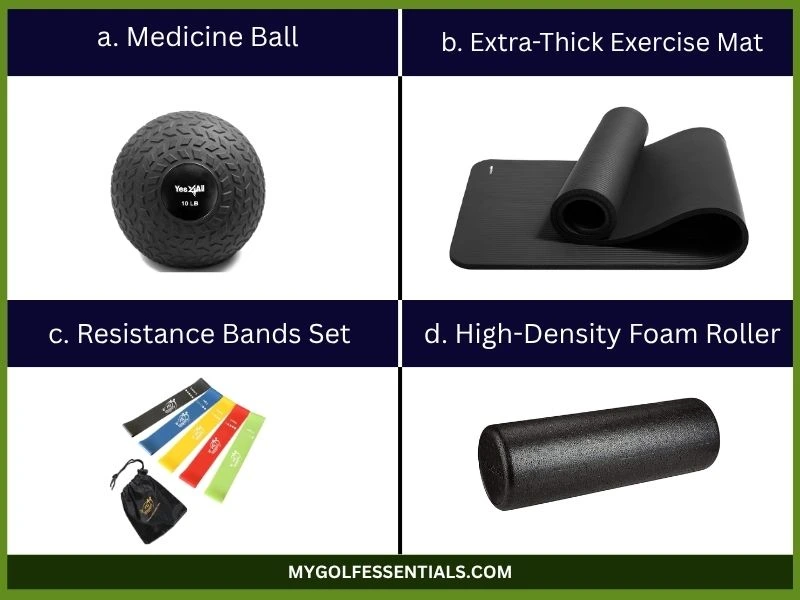
| Product Name | Why It Is Good | Check Out |
| Medicine Ball | Durable rubber shell for slams and throws, textured grip for control, ideal weight range for golf-specific power training. | Check Out on Amazon |
| Extra-Thick Exercise Mat | Provides joint-friendly cushioning during floor-based movements and stretches; non-slip surface for safety. | Check Out on Amazon |
| Resistance Loop Bands | Excellent for warm-ups, mobility drills, and adding resistance to lunges or twists; includes multiple tension levels. | Check Out on Amazon |
| High-Density Foam Roller | Helps with post-workout recovery and mobility; great for loosening up before rotational exercises. | Check Out on Amazon |
Additional Equipment (Optional but Helpful)
These tools aren’t required, but they can improve your training experience:
- Wall Space or a Solid Vertical Surface – Essential for rotational throws or chest passes.
- Workout Gloves – Helpful if your hands get sweaty during explosive movements.
- Timer or Fitness App – Great for tracking rest periods and set timing.
- Notebook or Training Log – Helps track your progress and plan your workouts.
Equipping yourself with just a few key tools ensures you can train consistently and safely, without needing a full gym setup. A good-quality medicine ball and a mat can go a long way in helping you build a more powerful, balanced golf swing from home or the gym.
Final Thoughts
Medicine ball exercises are a highly effective, accessible way for golfers to build core strength, rotational power, and overall stability, which are key elements for a powerful, consistent golf swing.
By mimicking the dynamic movements of the golf swing, these exercises help improve clubhead speed, balance, and coordination while reducing the risk of injury. Regular practice with a medicine ball, using proper form and gradual progression, leads to noticeable improvements in both power and control on the course.
For best results, incorporate 2–3 sessions per week, focusing on controlled, explosive movements and always prioritizing good posture and core engagement. Combine medicine ball training with basic strength exercises and track your progress to stay motivated and see continuous improvement.
With the right approach and equipment, medicine ball workouts can become a cornerstone of your golf fitness routine, helping you play better and enjoy the game longer
Key Takeaways
- Medicine ball exercises target the core muscles, which are essential for generating power and maintaining control during a golf swing.
- Movements like rotational throws mimic the twisting motion of a golf swing, improving clubhead speed and distance off the tee.
- These exercises strengthen weak areas and improve overall stability, reducing the risk of injuries to the lower back, shoulders, and joints.
- Medicine ball drills involve multiple muscle groups, teaching the body to move efficiently and in sequence, just like during a golf swing.
- Dynamic exercises enhance balance and coordination, helping golfers maintain posture and control throughout their swing.
- Perform 2–3 sessions per week, selecting 4–5 exercises per session, with recommended sets and reps for each.
- Beginners should use lighter balls (4–6 lbs), focusing on form before increasing weight or complexity.
- Always warm up before and cool down after workouts to prepare muscles and aid recovery.
- Pair medicine ball workouts with basic strength exercises for overall fitness and injury prevention.
- Monitor clubhead speed, distance, and swing mechanics to stay motivated and see tangible improvements.
FAQs
What muscles do medicine ball exercises work?
Medicine ball exercises work multiple muscle groups, including the abs, shoulders, arms, glutes, legs, and core. Movements like slams, tosses, and twists target these areas, promoting functional strength and coordination.
Are medicine ball exercises effective for weight loss?
Yes, medicine ball exercises can be effective for weight loss when combined with a balanced diet and regular exercise routine. They help burn calories, improve cardiovascular health, and build muscle, which boosts metabolism.
Can you do medicine ball exercises at home?
Yes, medicine ball exercises can easily be done at home with minimal space and equipment. Use a mat and a medicine ball of appropriate weight for your fitness level.
Are medicine ball exercises safe for everyone?
Most people can safely perform medicine ball exercises, but those with shoulder or back pain or recent abdominal surgery should avoid them or consult a healthcare provider before starting.