
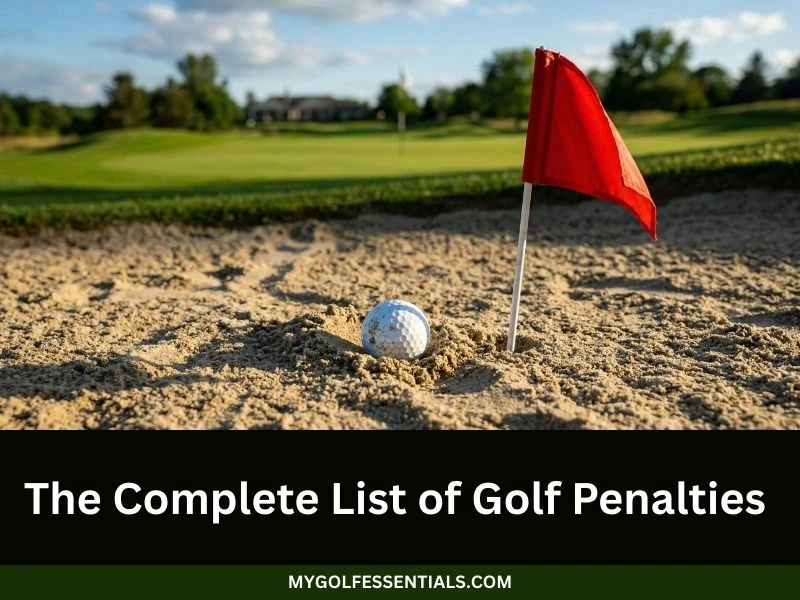
The Complete List of Golf Penalties can feel overwhelming, but understanding these rules is essential for every player. Golf has penalties for breaking the rules, but instead of sitting out, you add extra strokes to your score, which makes it harder to win.
This guide breaks down the complete list of golf penalties you need to know. You will learn the specific rules they apply to and with this knowledge, you can avoid getting penalty strokes added the next time you play.
What’s a Golf Penalty?
A golf penalty adds strokes to your score when you break a rule or find yourself in specific trouble situations.
Most penalties cost you one or two strokes. The USGA and R&A set these rules to keep the game fair for everyone. When you take a penalty, you add the strokes to your scorecard and continue to play according to the specific procedure.
Here’s what you need to know:
- Penalties maintain fairness across all skill levels
- They apply in both casual and tournament play
- Knowing them prevents slow play and confusion
- Modern rules simplify many old procedures
Three types of penalties in golf
- One stroke penalties cover most situations. Penalty areas, unplayable lies, and accidentally moving your ball at rest all cost one stroke. These are the most common penalties you’ll face.
- Stroke and distance penalties apply to out of bounds and lost balls. You add one stroke AND must replay from where you hit the previous shot. This effectively costs you two strokes on your scorecard.
- Two stroke penalties hit you for serious rule violations. Playing the wrong ball in stroke play or carrying too many clubs results in two-stroke penalties. These hurt your score significantly.
What Is the Out of Bounds Penalty
In golf, out of bounds (OB) refers to areas outside the course’s playable boundaries, usually marked by white stakes or lines. If your ball lands out of bounds, it’s not playable, and a penalty is applied.
What marks out of bounds:
- White stakes
- White boundary lines
- Fences marked with white paint
- Property boundaries
The entire ball must be out of bounds for the penalty to apply. If any part of your ball touches the course side of the white line, you’re still in play.
The Penalty Rule
Out of bounds penalty golf follows the stroke and distance rule.
Here’s the procedure:
- Add one penalty stroke to your score
- Return to where you hit the previous shot
- Hit another ball from that spot
The total cost is effectively two strokes. You lose one stroke for the penalty and another stroke to replay the shot.
The Provisional Ball Rule
Smart golfers hit a provisional when their ball might be OB or lost. This saves time and prevents walking back.
How it works:
Before leaving the tee, announce “I’m hitting a provisional.” Then hit another ball.
If your first ball is in bounds, great! Play it and ignore the provisional.
If your first ball is OB, the provisional becomes your ball in play. You’re already hitting your fourth shot with that provisional.
What Is the Lost Ball Penalty in Golf
In golf, a lost ball is any ball that cannot be found within 3 minutes of searching. When this happens, the rules require a stroke-and-distance penalty, similar to hitting out of bounds.
This penalty frustrates golfers because that ball might be sitting right there in thick rough but it doesn’t matter. Three minutes is the limit.
Your ball is lost when:
- Three minutes pass without finding it
- You play a provisional ball beyond where the original likely rests
- You put another ball in play
- The original ball sits outside a penalty area
The procedure is identical to out of bounds. Go back to your original spot. Add one penalty stroke and play your next shot from there.
If you find your original ball within three minutes, play it with no penalty. If you don’t find it, continue with the provisional.
The three minute clock starts when:
- You or your caddie begins searching
- You reach the area where the ball should be
- Anyone in your group starts looking
What Is the Water Hazard Penalty in Golf
A water hazard is any body of water on the course, like a pond, lake, or stream. If your ball lands in a water hazard, the rules require a penalty stroke, and you must drop the ball in a designated area to continue play.
When your ball enters a penalty area marked by red or yellow stakes, you have several options for relief. All relief options cost one penalty stroke.
Types of Penalty Areas
The 2019 rules renamed “water hazards” to “penalty areas.” The stakes or lines marking these areas tell you which relief options are available.
- Red Penalty Areas: Marked with red stakes or red lines. These typically run alongside holes, parallel to your line of play.
- Yellow Penalty Areas: Marked with yellow stakes or yellow lines. These usually cross your line of play, like a pond in front of a green.
The color determines your relief options. Red areas give you more choices than yellow areas.
Relief Options
Water hazard penalty golf gives you multiple choices. All cost one stroke, but you pick the best option for your situation.
Option 1: Play It As It Lies
If your ball is playable in the penalty area, you can attempt to hit it. No penalty applies if you choose this option. Most players avoid this choice because the risk usually outweighs the benefit.
Option 2: Stroke and Distance
Return to where you hit the previous shot. Add one penalty stroke and play from there. This option is always available but rarely the best strategic choice.
Option 3: Back-on-the-Line Relief
Identify where your ball last crossed the edge of the penalty area. Draw an imaginary line from the hole through that point. You can drop anywhere on that line behind the penalty area, going back as far as you want. Add one penalty stroke.
Option 4: Lateral Relief (Red Areas Only)
This option only applies to red penalty areas. Drop within two club-lengths of where your ball last crossed the edge, no closer to the hole.
If both sides of the penalty area are marked with red stakes, you can choose either side for your drop. Add one penalty stroke.
What Is an Unplayable Lie Penalty
An unplayable lie occurs when your ball lands in a spot where you cannot make a reasonable shot, such as deep rough, thick bushes, or behind a tree. Unlike water hazards or out of bounds, you can’t continue from the exact spot without penalty. The rules require you to take a one-stroke penalty and drop the ball in a new position.
You are the only person who can decide your ball is unplayable. The Rules of Golf give you full discretion to make this decision.
Common situations include:
- Ball stuck in bushes or thick vegetation
- Ball wedged between tree roots
- Ball against a fence or immovable object
- Ball in position where you cannot take a stance
You can declare any ball unplayable except balls in penalty areas (water) or balls that are out of bounds.
Relief Options
The unplayable lie penalty costs one stroke. You can choose from three different relief options.
Option 1: Stroke and Distance
Return to where you hit the previous shot. Add one penalty stroke and play from there. This option is always available.
Option 2: Back-on-the-Line Relief
Keep the spot where your ball lies between you and the hole. Go back on that line as far as you want. Drop within one club-length of any point on that line.
This works well when your ball is near the green but blocked by an obstacle.
Option 3: Two Club-Lengths Relief
Drop within two club-lengths of where the ball lies. You cannot drop closer to the hole. This is often the best option because it provides relief while keeping you close to your current position. Add one penalty stroke.
What Is Wrong Ball Penalty in Golf
In golf, using a wrong ball means you hit a ball that isn’t yours during play. This is considered a rules violation and incurs a penalty.
What counts as the wrong ball:
- Hitting another player’s ball
- Hitting an abandoned ball found on the course
- Playing your partner’s ball in a team event
- Not identifying your ball before hitting it
Most golfers mark their balls with unique identifiers. Common methods include dots, lines, initials, or special markings with a permanent marker.
The Penalty for Playing the Wrong Ball
In stroke play, you get a two-stroke penalty. In match play, you lose the hole immediately.
Stroke Play Procedure:
- Realize you played the wrong ball
- Add two penalty strokes
- Find your actual ball
- Play your ball from where it lies
- The strokes you made with the wrong ball don’t count
Match Play: You lose the hole, game over for that hole. Move to the next tee.
Other Common Golf Penalties
Several additional penalties occur less frequently but are important to know.
Equipment Violations
1. Too Many Clubs
You’re allowed a maximum of 14 clubs in your bag. If you carry more, you receive a two-stroke penalty for each hole where you had the extra clubs, up to a maximum of four strokes.
Count your clubs before starting your round to avoid this penalty.
2. Damaged Club
You can replace a club damaged during normal play. However, if you damage a club in anger or frustration, you cannot replace it. You must finish the round without that club. No stroke penalty applies, but you lose the use of the club.
3. Ball at Rest Penalties
- Ball Moves After Address: If your ball moves after you’ve taken your stance and addressed it, you must replace the ball. Add one penalty stroke to your score.
- Ball Hits You or Your Equipment: If your ball in motion hits you, your caddie or your equipment, add one penalty stroke. Play the ball from where it comes to rest.
4. Putting Green Rules
- Ball Hits Flagstick: The 2019 rules changed this significantly. You can now leave the flagstick in the hole while putting. If your ball hits the flagstick, no penalty applies.
- Improper Ball Marking: You must mark your ball correctly on the green. Place a coin or ball marker directly behind the ball. If you mark carelessly and cause the ball to move, add one penalty stroke.
- Testing the Green: You cannot test the putting surface by rolling a ball or roughing up the surface. This results in a two-stroke penalty.
Complete Penalty Summary Chart
Use this chart as a quick reference guide on the course:
| Penalty Situation | Strokes | Procedure |
| Out of bounds | Stroke & distance | Return to original spot, replay |
| Lost ball | Stroke & distance | Return to original spot, replay |
| Water (yellow stakes) | +1 | Choose relief option |
| Water (red stakes) | +1 | Choose relief option (more choices) |
| Unplayable lie | +1 | Choose from three relief options |
| Wrong ball (stroke play) | +2 | Find correct ball, play it |
| Wrong ball (match play) | Lose hole | Move to next tee |
| Too many clubs | +2 per hole (max 4) | Remove extra clubs immediately |
| Ball moves at address | +1 | Replace ball |
| Ball hits you/equipment | +1 | Play from where it stops |
| Testing green surface | +2 | Continue play |
| Grounding in bunker | None | Play normally |
| Flagstick hit on green | None | Continue play |
How to Avoid Common Penalty Mistakes
Avoiding penalties is often the fastest way to lower your score. You do not need to hit the ball further; you just need to stop giving strokes away.
Here are some tips to keep in mind to avoid making penalty mistakes in the future:
- Mark Your Ball: Before the first tee, mark your ball with a unique symbol. This simple habit prevents the disastrous “wrong ball” penalty that costs two strokes.
- Check the Local Rules: Every course has specific local rules on the scorecard. These might define unique out-of-bounds areas or drop zones that can save you strokes.
- Play a Provisional: If there is any doubt your ball is safe, hit a provisional. It takes thirty seconds and saves you the walk of shame back to the tee if your first ball is lost or out of bounds.
- Know Your Relief Options: Don’t just pick up your ball when in trouble. Know exactly where you can drop it to give yourself the best possible next shot.
- Watch the Clock: You have three minutes to find a lost ball. Keep track of time to avoid slow play penalties and the stress of rushing.
- Keep Up: Slow play is penalized in tournaments. Always be ready to hit when it is your turn.
Final Thoughts
Golf penalties are part of the game. Understanding them helps you handle trouble situations correctly and keeps play moving smoothly.
The complete list of golf penalties covers common situations you’ll encounter on the course. Keep this guide handy for reference during your rounds. Understanding penalties before they occur helps you make quick, correct decisions. You’ll avoid confusion, prevent slow play, and score better.
Mark your ball, know the basic penalties, and play with confidence.
Key Takeaways
- The complete list of golf penalties includes out of bounds, lost balls, penalty areas, unplayable lies, and wrong balls as the most common situations.
- Out of bounds and lost balls both cost you stroke and distance, meaning you replay from the original spot lying three.
- Penalty areas (water hazards) give you multiple relief options for a one-stroke penalty, including lateral and back-on-line relief.
- You decide if your ball is unplayable anywhere on the course except penalty areas, with three relief options for one stroke.
- Playing the wrong ball costs two strokes in stroke play or loss of hole in match play.
- Hit provisional balls when shots might be lost or out of bounds to save time and avoid the walk back.
- The 2019 rules simplified many penalties, allowing you to ground clubs in bunkers and remove loose impediments in penalty areas.
- Double hits no longer carry an additional penalty, counting only as one stroke.
- Most penalty situations can be avoided with proper preparation, ball marking, and strategic decision making.
- Keep a penalty reference chart handy to resolve situations quickly and prevent slow play.
FAQs
What is general penalty in golf?
The general penalty in golf is two strokes in stroke play or loss of hole in match play. This applies to serious rule violations that don’t have a specific penalty assigned, such as playing the wrong ball or making a stroke at a moving ball.
What happens if you accidentally hit your ball twice in one swing?
Under the current rules, there is no penalty for accidentally hitting your ball twice in one swing. It counts as only one stroke. Before the 2019 rules changes, this resulted in a one-stroke penalty, but that rule has been eliminated.
What is an example of a water hazard?
Common examples of water hazards (now called penalty areas) include ponds, lakes, streams, rivers, and ocean areas on coastal courses. These are marked with yellow or red stakes or lines. A pond in front of a green marked with yellow stakes or a creek running alongside a fairway marked with red stakes are typical water hazards you’ll encounter on golf courses.