
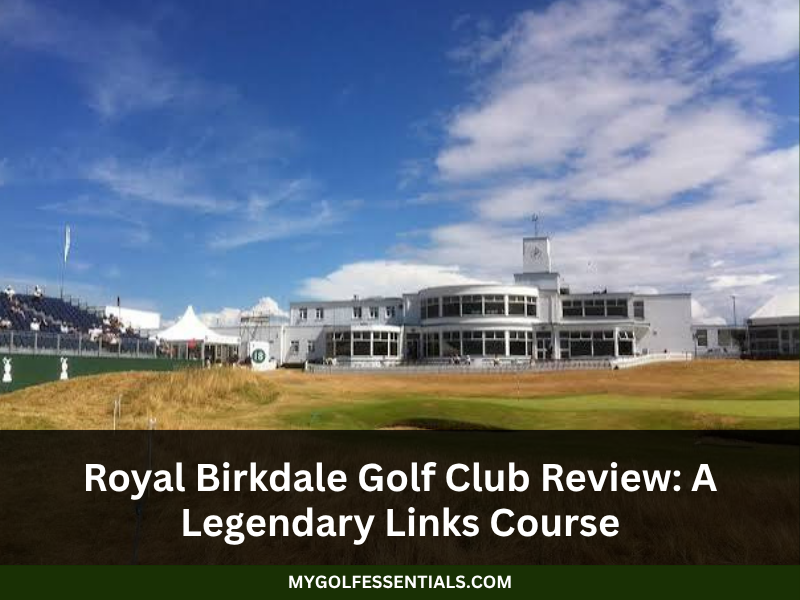
Royal Birkdale is a championship links course that sits among the towering sand dunes of Southport, on England’s north-west coast. Golfers across the world regard Royal Birkdale as the fairest examination in Open Championship golf. And Royal Birkdale has earned that reputation the hard way, across ten Opens, two Ryder Cups and more than a century of seaside drama.
This review digs into what makes Royal Birkdale special. The history. The design. The holes that break hearts. It also covers what visitors can expect if they book a round at Royal Birkdale, how much it costs, and how the course stacks up against other Open venues. By the end, one question should answer itself: why do so many professionals call this stretch of Lancashire dunes the best course in England?
What Makes Royal Birkdale a Legendary Links Course?
Royal Birkdale is legendary because it combines fair, valley-based fairways with some of the most dramatic dune scenery in links golf, and it has hosted ten Open Championships since 1954. Few venues in the world can match that record. Fewer still can match it while remaining genuinely playable for club golfers.
Most links courses send the ball bouncing off humps and hollows in the fairway. Royal Birkdale does not. Its holes run through flat-bottomed valleys between the dunes, so a good shot stays a good shot. Players see exactly what stands in front of them. No blind luck. No hidden tricks.
That fairness is the quality champions mention first. Nick Faldo once described the layout as a course without a single weak hole, and course-ranking panels tend to agree with him. Golf Monthly and other UK publications have repeatedly placed Royal Birkdale first among England’s courses, ahead of far older rivals.
The credentials speak plainly:
- Ten Open Championships hosted between 1954 and 2017, with an eleventh arriving in July 2026
- Two Ryder Cups, including the famous 1969 contest that ended in a tie
- Regular top-25 placement in world course rankings, and frequent top spot in England
- A history of champions that includes Palmer, Trevino, Watson and Spieth
That final point matters. Great courses tend to produce great winners. Royal Birkdale has produced almost nothing else.
The History Behind Royal Birkdale Golf Club
The club began modestly. In 1889, nine holes and a rented room were all its founders could manage. Nobody watching those early members hack around a small plot near Shaw Hills could have predicted that Royal Birkdale would one day sit at the centre of world golf.
Early Years and the Move to the Dunes
The club moved to its present site at Birkdale Hills in 1897, and everything changed. The new land offered vast sandhills, firm turf and constant wind off the Irish Sea. Perfect raw material. Fred Hawtree and five-time Open champion J.H. Taylor then remodelled the layout in the early 1930s, threading the holes through the dune valleys rather than over the top of them.
That single design decision still defines Royal Birkdale today. While rival architects of the era loved blind shots and lottery bounces, Hawtree and Taylor wanted the golf out in the open. Their gamble paid off handsomely. The club also built its striking white Art Deco clubhouse in 1935, shaped to resemble an ocean liner sailing through a sea of dunes. King George VI granted Royal status in 1951, and the modern Royal Birkdale was born.
Open Championships That Shaped Royal Birkdale
The R&A brought the Open to Royal Birkdale for the first time in 1954, and Peter Thomson lifted the Claret Jug. Thomson liked the place so much he won there again in 1965. Arnold Palmer triumphed in 1961, hitting a recovery shot from deep rough on the 15th so remarkable that a plaque now marks the spot. Lee Trevino followed in 1971. Johnny Miller in 1976. Tom Watson claimed his fifth Open at Royal Birkdale in 1983.
Later decades added more names. Ian Baker-Finch in 1991, Mark O’Meara in 1998, Padraig Harrington in 2008. Then came 2017, when Jordan Spieth recovered from a wild drive on the 13th to win one of the most dramatic Opens in memory. That same week, Branden Grace shot 62, the lowest single round ever recorded in men’s major championship history.
But the history of Royal Birkdale stretches beyond the Open. The links has staged the Women’s British Open, the Walker Cup and the Curtis Cup, along with the Senior Open. Few venues anywhere carry a deeper championship record. And notice the pattern in the winners’ list. Nearly every Open champion crowned here already ranked among the finest players of his generation. Coincidence? The members would say the course simply refuses to crown a lucky winner.
Course Layout and Design at Royal Birkdale
The design philosophy at Royal Birkdale is simple: reward the brave, punish the careless, and never rely on luck. Fairways sit in natural amphitheatres. Dunes frame nearly every shot. Greens are protected by deep pot bunkers with steep revetted faces that swallow anything lazy.
Wind decides everything. On a calm day, Royal Birkdale invites attacking golf, and Grace’s 62 proved what is possible when the breeze sleeps. When the wind rises off the sea, even short holes become monsters, and scores balloon within an hour. The scorecard tells only part of the story:
| Feature | Detail |
| Location | Southport, Merseyside, England |
| Founded | 1889 |
| Championship par | 70 |
| Championship length | Approximately 7,150 yards |
| Course record | 62 (Branden Grace, 2017 Open) |
| Open Championships hosted | 10, with the 11th in 2026 |
Signature Holes Worth Knowing
The 12th draws the most photographs. A short par three played to a green cradled by enormous dunes, it looks gentle and plays anything but. The 6th, a long two-shotter that doglegs around bunkers and scrub, regularly ranks among the toughest holes in Open golf. And then there is the 18th. A demanding par four finishing beneath the clubhouse windows, where Opens have been won, lost and thrown away.
Harrington effectively sealed the 2008 Open on the 17th with a five-wood to a few feet, one of the great closing shots in championship history. Every hole at Royal Birkdale offers a clear question like that. Answering it is another matter entirely.
Is Royal Birkdale a Tough Course?
Yes, Royal Birkdale is a genuinely tough course, though players consider it hard in a fair way rather than a punishing one. The 2008 Open proved the point. Padraig Harrington won with a score of three over par, the highest winning Open total in nearly a decade, after storms battered the links all week.
The difficulty comes from a few consistent sources:
- Coastal wind that can shift direction and strength between the front nine and the back
- Thick willow scrub and dense rough lining nearly every fairway
- More than 120 revetted bunkers, many deep enough to force a sideways escape
- Firm, fast greens with subtle borrows that punish careless approach putts
Statistics from Open weeks back this up. In 2017, the field averaged well over par across the four days, even though conditions stayed relatively kind. In 2008, only Harrington and Ian Poulter finished better than six over. Royal Birkdale does not hand out low scores as gifts.
Yet club golfers still love playing here. The valleys give honest lies. The targets are visible. A well-struck shot gets its reward, which is more than many famous links can claim. Tough, then. But never unfair, and that distinction is the whole point.
The Front Nine: A Measured Start
The opening hole at Royal Birkdale sets the tone straight away. A par four bending left, with out of bounds lurking and the wind usually hurting, it has ruined plenty of cards before they began. Trevino once took a seven there during the 1971 Open. He still won.
The stretch from the 2nd to the 5th demands accurate driving above all else. Miss the valleys and the willow scrub takes over, and escaping it often costs a full shot. Then comes the brutal 6th, followed by a run of holes weaving through the tallest dunes on the property. The 7th is a lovely par three set in its own natural bowl. The 9th offers a slight breather before the turn.
Nothing on the front nine is flashy. The course simply asks for controlled, thoughtful golf, shot after shot, and it keeps asking for eighteen holes. And then the back nine raises the stakes.
The Back Nine: Where Royal Birkdale Bites Back
The inward half of Royal Birkdale is where championships get decided. The 10th and 11th continue the theme of tight driving lines, before the gorgeous 12th provides a moment of calm beauty. It rarely lasts. The 13th, the longest hole on the course, was where Spieth’s 2017 wobble began, with a drive so far right he took a penalty drop among the equipment trucks near the practice range. He escaped with a bogey, then played the next five holes in five under. Extraordinary stuff, on an extraordinary stretch of golf holes.
The Famous Finishing Stretch
From the 15th onwards, the course turns for home and the pressure climbs. The par-five 17th offers a real birdie chance, which makes it dangerous, because chasing that birdie has wrecked many a final round. Then the 18th waits.
This green staged one of sport’s greatest gestures. In the 1969 Ryder Cup, Jack Nicklaus conceded Tony Jacklin’s short putt on the final hole, tying the entire match rather than making his opponent hole out under crushing pressure. Nicklaus later explained that he simply refused to give Jacklin the chance to miss in front of his home crowd. The moment became known as “The Concession”, and golfers still speak of it with reverence.
The 15th deserves its own mention too. A long par five ringed by bunkers, it once played as the hardest hole on the course during Open weeks. Palmer’s legendary 1961 recovery happened along this stretch, and his plaque still draws visitors who stand in the rough and wonder how he moved the ball at all. From a buried lie in tangled scrub, he ripped a six-iron onto the green. Course officials measured the divot afterwards. They kept it.
History soaks into every yard of this closing stretch. Players feel it. Caddies talk about it. Even hardened professionals admit the walk up the last, with the great white clubhouse rising behind the green, ranks among the finest finishing experiences in golf.
What Is Rory McIlroy’s Favourite Golf Course?
Rory McIlroy has repeatedly named Royal County Down in Northern Ireland as his favourite course in the world. His home club, where he learned the game as a boy, is Holywood Golf Club near Belfast. So Royal Birkdale does not top his personal list.
But McIlroy holds Royal Birkdale in high regard, as most modern professionals do. He famously opened the 2017 Open there with five bogeys in six holes, fought back to make the cut, and finished fourth. That week showed both sides of the course: it punished his early looseness, then rewarded his brilliance without prejudice.
His fondness for pure links golf, shaped by a childhood on Irish courses, explains why venues like Royal Birkdale suit his eye. When the world’s best players discuss the fairest Open venue, this Southport links enters the conversation almost every time.
Visitor Experience at Royal Birkdale
Visitors can play Royal Birkdale, and thousands do every year. The club welcomes green-fee golfers on selected days, though demand is fierce and tee times vanish months in advance. Booking early is not a suggestion. It is a requirement, particularly in an Open year like 2026, when pilgrimage traffic surges.
Green Fees and Booking Essentials
A round at Royal Birkdale is a premium purchase. Green fees in recent seasons have run well above £300 per player in peak summer, placing the club among England’s most expensive tee times. Winter rates drop considerably, and shoulder-season mornings often represent the best value. Handicap certificates are required, and the club publishes current fees and visitor days on its official website, which remains the only reliable source for up-to-date pricing.
Getting there is easy, which surprises many first-time visitors. Hillside railway station sits practically beside the links, with direct trains from Liverpool. Southport itself, a classic Victorian seaside town, lies a few minutes up the road and offers plenty of accommodation. Golfers often pair the trip with rounds at neighbouring Hillside and Southport & Ainsdale, two superb links within walking distance of Royal Birkdale’s gates. England’s golf coast earns its nickname honestly.
A few practical tips make the day smoother:
- Book several months ahead, especially for spring and summer weekend dates
- Carry proof of handicap, as the club checks certificates for all visiting players
- Hire a caddie if possible, because local knowledge saves shots on blind lines and green reads
- Allow time after the round for the clubhouse, which deserves a visit in its own right
The Clubhouse and Facilities
The 1935 clubhouse is a listed building and an attraction by itself. Its curved white walls and porthole-style windows still evoke a great ship at sea. Inside, the walls carry decades of Open memorabilia, honours boards and photographs of every champion crowned on the links outside. The food is excellent. The welcome, by most visitor accounts, is warmer than the wind.
Practice facilities, a well-stocked pro shop and trolley or caddie hire round out the offering. Everything feels polished without feeling stuffy.
How Royal Birkdale Compares to Other Open Venues
Comparisons with other Open hosts come up constantly, so a side-by-side view helps:
| Venue | First Open | Opens Hosted | Defining Trait |
| Royal Birkdale | 1954 | 10 (11th in 2026) | Fair valley fairways between huge dunes |
| St Andrews (Old Course) | 1873 | 30 | History, shared fairways, the Road Hole |
| Royal Liverpool | 1897 | 13 | Flat, exposed, brutally wind-dependent |
| Royal St George’s | 1894 | 15 | Wild bounces and rumpled fairways |
St Andrews owns the history. Nobody argues otherwise. But many professionals privately rate Royal Birkdale as the better pure test, precisely because it removes luck from the equation. Tom Watson called it a true and honest examination. Modern players echo him almost word for word.
The comparison with Royal Liverpool, just down the coast, is instructive. Hoylake spreads across flatter ground and depends heavily on wind and firm turf for its defence. Royal Birkdale carries its defence in the land itself, in the dunes and valleys that never change no matter what the weather does. Where rivals rely on quirk, this course relies on clarity. That is its identity, and it has never wavered from it in nearly a century.
Final Thoughts
Royal Birkdale stands as the complete links experience: historic, beautiful, demanding and scrupulously fair. Few courses anywhere reward good golf so reliably or expose weak golf so quickly. The dunes provide the theatre. The design provides the justice.
With the 2026 Open Championship returning to Royal Birkdale this July, a new chapter is being written on those famous fairways right now. Another champion will join Palmer, Watson and Spieth on the honours board. For any golfer weighing up a pilgrimage, the answer is simple. Royal Birkdale belongs on the list, somewhere very near the top.
Key Takeaways
- Royal Birkdale is a championship links course located in Southport on England’s north-west coast.
- The club was founded in 1889 and moved to its current dune-land site in 1897.
- Fred Hawtree and J.H. Taylor designed the modern layout through flat dune valleys in the 1930s.
- King George VI granted the club its Royal title in 1951, three years before its first Open.
- The course has hosted ten Open Championships, with the eleventh taking place in July 2026.
- Branden Grace shot 62 here in 2017, the lowest round in men’s major history.
- The 1969 Ryder Cup “Concession” between Nicklaus and Jacklin happened on the 18th green.
- Players rate the course as tough but fair, thanks to visible targets and honest lies.
- Visitors can book rounds on selected days, with peak green fees exceeding £300 per person.
- The 1935 Art Deco clubhouse is a listed building filled with Open Championship memorabilia.
FAQs
Is Royal Birkdale a private club?
Yes, it operates as a private members’ club, but it welcomes visiting golfers on designated days throughout the year. Visitors must book in advance through the club and provide a valid handicap certificate before playing.
How much does it cost to play Royal Birkdale?
Peak-season green fees have exceeded £300 per round in recent years, with reduced rates available during winter months. The club’s official website publishes the current fee schedule, and prices change from season to season.
Has Royal Birkdale hosted the Ryder Cup?
Yes, it staged the Ryder Cup twice, in 1965 and 1969. The 1969 edition ended in the first tie in Ryder Cup history and produced the famous concession from Jack Nicklaus to Tony Jacklin.
What is the course record at Royal Birkdale?
Branden Grace holds the record with a 62, shot during the third round of the 2017 Open Championship. It remains the lowest single round ever recorded in a men’s major.