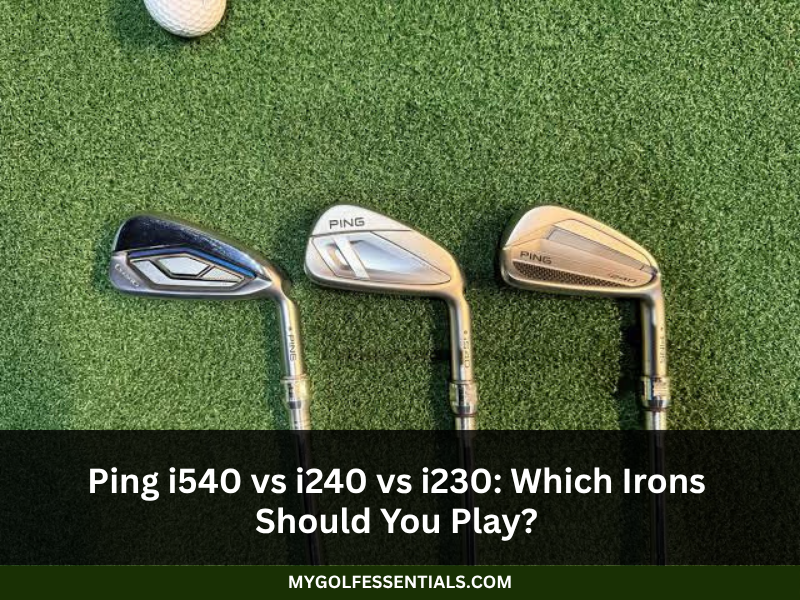
Choosing irons can get oddly complicated. Three heads can look close enough at address, yet produce noticeably different results once the ball is struck. That is the situation with the Ping i230, i240 and i540. The i230 has already proved itself. The i240 takes the players-iron idea and pushes the conversation toward control and precision. The i540 is the speed play, built for golfers who want more carry without jumping straight into a bulky game improvement shape.
So there is no sensible answer to the question of which one is simply best. A golfer who needs ten more yards from an iron is asking a different question from a golfer who wants a tighter pattern into the green.That is where Ping i540 vs i240 vs i230 becomes useful.
Ping i540 vs i240 vs i230 Comparison
The i540 is the most logical choice when distance and forgiveness sit at the top of the list. The i240 is more interesting for golfers who already have enough speed and want a controlled, repeatable flight. The i230 remains a strong option for anyone who likes its compact shape, feel and established performance.
| Category | i540 | i240 | i230 |
| Design priority | Speed and distance | Control and precision | Players-iron control |
| Distance | Highest | Controlled | Controlled |
| Spin | Moderate | Higher | Strong |
| Forgiveness | Higher | Moderate | Moderate |
| Good fit | Distance-focused golfers | Consistent strikers | Golfers wanting proven performance |
For golfers comparing Ping i540 vs i240 vs i230, that is the starting point; the better answer comes from matching the head to the swing. That is the quick version. The choice gets more interesting when the strengths of each model are put into a real round-of-golf context.
Ping i540 Irons: The Distance Option
In Ping i540 vs i240 vs i230, the i540 makes the strongest argument for speed. More ball speed can mean a shorter club into the green, while forgiveness can limit distance loss on imperfect strikes. But there is a difference between hitting an iron farther and playing an iron better. A golfer who adds distance but loses control of the landing window may not actually gain much on the scorecard.
That is the main thing to keep in mind with the i540. Its strength is obvious. Whether that strength matters most depends on the golfer.
Who Benefits Most From the i540?
The natural candidate is the golfer who needs more carry. That could be a moderate-speed player looking for help, or a stronger player who simply wants a fast iron with a little more forgiveness.
There is also the occasional mishit to consider. Nobody finds the center every time. An iron that retains useful speed when contact drifts toward the toe or low on the face can save a shot without making the club look oversized. For golfers in that situation, the i540 deserves a serious test.
Ping i240 Irons: More About Control
Ping i540 vs i240 vs i230 tells a different story with the i240. That matters most when distance is no longer the main problem. Once an iron already reaches the required yardage, another five or ten yards may not improve the approach. A predictable flight can.
The testing referenced in the supplied material supports that idea. The i240 produced the highest spin among the compared irons in the PGAPappas testing, while the i540 had the stronger carry-oriented result. Too much spin can cost distance, so the right amount is a fitting question. The i240 is therefore not the ‘shorter’ choice in any useful sense. It is the more control-minded choice.
Ping i230 Irons: Don’t Count Them Out
In Ping i540 vs i240 vs i230, the i230 is the oldest model, but that does not make it irrelevant. Golfers get caught up in release cycles. On the course, a good iron remains a good iron.
Ping i540 vs i240 vs i230 still includes the i230’s compact look and familiar control. Price can matter as well. Once a newer generation arrives, the previous model can become a much more attractive proposition for a buyer who does not need the latest technology.
Is the i230 Still Worth Playing?
Yes. Especially when it already fits. There is little reason to replace a set simply because a newer number is stamped on another model. An upgrade becomes easier to justify when testing shows a meaningful gain in carry, dispersion, launch, spin or forgiveness. Otherwise, the i230 can stay right where it is.
Ping i540 vs i240 vs i230: The Performance Breakdown
The Ping i540 vs i240 vs i230 comparison is easier when each club gets judged on one job at a time. For distance, Ping i540 vs i240 vs i230 gives the i540 the obvious edge. For spin and control, the i240 moves to the front. The higher-spin profile can produce a more controlled flight, particularly for golfers who already have enough speed.
The i230 remains close to that control-oriented side of the spectrum. It is not trying to be the fastest club in the group, and that is fine. Its appeal comes from consistency and a familiar players-iron feel. Forgiveness is another area where the i540 has an advantage. But forgiveness is not only about keeping a mishit long. Directional consistency matters too, and a golfer who repeatedly starts the ball on the intended line may value that more than a few extra yards.
| Area | Best fit | Why |
| Distance | i540 | Speed and carry |
| Spin | i240 | Higher control-oriented spin |
| Dispersion | i240 | Predictable flight pattern |
| Forgiveness | i540 | More help on imperfect contact |
| Value | i230 | Previous-generation option |
| Control | i240 | Precision-focused design |
Which Ping Iron Is Easiest to Hit?
In Ping i540 vs i240 vs i230, the i540 is generally the easiest starting point for golfers wanting forgiveness. But that answer changes for a consistent striker. For that golfer, an iron can feel easier simply because the distance and flight repeat more often. The i240’s control-oriented character may be a better fit even though it is not the most forgiving head on paper. In Ping i540 vs i240 vs i230, the best-performing iron is usually the one that produces a useful result most often.
Which Iron Is Longest?
In Ping i540 vs i240 vs i230, the i540 is the clear choice if maximum carry is the main goal. That does not mean every golfer will see the same gap. Loft, shaft, swing speed and strike location all influence the final number. Two players can hit the same model and see very different results. And a longer iron is not automatically a better scoring club. A ball that flies five yards farther but lands with less useful height or spin can create a tougher approach.
Which Iron Has the Most Spin?
In Ping i540 vs i240 vs i230, the i240 has the strongest spin-oriented profile in the supplied testing. That can help on approach shots where stopping the ball and controlling distance matter. There is no magic spin number, though. The right window depends on the swing and the club. More is not always better.
Who Are Ping i240 Irons For?
The i240 suits golfers who put control ahead of maximum distance. Consistent ball strikers are the obvious audience, but handicap should not be treated as a gatekeeper. A mid-handicap golfer who strikes the ball well can make plenty of sense with a control-oriented iron. A low-handicap golfer who struggles with contact may be better served by something more forgiving.
The better questions are simpler: Where does the strike occur? How consistent is the carry? Does the ball launch high enough? And how tightly does it finish around the target?
What Handicap Should Use Ping i230 Irons?
In Ping i540 vs i240 vs i230, there is no fixed handicap cutoff for the i230. A higher-handicap golfer with reliable iron contact can play it. A lower-handicap golfer who needs more forgiveness can choose something else. Handicap is a useful clue, not a rule.
What Are the Key Differences Between the PING i540 and i240 Irons?
The basic split is easy to remember: the i540 puts more weight on speed, distance and forgiveness, while the i240 puts more weight on spin, control and precision. That difference matters when choosing between them. A golfer who regularly leaves approaches short has an obvious reason to look at the i540. A golfer who reaches the green comfortably but struggles to control the result has a different reason to look at the i240.
Neither needs to win every category.
Ping i540 vs i240 vs i230: Which Iron Fits Each Golfer?
If the problem is carry, the i540 is the first club worth testing. If the problem is controlling the flight or holding a number, the i240 is more compelling. If the i230 already produces the right flight and distance, there may be nothing to fix. That makes the Ping i540 vs i240 vs i230 decision much less about choosing a winner and more about finding the model that answers the golfer’s particular weakness.
Should i230 Owners Upgrade to the i240 or i540?
Not automatically. In Ping i540 vs i240 vs i230, a golfer who already gets the desired distance and dispersion from an i230 set has a good reason to keep it. Ping i540 vs i240 vs i230 is best tested with numbers, not a marketing claim. If the new club clearly improves the numbers, the upgrade has a purpose. If it does not, there is no prize for changing clubs.
Distance vs Control: Which Matters More?
It depends. A golfer who struggles to reach the green may care far more about carry than anything else. Another golfer may already hit the green regularly but have trouble controlling the landing point.
Those are different problems. The first golfer should probably investigate the i540. The second may get more from the i240. And someone who is already happy with the i230 does not need to manufacture a reason to replace it. Equipment works best when it solves a real problem.
Final Thoughts
The Ping i540 vs i240 vs i230 debate has a straightforward answer once the golfer’s priority is clear. Choose the i540 when speed, carry and forgiveness matter most. Look closely at the i240 when control, spin and repeatability matter more. Keep the i230 firmly in the conversation when it already fits the swing or offers the better value.
There is no need to force one model into every golfer’s bag. The right iron is the one that makes the next approach shot easier to play.
Key Takeaways
1. The i540 puts speed, distance and forgiveness at the center of its design.
2. The i240 places greater emphasis on control, spin and predictable approach performance.
3. The i230 remains a capable players iron with proven control and familiar feel.
4. Maximum distance does not automatically translate into better scoring performance.
5. The i540 deserves testing when carry distance is the golfer’s main limitation.
6. The i240 can suit consistent strikers who already generate sufficient iron distance.
7. The i230 remains sensible when its existing distance and dispersion already fit.
8. Spin, launch and landing angle can influence how effectively an iron holds greens.
9. Handicap alone cannot determine whether a particular Ping iron is appropriate.
10. A fitting can reveal which head produces the most useful overall shot pattern.
FAQs
Who are the Ping i230 irons designed for?
Yes. The i230 is designed for golfers who prefer a compact players-style iron with control and useful feedback. Consistent ball strikers are the natural fit, although there is no strict handicap limit. Strike quality, swing speed, launch and dispersion matter more than handicap alone. Golfers who already get reliable results from the i230 may have little reason to change.
How far should a 12 handicap hit a 7 iron?
No. A 12 handicap does not have one standard 7-iron distance. Carry depends on swing speed, loft, strike quality, launch and shaft setup. Two golfers with the same handicap can have very different numbers. A consistent carry window is a more useful measure than a generic handicap-based distance when assessing iron performance.
Which PING iron is easiest to hit?
Yes. The i540 generally provides the easiest combination of speed and forgiveness among these three models. It can help preserve useful distance when contact is not centered. Still, a consistent striker may find the i240 easier to manage because its flight and distance can be more predictable. Ease of use depends on the golfer.
How forgiving are the Ping i230 irons?
Yes. The i230 offers meaningful forgiveness for a compact players-style iron, but it is not designed to match the forgiveness of a larger game-improvement head. Its balance favors control and feedback. Golfers who regularly miss the center may find the i540 more forgiving, especially when retaining ball speed on mishits is important.
Which is better for me, the Ping i240 or the i530?
No. Neither is automatically better because the two models emphasize different qualities. The i240 leans toward control, spin and precision, while the i530 takes a more distance-oriented approach. Golfers who want predictable approach performance may prefer the i240. Golfers seeking easier speed and carry may find the i530 more suitable.