Mizuno Pro 243 vs 245: Which Irons Are the Better Choice?
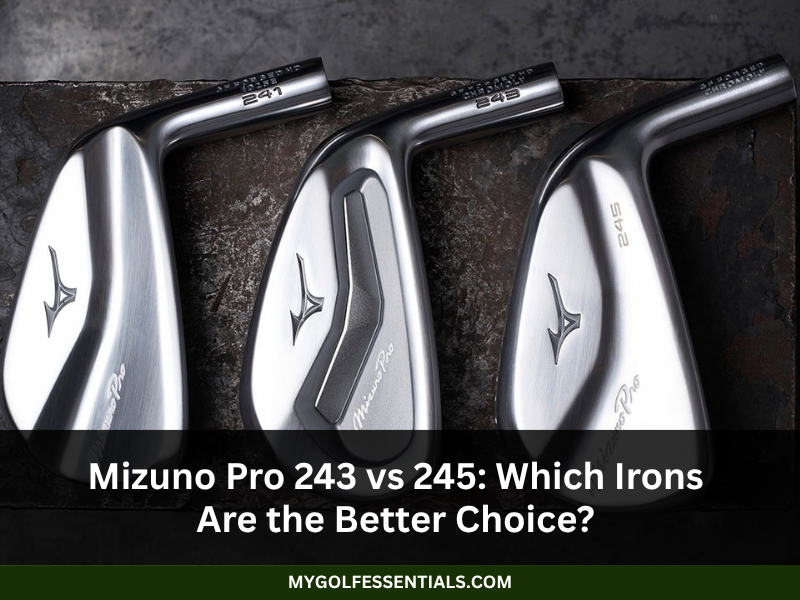
The Mizuno Pro 243 and Pro 245 are close enough in appearance to create an obvious question: why choose one over the other? Both sit in the better-player end of Mizuno’s 2024 Pro range. Both have compact heads, premium construction and the soft impact character expected from a Mizuno iron. Yet the two sets take noticeably different routes to performance. The 243 uses a cavity-back design that balances distance with control, while the 245 uses a hollow construction built around speed and forgiveness.
That makes the Mizuno Pro 243 vs 245 decision less straightforward than a simple distance comparison. Independent testing has produced some interesting results, too. One test found almost no meaningful 7-iron distance difference between the two, while another recorded a clearer advantage for the 245, particularly in the longer irons.
Mizuno Pro 243 vs 245 Comparison
| Details | Pro 243 | Pro 245 |
| Construction | Players cavity | Hollow body |
| Main character | Control and feedback | Speed and forgiveness |
| Appearance | Compact cavity | Compact player-distance profile |
| Long-iron emphasis | Launch and control | Speed and assistance |
| Workability | Strong | Good |
| Forgiveness | Moderate | More help on mishits |
| Typical appeal | Consistent ball striker | Golfer wanting more speed and stability |
The table gives the short version, but it misses an important detail. The 243 is not a slow, traditional players iron, and the 245 is not a bulky game-improvement club. Both sit somewhere between those familiar categories.
The Construction Difference Matters More Than the Numbers Suggest
The 243 uses a players-cavity construction. Its 4- through 7-irons use a thinner 4120 Chromoly face and micro-slot, while the 8-iron through wedge move toward a more traditional 1025 carbon-steel construction. Mizuno also reworked the sole through the set for turf interaction. The 245 takes a more aggressive approach to speed. Its face and neck use 4135 Chromoly, while a 47-gram tungsten weight sits within the back section. The hollow construction allows Mizuno to work on face flex and launch without giving the club the oversized appearance associated with many distance irons.
That distinction explains much of the Mizuno Pro 243 vs 245 story. The 243 gives the cavity more responsibility for balancing forgiveness and playability. The 245 uses its hollow structure and internal weighting to push harder toward ball speed and stability. Neither approach is inherently better. They simply place different demands on the head.
They Look More Similar Than They Play
At address, neither iron looks intimidating. The 243 has a compact cavity-back profile, with a topline and sole that remain relatively restrained. Golfer Geeks describes the head as compact but slightly thicker than a pure players iron. The 245 is also compact, despite its hollow construction, although its sole and topline are a touch larger. That matters because the 245 does not announce itself as a distance iron in the way some hollow-body designs do.
The visual difference becomes more apparent from the back of the club. The 243 exposes its cavity, while the 245 has the more muscle-back-like appearance created by the hollow-body design. For a golfer who cares strongly about the traditional cavity-back look, the 243 has an obvious appeal. For someone who wants modern distance technology without looking down at a large head, the 245 occupies an interesting middle ground.
Feel Is One Area Where Both Are Strong
This is perhaps the least useful place to declare a winner. Both sets received strong marks for feel in independent testing. Golfer Geeks described both as soft and solid, including on mishits, while Golfpowers found the 245 soft at impact despite its strong face response. The difference is more subtle.
The 243 has the sort of feedback expected from a compact cavity. A well-struck shot feels dense and controlled, while an imperfect strike communicates more clearly what happened. The 245 adds a livelier sensation to that formula. Golfpowers noted the strong rebound from the face, while still describing the impact as soft.
That creates an interesting split within the Mizuno Pro 243 vs 245 comparison. The 243 leans toward the traditional forged-iron experience. The 245 retains much of that character while making the face feel more active. For golfers choosing primarily on feel, a side-by-side fitting may reveal more than specifications ever could.
The Distance Story Is Not Quite as Simple as “245 Is Longer”
The 245 has the stronger case on paper. Its construction is specifically designed to generate speed, and its lofts are stronger through much of the set. Golfer Geeks’ testing recorded 118 mph of ball speed and 181.5 yards of carry with the 245 7-iron, compared with 116 mph and 178 yards for the 243. The same test showed a more noticeable gap with the 6-iron: 190.38 yards for the 245 versus 183.5 yards for the 243. But another test complicates the picture.
Golfpowers compared the two 7-irons in a test-room environment and found almost no difference in distance. Its 243 testing produced distance performance comparable to the 245 despite the 243 carrying a 32-degree 7-iron. That disagreement is actually useful.
It shows why Mizuno Pro 243 vs 245 should not be reduced to a loft chart or a single launch-monitor session. The golfer’s delivery, shaft, strike location and launch conditions all influence the result. The 245 clearly has the design credentials to produce more speed. Whether that translates into a meaningful advantage depends on the person swinging it.
Forgiveness Becomes More Interesting on Poor Strikes
Neither model is a game-improvement iron. Golfer Geeks found that both sets punished fat and thin shots, despite offering some help. The reviewer specifically concluded that solid mid- and long-iron contact remained important. That is worth emphasizing because the 245’s “forgiving” label could otherwise create the wrong expectation. The 245 provides more assistance, particularly in the longer irons, but it does not turn a poor strike into a perfect one. The difference is more about what remains after the miss.
The 245’s hollow construction and internal weighting are intended to preserve speed and launch. Golfpowers also notes the role of additional tungsten in lowering the center of gravity and increasing forgiveness. The 243, meanwhile, offers a little less insurance but maintains the compact, responsive character expected from a players cavity. For a golfer who regularly misses the center, that distinction can become more important than a three-yard difference on a perfect strike.
Long Irons Tell a Different Story
The longer clubs are where the Mizuno Pro 243 vs 245 comparison becomes particularly interesting. The 245’s construction is designed to help the long irons launch, but the stronger lofts can also make launch more demanding for some golfers. Golfer Geeks reported easy launch through the 6-iron before seeing the flight come down more noticeably with the 5-iron.
The 243 also uses different construction through the set, with its longer irons designed to help launch while its shorter clubs emphasize a more traditional feel. Golfpowers found a good balance between maneuverability and spin and reported similar distance to the 245 in its test-room comparison. That leaves a useful lesson: more speed does not automatically mean a better long iron. Peak height, spin and descent angle still determine whether a long iron can hold a green.
What Handicap Should Play Mizuno 245?
There is no sensible single handicap cutoff. The Mizuno Pro 243 vs 245 comparison suggests that the 245 suits golfers who want a compact head but would appreciate additional speed and stability. Golfer Geeks’ testing placed the model toward the better-player end of the market and noted that true low-handicap players may still prefer smaller heads.
A golfer’s handicap tells only part of the story. Strike consistency, swing speed and launch conditions matter considerably more when selecting a strong-lofted players-distance iron. A mid-handicap golfer who makes reliable contact may find the 245 perfectly appropriate, while a low-handicap golfer with lower launch could need something with different launch characteristics.
The Pro 243 Has a Different Kind of Appeal
The 243 makes a strong case for golfers who want modern distance without giving up the traditional behavior of a cavity-back players iron. Its compact shape, feedback and workability are central to the package. Golfpowers found the balance between maneuverability and spin particularly appealing and reported distance comparable with the 245 during its testing.
That makes the 243 an interesting choice for a consistent ball striker who does not need the maximum amount of help from the clubhead. It also explains why the 243 should not be dismissed as simply the “less forgiving” option. It brings its own strengths to the table: trajectory control, feedback and a more traditional relationship between strike and result.
What Handicap Are the Mizuno 243 Irons For?
Again, handicap provides only a rough reference. The Mizuno Pro 243 vs 245 question is better answered through contact quality and launch conditions. A golfer with a repeatable strike who likes compact heads can potentially fit the 243 even without having a tour-level handicap.
Golfer Geeks tested the 243 as a player-distance cavity and reported strong distance on center contact, while also noting that the clubs punished significant mishits. The model therefore makes the most sense for golfers who can consistently find the middle of the face and value control as much as raw distance.
Could a Combo Set Make More Sense?
The most interesting answer may be neither. The 245’s characteristics can be useful at the top of the set, where launch and speed become harder to generate. The 243’s characteristics become increasingly attractive in the scoring irons, where feel, precision and workability carry greater importance. GolfWRX has specifically discussed the potential for combining the models.
A mixed set could therefore place 245 irons into the longer portion of the bag and transition into 243s as the clubs become shorter. That approach requires careful attention to loft gaps, shaft specifications and swing weight. It should be treated as a fitting exercise rather than simply mixing two heads.
Mizuno Pro 243 vs 245: Which One Fits the Golfer?
The Mizuno Pro 243 vs 245 decision becomes fairly clear once the priorities are separated.
| Priority | More closely aligned model |
| Traditional cavity feel | Pro 243 |
| Workability | Pro 243 |
| Compact cavity appearance | Pro 243 |
| Ball-speed emphasis | Pro 245 |
| Additional long-iron assistance | Pro 245 |
| Greater mishit protection | Pro 245 |
| Traditional feedback | Pro 243 |
| Player-distance character | Pro 245 |
The interesting point is that the two models overlap considerably. Both can produce strong distance. Both feel good. Both look compact. Neither offers the forgiveness of a full game-improvement iron. The gap appears mainly in how the clubs achieve their performance. The 243 relies more heavily on the golfer’s strike and control. The 245 gives the head a greater role in preserving speed and stability.
Final Thoughts
The Mizuno Pro 243 vs 245 debate does not produce a universal winner, and the independent testing helps explain why. The 243 can deliver plenty of distance while retaining the compact shape, feedback and workability expected from a players cavity. The 245 pushes further toward speed and forgiveness, with its hollow construction becoming particularly useful when the longer irons are involved. The testing evidence is also revealing. One reviewer found almost no distance difference between the two 7-irons, while another recorded a measurable advantage for the 245 and a larger gap in the 6-iron. That variation is exactly why a specification sheet cannot settle the question.
For golfers who value traditional feedback and control, the 243 has a compelling case. For those who want additional speed and help on imperfect strikes, the 245 deserves serious consideration. And for golfers caught between the two, the most sensible solution may be a combination of both. A side-by-side fitting remains the clearest way to settle the Mizuno Pro 243 vs 245 question because launch, spin, dispersion and strike quality can vary considerably from one golfer to another.
Key Takeaways
· The Pro 243 uses a cavity design that emphasizes control, feedback and workability.
· The Pro 245 uses hollow construction to increase speed and forgiveness without excessive head size.
· Both models maintain compact appearances suitable for golfers who dislike oversized iron heads.
· The 243 produces a traditional, solid impact sensation with clear feedback from the strike.
· The 245 combines Mizuno’s soft feel with a livelier response from its speed-oriented face.
· Independent testing shows that distance differences vary considerably according to golfer and testing conditions.
· The 245’s biggest practical advantage can appear in longer irons where speed matters.
· Neither iron provides the extreme mishit protection associated with large game-improvement designs.
· The 243 suits consistent ball strikers who place greater value on control and workability.
· A combo set can combine the long-iron assistance of the 245 with 243 scoring-iron characteristics.
Frequently Asked Questions
How forgiving are the Mizuno Pro 245 irons?
Yes, the Mizuno Pro 245 irons provide useful forgiveness for a compact player-distance design. Their hollow construction and internal weighting help preserve speed and launch, particularly in the longer irons. They still punish significant mishits, however, so the 245 should not be confused with a maximum-forgiveness game-improvement iron.
Who are Mizuno 245 irons for?
Yes, Mizuno 245 irons can suit golfers who want a compact head with additional speed and stability. The design fits players who make reasonably consistent contact but would like more assistance from the longer irons. Stronger lofts and the hollow-body construction make launch and ball speed important fitting considerations.
What are the best Mizuno irons for a 15 handicap?
Yes, a 15-handicap golfer can consider Mizuno’s Pro 245 and other more forgiving models. The right choice depends on contact, launch, swing speed and desired head size rather than handicap alone. A competent 15-handicap player who prefers compact heads may fit the 245, while frequent mishits may point toward a more forgiving design.
When did Mizuno Pro 243 come out?
Yes, the Mizuno Pro 243 arrived as part of Mizuno’s 2024 Pro iron family. The 243 launched alongside the Pro 241 and Pro 245, continuing the three-model structure used in the previous generation. Golfpowers published its review of the 2024 series on May 9, 2024, while GolfWRX reviewed the new models earlier that year.