
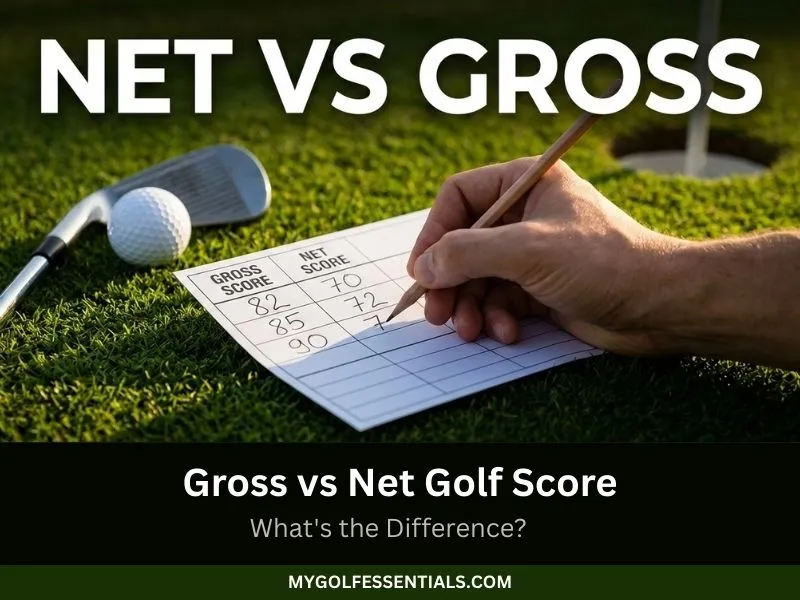
Understanding Gross vs Net Golf Score can feel confusing when you first start tracking your performance on the course. You finish your round, look at your scorecard, and wonder which number actually matters. Here’s the thing: Golf uses two different scoring systems.
Once you grasp this concept, golf becomes far more enjoyable. You can compete with anyone, regardless of skill level.This guide will break down exactly what gross and net scores mean. You’ll learn how handicaps transform your score, when to use each type, and why both numbers matter for your game.
What Is Gross Score in Golf?
Gross score is the total number of strokes you take to complete a round of golf, before any handicap is applied. It’s your raw, unadjusted performance on the course.
If you hit the ball 95 times during 18 holes, your gross score is 95. Every swing counts. Every putt adds up.
Think of gross score as the pure measure of your golf game. It tells you exactly how many shots it took to finish the round.
Why Gross Scores Matter?
Gross scores show your true performance without any adjustments or handicaps. They’re the most honest snapshot of how you played.
Here’s why that matters:
- Personal record tracking: You want to know your actual performance without handicap adjustments affecting the number.
- Handicap calculations: Your gross scores determine your handicap index. The system uses your raw scores to calculate your potential.
- Qualifying rounds: Most tournaments use gross scores to determine who advances to the next stage.
- Scratch golfer competitions: When everyone plays at the same skill level, gross scores create fair competition.
What Is Net Score in Golf?
Net score levels the playing field by adjusting your gross score using your course handicap.
The Formula: Net Score = Gross Score – Course Handicap
This system allows golfers of different abilities to compete fairly. A beginner can play against a club champion and have a legitimate chance to win.
Here’s how it works:
The handicap system subtracts strokes from your total score based on your skill level. Higher handicaps get more strokes removed. Lower handicaps get fewer strokes removed.
You shoot a 95 with an 18 handicap. Your net score becomes 77. That’s a solid round! Meanwhile, a scratch golfer shooting 77 has the same net score as you, even though their gross score was 18 strokes better.
Why Net Scores Exist?
Net scores level the playing field so golfers of different skill levels can compete meaningfully against each other. Without this system, a beginner would have no chance against a club champion.
The handicap system solved this challenge decades ago. It transforms golf into an inclusive sport where skill level doesn’t determine who can play together.
Check this out with four players teeing off:
- Player A: Shoots 75 (scratch golfer, 0 handicap) = 75 net
- Player B: Shoots 85 (10 handicap) = 75 net
- Player C: Shoots 95 (20 handicap) = 75 net
- Player D: Shoots 105 (30 handicap) = 75 net
All four players tied! They all shot net 75. The gross scores ranged from 75 to 105, but the net scores made it fair.
This is why net scoring makes golf fun for everyone. You don’t need to be a scratch golfer to compete and win.
How Do Golf Handicaps and Net Score Work?
You cannot understand net scoring without understanding handicaps.
What Is a Golf Handicap?
A golf handicap measures your potential playing ability. It’s not your average score. It reflects how well you can play on your best days. The World Handicap System(WHS) calculates this number based on your recent rounds. The system takes your best scores and uses them to predict your potential.
Handicap ranges look like this:
- 0-5: Expert level players
- 6-12: Advanced amateurs
- 13-20: Solid recreational golfers
- 21-30: Developing players
- 31-54: Beginners and high handicappers
Lower handicaps mean better golfers. A scratch golfer has a 0 handicap. They’re expected to shoot par on an average course.
How Handicaps Transform Your Score
Your handicap index converts to a course handicap based on the specific course you’re playing.
The calculation process is as follows in general:
- Start with your Handicap Index
- Check the course Slope Rating (typical range: 113-155)
- Apply the formula: Course Handicap = (Handicap Index × Slope Rating) ÷ 113
- Round to the nearest whole number
Quick Tip: Get your official handicap through the GHIN system (Golf Handicap and Information Network). Most golf clubs offer this service. It tracks all your scores automatically.
The course handicap differs from your handicap index because courses have different difficulty levels. A tough course gives you more strokes. An easier course gives you fewer.
Golf handicap and net score work as partners. You cannot calculate an accurate net score without knowing your course handicap for that specific track.
How Handicaps Affect Golf Scoring
Golf handicaps play a crucial role in how scores are calculated and compared, especially when players of different abilities compete against one another. Here are the key ways handicaps affect golf scoring:
1. They Convert Gross Scores Into Net Scores
Handicaps transform your raw score into a competitive score. You subtract your course handicap from your gross total to get your net score. This allows fair comparison between players of vastly different skill levels.
2. They Decide Where You Get Extra Strokes
The system distributes strokes strategically across the hardest holes. Every hole gets a handicap rating from 1 to 18. If your course handicap is 10, you receive strokes on the ten hardest holes. A player with a 25 handicap gets two strokes on the seven hardest holes and one stroke on the remaining eleven.
3. They Change How Points Are Scored (Stableford)
In Stableford format, handicaps directly impact points awarded per hole. Your handicap determines your target score on each hole. Beat that target and you earn bonus points. This scoring method rewards consistent play relative to your ability.
4. They Level Course Difficulty
Different courses have different difficulty levels measured by slope rating. Your handicap adjusts based on the course you’re playing. A tough course gives you more strokes. An easier course gives you fewer. This ensures fair play regardless of where you tee it up.
5. They Shape Competition Formats
Handicaps determine how different tournament formats work. In stroke play, you subtract your full course handicap from your total. In match play, you use the difference between handicaps and apply strokes only on specific holes. Tournament organizers use handicaps to create divisions and flight competitions.
Gross Score vs Net Score in Golf: Key Differences
Gross score vs net score in golf comes down to fairness versus accuracy. One measures skill and the other measures competitive equity.
Here’s a simple comparison between gross score and net score:
| Attribute | Gross Score | Net Score |
| Definition | Total strokes taken | Gross score minus handicap |
| Calculation | Simple addition | Requires course handicap |
| Who Uses It | Professionals, scratch golfers | Amateur tournaments, club play |
| Best For Measuring | Raw skill and improvement | Fair competition across skill levels |
| Tournament Types | PGA Tour, qualifying events | Club championships, member events |
| Fairness | Equal only for same skill level | Equalizes all skill levels |
Both scores have value. Your gross score reveals where you stand skill-wise. Your net score shows how you performed relative to your potential.
What Is a Good Net Score in Golf?
A good net score is one that shows you’ve played to or better than your handicap. In most cases, a net score around par is considered solid, while anything below par indicates an excellent round.
Par is always the target. If you shoot net par or better, you played well relative to your handicap. The handicap system predicts you’ll shoot around par on your good days.
If you shoot net 72 on a par 72 course, you met expectations. Under par? That’s an excellent round. You played better than your handicap suggests.
A net 68 is a net 68, regardless of your handicap. The 30-handicapper who shoots 98 (net 68) played just as well relative to ability as the 10-handicapper who shot 78 (net 68).
That’s the beauty of the system. Everyone competes on equal footing.
Real-World Examples: Gross vs Net
Let’s see how this plays out in actual tournament scenarios.
Scenario 1: Club Championship
Four players compete in your club’s monthly tournament. Check out how the scoring turns out.
| Player | Handicap | Gross Score | Net Score |
| Mike | 5 | 77 | 72 |
| Sarah | 12 | 86 | 74 |
| James | 22 | 95 | 73 |
| Lisa | 8 | 82 | 74 |
Here,
- Gross Division Winner: Mike shoots 77, wins by 5 strokes over Lisa.
- Net Division Winner: Mike again! His net 72 beats James by one stroke.
But here’s where it gets interesting. James shot 18 strokes worse than Mike in gross scoring. Yet he finished just one shot behind in net scoring.
This scenario shows why tournaments often award separate prizes for gross and net. Mike deserves recognition for shooting 77. But James played extremely well relative to his 22 handicap.
Scenario 2: Friendly Weekend Match
Two buddies play. Tom is a 6 handicap. Dave is a 24 handicap.
Without handicaps, this match is pointless. Tom would destroy Dave every single time.
The Setup:
Dave gets 18 strokes (the difference between 24 and 6). He receives strokes on the 18 hardest holes.
Hole-by-Hole Breakdown:
Hole 1 (Par 4, Handicap 3):
- Tom makes 4
- Dave makes 6, minus stroke = net 5
- Tom wins the hole, goes 1-up
Hole 5 (Par 4, Handicap 1):
- Tom makes 5
- Dave makes 7, minus stroke = net 6
- Tom wins, goes 2-up
Hole 9 (Par 5, Handicap 7):
- Tom makes 5
- Dave makes 6, minus stroke = net 5
- Hole tied, Tom still 2-up
Hole 15 (Par 3, Handicap 15):
- Tom makes 3
- Dave makes 5, minus stroke = net 4
- Tom wins, goes 3-up
Final Result: Tom wins 2&1 (2 holes up with 1 to play).
Dave lost, but the match stayed competitive. Without handicaps, Tom would have won 7&6 or worse. The strokes gave Dave fighting chances throughout the round.
This is exactly why net scoring exists. It transforms an unfair beatdown into an actual competition.
When to Use Gross vs Net Scores
Gross Score Situations:
Use gross scoring when skill level matters most. These situations demand pure performance measurement.
- Playing championship or elite amateur events
- Tracking personal improvement milestones
- Competing with players within 5 handicap strokes
- Posting scores for handicap calculation
Net Score Situations:
Net scoring dominates amateur golf. Use it when fairness between different skill levels matters.
- Playing club tournaments
- Competing in charity or fundraiser events
- Playing casual rounds with mixed skill levels
- League play
Common Mistakes in Net Score Calculations
Calculating net scores seems simple, but golfers often make mistakes that can affect competition results or personal tracking. Here are some common errors to watch out for:
Mistake #1: Using Handicap Index Instead of Course Handicap
Your handicap index is NOT the number you subtract. You must convert it to a course handicap first.
The formula: (Handicap Index × Slope Rating) ÷ 113
Skip this step? Your net score is wrong. Most players end up giving themselves too few strokes.
Mistake #2: Forgetting the Slope Rating
Every course has different slope ratings for different tees. The slope adjusts your handicap based on course difficulty.
Playing the white tees (slope 125) versus the blue tees (slope 135) changes your course handicap. Always check the scorecard.
Mistake #3: Misreading Stroke Allocation
You have a 14 handicap. You get strokes on holes rated 1 through 14 in difficulty.
Some players mistakenly take strokes on the first 14 holes on the scorecard. Wrong! You take strokes on the 14 hardest holes, which are scattered throughout the course.
Check the handicap row on your scorecard. It tells you exactly which holes get strokes.
Mistake #4: Not Updating Your Handicap Regularly
Your handicap changes after every round you post. Playing with an outdated handicap creates unfair competition.
Post your scores within 24 hours. The GHIN system recalculates automatically. Use your current handicap for every competitive round.
Mistake #5: Applying Full Handicap in Match Play
Match play uses the difference between handicaps, not your full course handicap.
You’re a 16 playing a 10. You get 6 strokes (16 minus 10), not 16 strokes. Apply those 6 strokes on the six hardest holes only.
Final Thoughts
Golf scoring doesn’t need to confuse you anymore. The difference between gross and net is straightforward. Gross score measures raw performance, It’s every stroke you take without adjustments and Net score levels the playing field by subtracting your handicap.
Both scoring methods serve important purposes. Track your gross scores to monitor actual improvement. Use net scores to compete fairly against players of any skill level.
Understanding gross vs net golf score makes you a smarter, more informed golfer. You’ll know which number matters in different situations. You’ll calculate scores correctly and compete with confidence. Now take this knowledge to the course. Track both your gross and net scores. Watch yourself improve in both categories.
Golf becomes more enjoyable when you understand the scoring. Get out there and play.
Key Takeaways
- Gross score equals total strokes without adjustments; net score equals gross minus your course handicap.
- Gross scores measure raw performance; net scores enable fair competition between different skill levels.
- Course handicap differs from handicap index based on the specific course’s slope rating and difficulty.
- Net scoring allows players of all abilities to compete fairly in tournaments and casual rounds.
- Professional golf uses only gross scores; amateur tournaments typically award prizes for both gross and net.
- A good net score is around par or better, regardless of your handicap level.
- Strokes are allocated by hole difficulty, marked as handicap 1-18 on your scorecard.
- The system uses your best scores (approximately 70% of demonstrated ability) to calculate handicap potential.
- Always verify you’re using course handicap, not handicap index, for accurate net score calculations.
- Both scoring methods have value: gross for measuring personal improvement, net for competitive play.
FAQs
What is the 70/30 rule in golf?
The 70/30 rule refers to how the USGA calculates handicaps based on your potential rather than average scores. The system takes your best 8 scores from your last 20 rounds (representing roughly 70% of your demonstrated ability). This ensures your handicap reflects what you’re capable of shooting, not your typical performance.
Why do some tournaments only use gross scores?
Some tournaments use only gross scores to identify the best raw performance regardless of handicap. These events, often called scratch tournaments or championships, reward pure skill and ball-striking ability rather than performance relative to potential. They’re common in elite amateur competitions and qualifying events.
Can your net score be lower than your gross score?
Yes, your net score is always lower than your gross score if you have a handicap. The net score equals gross score minus handicap strokes. A player shooting 95 with a 20 handicap has a net score of 75, which is 20 strokes lower than their gross.
Is Stableford net or gross?
Stableford can be played as both net or gross. Most amateur and recreational golfers play Stableford using net scores, meaning your handicap strokes are applied before points are calculated. Gross Stableford is less common and typically used in professional or scratch competitions where no handicap adjustment is made.