
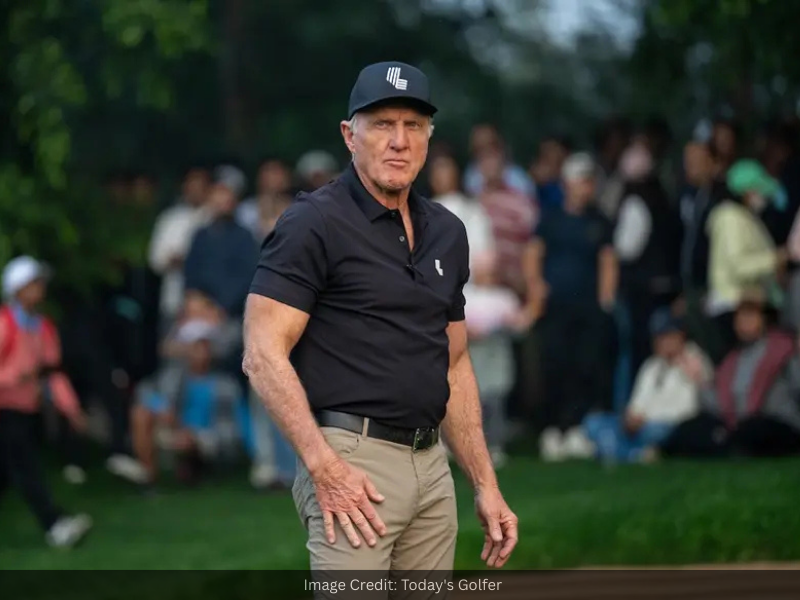
Image Credit: Today’s Golfer
Greg Norman believes PGA Tour stars who rejected LIV Golf have still benefited from the upheaval it created, insisting the breakaway league transformed golf’s power structure for the better.
Nearly a year after stepping down as LIV Golf CEO, the 70-year-old Australian says the sport’s elite players now enjoy greater influence and financial control because of LIV’s arrival.
Life After LIV Golf
Norman was replaced by Scott O’Neil as LIV Golf’s chief executive in January, with his contract officially ending in August. Since then, he has divided his time between his golf course design business and his role on the organising committee for the 2032 Brisbane Olympic Games.
However, his influence as LIV’s founding CEO remains clear. Under his leadership, LIV Golf lured several top PGA Tour players with lucrative contracts, triggering one of the most disruptive periods in the sport’s history.
How LIV Changed the PGA Tour
With reunification talks stalled, LIV continues to pursue Norman’s vision of a global tour backed by the Saudi Public Investment Fund.
The PGA Tour, meanwhile, has been forced to overhaul its structure to protect itself. Top players who resisted LIV have been rewarded with equity worth $1.5 billion in PGA Tour Enterprises, a new commercial arm of the circuit.
Billions in New Investment
External funding has also arrived through the Strategic Sports Group, which invested $3 billion into the PGA Tour. After being caught off guard by the 2023 framework agreement with LIV’s backers, leading players now hold significant sway over how the tour is run.
Norman argues this shift was inevitable once LIV entered the picture.
“Players now control their own destiny,” he said on the Straight Talk Podcast. “I’m a disruptor. I see weaknesses.”
A Long-Standing Player Grievance
Norman has long argued that players were historically denied control over their earning potential. During his own career, he felt the system favoured institutions over individuals.
“It was unfair to the players,” he said. “If Jack Nicklaus or Arnold Palmer had owned their own intellectual property from the start, they’d be billionaires.”
According to Norman, LIV forced golf to accept private equity for the first time in more than five decades, opening the door to innovation and growth.
Investment Beyond the Fairways
“What LIV did was bring outside money into the sport,” he explained. “That created opportunities to invest in production, marketing, hospitality, entertainment, and fandom. Innovation came because the investment had to grow.”
Clearing Up the LIV Perception
Despite the controversy, Norman insists he never intended to damage the PGA Tour.
“The thing that bothers me most is the perception that I was trying to destroy the PGA Tour,” he said. “That’s the opposite of the truth. Competition is a wonderful thing.”
He described LIV as an entertainment-driven counterbalance, featuring teams, music, and enhanced hospitality, which he believes the sport was “crying out for.”
While his LIV legacy remains divisive, Norman appears content with the disruption he caused, convinced it reshaped professional golf for the long term, even if many still refuse to admit it.