
Thinking about adding deadlifts to your golf fitness routine? You’re not alone. As more golfers look to boost their power, control, and longevity on the course, strength training is becoming a game-changer, and deadlifts are at the center of it.
In this guide, we’ll break down whether deadlifts are actually good for golfers, how they impact your swing, and how to use them safely and effectively in 2025.
Let’s get into it.
What is a Deadlift?
The deadlift is one of the most effective strength-training exercises used by athletes across sports. And yes, that includes golfers.
At its core, the deadlift is a hip-hinge movement where you lift a weight, typically a barbell, from the ground to a standing position using your lower body and back muscles. It’s a compound exercise, meaning it works multiple muscle groups at the same time, especially the posterior chain (backside of your body).
The main purpose of a deadlift is to develop strength, power, and stability, all of which are vital for a consistent, powerful golf swing.
Key Muscles Worked by Deadlifts for Golf
Deadlifts mainly target the posterior chain, which plays a big role in the golf swing and overall stability. Here’s a breakdown of the muscle groups involved:
- Glutes – Power the hip drive during your swing.
- Hamstrings – Support knee stability and hip extension.
- Lower back – Helps maintain posture and resist early extension in your swing.
- Core muscles – Provide rotational control and improve balance throughout your swing.
- Forearms and grip strength – Important for maintaining control of the club during impact and follow-through.
These muscles are essential for generating power, maintaining form, and preventing injuries over time, especially as you age or increase your play frequency.
Why Golfers Need to Care About Strength & How Deadlifts Help
Golf may seem like a finesse sport, but strength plays a major role in how well you perform, especially when it comes to swing power, control, and injury prevention. Stronger golfers often enjoy longer drives, better balance, and more consistent play.
Deadlifts are one of the best strength-building exercises you can add to your golf fitness routine because they directly target the muscles and movement patterns involved in the golf swing.
Key Benefits of Strength Training with Deadlifts for Golfers:
- Increases Clubhead Speed and Swing Power: A strong lower body and core create more ground force, which translates to faster clubhead speed and longer drives. Deadlifts help you build this kind of explosive strength from the ground up.
- Improves Stability and Balance: Deadlifts activate deep core muscles and stabilizers, helping you stay balanced throughout your swing. This is crucial when hitting from uneven lies or maintaining control through impact.
- Enhances Posture and Hip Drive: The deadlift’s hinge pattern improves hip mobility and glute activation, key for generating torque in your backswing and maintaining posture throughout your swing without “standing up” early.
- Supports Core Strength and Rotation: A strong core isn’t just about visible abs. It’s about controlling movement and resisting unwanted rotation. Deadlifts build core endurance that helps you maintain a smooth and powerful swing.
- Builds Grip Strength and Club Control: Holding and lifting a loaded bar naturally improves your grip strength, which translates into better control over the club and reduced wrist breakdown during impact.
- Reduces Risk of Injury: Strength training increases joint stability and muscle resilience. By training your hamstrings, glutes, lower back, and core, deadlifts help prevent common injuries like low back pain, hip strain, or early swing fatigue.
- Improves Overall Athleticism: Golfers today need more than just a good swing. They need a strong, mobile body that can perform consistently over 18 holes and across multiple rounds per week. Deadlifts help build that base.
Types of Deadlifts for Golfers and How to Do Them Properly.
There are several deadlift variations, but not all are equally suited for golfers. Below are three golfer-friendly options that focus on strength without putting unnecessary strain on the body:
1. Standard Barbell Deadlift
The standard barbell deadlift is a classic strength training movement that involves lifting a weighted barbell from the ground to a standing position using a hip-hinge motion. It is one of the most effective compound exercises for building overall strength, especially in the lower back, glutes, and hamstrings.
This version of the deadlift places the bar in front of you and requires solid technique to perform safely and effectively.
Muscles Worked:
- Glutes.
- Hamstrings.
- Lower back (spinal erectors).
- Core (abdominals and obliques).
- Upper back (traps, lats).
- Forearms and grip.
Additional or Alternative Muscles Worked:
- Quadriceps (during the initial push).
- Calves (as stabilizers).
Why It’s Good for Golfers:
- Builds raw lower body and core strength for better swing power and stability.
- Trains proper hip hinge mechanics, which support better posture and balance during the golf swing.
- Improves overall athleticism and durability, helping golfers stay strong throughout long rounds and busy playing seasons.
Equipment Required:
- Olympic barbell
- Weight plates
- Optional: lifting platform, weightlifting belt, chalk, lifting straps
How to Do It:
- Stand with feet hip-width apart and the barbell over your mid-foot.
- Bend at the hips and knees to grip the bar just outside your knees.
- Keep your back flat, chest up, and shoulders directly over the bar.
- Engage your core and push through your heels to lift the bar.
- Stand tall by fully extending your hips and knees.
- Lower the bar under control by pushing your hips back and bending your knees.
Pro Tips:
- Keep the bar close to your body throughout the lift.
- Do not round your back, maintain a neutral spine at all times.
- Use lighter weight when learning to master form before increasing load.
When to Use This:
- Great for intermediate to advanced lifters who have solid hip mobility and lifting technique.
- Best suited for off-season or general strength-building phases.
- Not recommended for beginners without proper coaching or for those with lower back injuries. So, start with regressions like trap bar or Romanian deadlifts instead.
2. Romanian Deadlift (RDL)
The Romanian Deadlift (RDL) is a hip-hinge exercise that targets the hamstrings and glutes with a greater emphasis on control and stretch than the standard deadlift.
Unlike the standard version, the RDL starts from a standing position and involves lowering the weight down the legs without touching the ground. It’s a more focused and joint-friendly variation that helps golfers develop the strength and mobility needed for a powerful, stable swing.
Muscles Worked:
- Hamstrings.
- Glutes.
- Lower back (spinal erectors).
- Core (especially lower abs and obliques).
Additional or Alternative Muscles Worked:
- Calves (as stabilizers).
- Lats and traps (for maintaining posture and tension).
Why It’s Good for Golfers:
- Improves hip mobility and control, which is key for a smooth and powerful golf swing.
- Builds eccentric hamstring strength, helping prevent injuries and support hip drive.
- Reinforces posture and balance throughout the swing, reducing early extension.
Equipment Required:
- Barbell or dumbbells.
- Optional: resistance bands, lifting straps, mirror for form checking.
How to Do It:
- Stand tall holding a barbell or dumbbells in front of your thighs with a shoulder-width grip.
- Keep your knees slightly bent and push your hips back while lowering the weight down your legs.
- Maintain a flat back and tight core as the bar moves just past your knees or mid-shin.
- Feel a stretch in your hamstrings while keeping your spine neutral.
- Drive your hips forward to return to the starting position, squeezing your glutes at the top.
Pro Tips:
- Think “hips back” instead of “bend over” to keep form clean.
- Don’t let the weights drift away from your legs. So, keep them close.
- Start light and move slowly to feel the muscle stretch and control.
When to Use This:
- Perfect for golfers of all levels, especially beginners learning the hip hinge.
- Great during in-season training for maintaining strength without excessive fatigue.
- Useful for improving posture, mobility, and injury resilience, ideal for golfers dealing with tight hips or lower back discomfort.
3. Trap Bar Deadlift
The trap bar deadlift uses a specialized hexagonal bar (trap bar) that allows you to stand inside the frame and lift with a neutral grip.
This variation shifts the load closer to your center of gravity, making it easier on the lower back while still engaging the legs, hips, and core. It’s often seen as a beginner-friendly and joint-safe alternative to the standard barbell deadlift.
Muscles Worked:
- Glutes
- Hamstrings
- Quadriceps
- Core (abdominals and obliques)
- Lower back
Additional or Alternative Muscles Worked:
- Traps and upper back
- Forearms and grip (due to the neutral hand position)
Why It’s Good for Golfers:
- Allows for safer lifting with less spinal stress, great for golfers with back issues.
- Builds lower body strength and power to support a stronger, more explosive swing.
- Enhances balance and posture through a more upright lifting position.
Equipment Required:
- Trap bar (hex bar)
- Weight plates
- Optional: lifting blocks, straps, or belt for added support.
How to Do It:
- Step into the center of the trap bar with feet hip-width apart.
- Bend at the hips and knees to grip the handles with a neutral grip.
- Keep your chest up, back flat, and shoulders aligned with the handles.
- Brace your core and push through your heels to lift the bar.
- Stand fully upright by extending your hips and knees.
- Lower the bar under control by reversing the motion with a hip hinge.
Pro Tips:
- Look forward(not down) to help keep your spine aligned.
- Use mirror feedback or a coach to check for symmetry and balance.
- Start with moderate weight to build form and confidence before going heavier.
When to Use This:
- Ideal for beginners or golfers recovering from injury due to reduced back strain.
- Great for strength-building phases and overall power development.
- It can be rotated with other deadlift styles to reduce overuse and keep training varied.
Equipment Recommendation To Do Deadlift: Our Recommendations For 2025
Having the right equipment can make deadlifts safer, more effective, and comfortable, especially if you’re training to support your golf performance. Quality gear helps you maintain proper form, reduce strain on your joints, and stay consistent with your workouts over time.
Below are our top picks for deadlift training, chosen for their reliability, ease of use, and suitability for golfers focusing on lower-body and core strength.
Our Equipment Recommendations
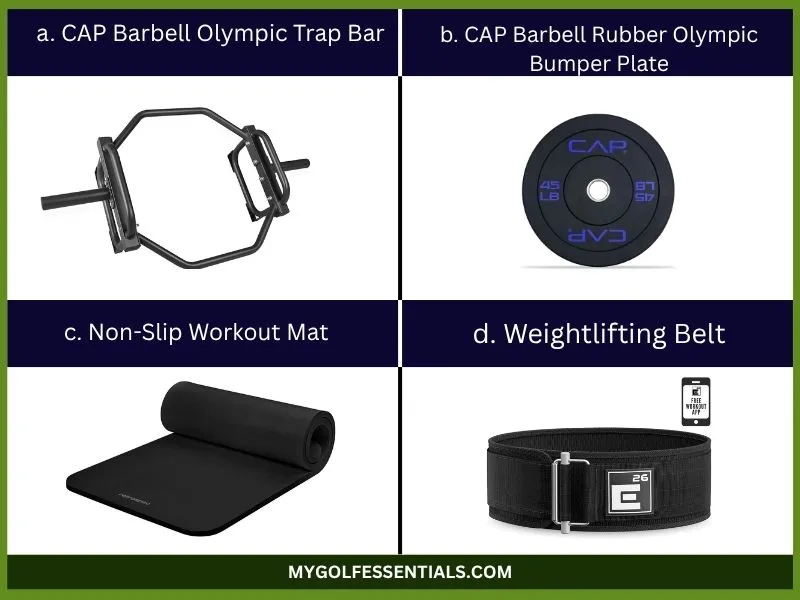
| Product | Why It’s Good | Check Out |
| CAP Barbell Olympic Trap Bar | Neutral grip design reduces lower back strain; ideal for building strength with good posture control. | Check Out on Amazon |
| CAP Barbell Rubber Olympic Bumper Plate | Durable and floor-safe; allows safe lifting and dropping during deadlift training. | Check Out on Amazon |
| Non-Slip Workout Mat | Protects your flooring and provides extra grip during setup and heavy lifts. | Check Out on Amazon |
| Weightlifting Belt | Offers lumbar support during heavy sets. Useful for golfers progressing to higher loads. | Check Out on Amazon |
Additional Equipment (Optional but Helpful)
These aren’t essential, but they can enhance your training experience:
- Lifting Straps – Helpful when grip strength limits your sets, especially with heavier weights.
- Foam Roller – Speeds up muscle recovery and keeps the hips and hamstrings mobile.
- Wall Mirror or Smartphone Camera – Great for checking deadlift form and posture.
- Flat Lifting Shoes or Barefoot Trainer – Improves ground contact and overall lift stability.
- Training Journal or App – Helps track your sets, reps, and weekly progress.
You don’t need a full gym to start deadlifting effectively. A trap bar, a couple of weight plates, and basic flooring protection are enough to begin building strength that translates directly to your golf game, from better posture to longer drives.
How to Add Deadlifts to Your Golf Fitness Routine
Adding deadlifts to your golf fitness plan doesn’t require a complete overhaul of your workout schedule.
Here, the key is to start with proper form, choose the right variation for your level, and gradually build strength without overtraining. Whether you’re an amateur or a seasoned golfer, deadlifts can fit seamlessly into your weekly routine.
Start with Proper Form and Lightweights
Before anything else, make sure your technique is dialed in. Good form reduces injury risk and ensures you’re actually working the muscles that matter for golf.
- Practice the hip-hinge pattern without weights using a dowel or resistance band.
- Start with light weights or even just a barbell to build confidence.
- Consider working with a coach or watching slow-motion video feedback for alignment and posture tips.
Frequency and Recommended Sets/Reps for Golfers
You don’t need to deadlift every day. Consistency and proper recovery matter more.
Frequency: 1–2 times per week is enough for most golfers.
Sets & Reps:
- Beginners: 3 sets of 8–10 reps (focus on form).
- Intermediate: 3–4 sets of 6–8 reps (moderate weight).
- Advanced: 4–5 sets of 3–5 reps (heavier for strength).
Adjust volume based on the intensity of your golf schedule and how you’re recovering.
Progressive Overload and Recovery
To get stronger, you’ll need to gradually increase the challenge, but smartly.
- Add small weight increments over time (2.5–5 kg at a time).
- Increase reps or sets only when form is perfect at the current level.
- Recovery matters: Always allow at least 48 hours between heavy deadlift sessions.
- Pair deadlifts with mobility drills and soft tissue work (foam rolling) to stay loose and mobile.
Tips for Beginners and Common Mistakes to Avoid
Getting started the right way sets you up for long-term success.
Tips:
- Warm up thoroughly before each session.
- Use mirrors or video to check your form.
- Stick to controlled reps. Don’t rush the movement.
Common Mistakes:
- Rounding the back during the lift.
- Letting the bar drift too far forward.
- Using too much weight too soon.
- Skipping warm-ups and mobility work.
Deadlifts don’t need to be intimidating. With the right approach, they become a powerful tool in your golf performance toolkit. This helps in building strength, stability, and resilience that pays off every time you swing.
Tips for Combining Deadlifts with Other Key Exercises
Deadlifts are a powerful cornerstone of any strength program. But to get the most out of your training for golf, they should be combined with other key exercises. A well-rounded routine builds total-body strength, stability, and mobility that directly supports your swing mechanics and injury prevention.
Focus on Full-Body Balance
While deadlifts primarily target the posterior chain (glutes, hamstrings, lower back), your program should also include exercises for other major movement patterns:
1. Squats – Develop leg power and core stability.
- Builds quad strength and hip drive, complementing the pulling motion of the deadlift.
2. Bench Press or Push-Ups – Strengthen the chest and arms.
- Supports upper body control during your swing and improves pushing mechanics.
3. Overhead Press – Improves shoulder strength and mobility.
- Helps stabilize the shoulders and upper back through your swing arc.
4. Rotational Core Exercises – Adds golf-specific rotational power.
- Use cable chops, Russian twists, or medicine ball throws to train your core in a golf-like motion.
Sample Weekly Golf Strength Training Split (2–3 Days)
Here’s how to combine deadlifts into a balanced weekly plan:
Day 1: Lower Body Focus
- Trap Bar Deadlift – 3 sets of 6
- Goblet Squat – 3 sets of 8
- Calf Raises – 3 sets of 15
- Plank – 3 x 30 seconds
Day 2: Upper Body + Core Focus
- Overhead Press – 3 sets of 6–8
- Dumbbell Row – 3 sets of 8
- Cable Woodchop – 3 sets of 12/side
- Bird Dog – 3 sets per side
Day 3: Power + Mobility (Optional)
- Romanian Deadlift – 3 sets of 8
- Jump Squats or Box Jumps – 3 sets of 5
- Medicine Ball Rotational Throws – 3 sets of 10
- Hip Mobility Drills + Foam Rolling
Don’t Skip Mobility and Recovery Work
Combining strength with flexibility keeps you efficient and injury-free:
- Include dynamic warm-ups (hip openers, leg swings, arm circles).
- Stretch key areas post-workout (hip flexors, hamstrings, thoracic spine).
- Foam roll regularly to support muscle recovery and mobility.
Rotate your main lifts throughout the season, trap bar deadlift during intense strength blocks, and Romanian deadlifts during lighter or in-season phases. This keeps your body fresh and continuously improving.
Safety and Injury Prevention
Deadlifts can be one of the best exercises for golfers, if done safely. The goal is to build strength without putting your body at risk, especially the lower back. Golf already places stress on your spine, hips, and shoulders, so your deadlift training should help protect those areas, not overload them.
Why Safety Comes First
Deadlifts involve multiple joints and muscle groups. If your form is off or your body isn’t ready, they can lead to injury. That’s why proper technique, smart programming, and recovery are just as important as the lift itself.
Key Safety Tips:
- Master the movement pattern first: Use bodyweight hip hinges or resistance bands to learn the motion before adding weight.
- Keep a neutral spine: A rounded back increases the risk of disc strain. Always maintain a flat back from start to finish.
- Don’t rush your progression: Start light, then build up weight slowly over weeks, not days.
- Engage your core: Brace your core as if you’re preparing for a punch. This helps protect your spine.
- Use correct equipment: Flat shoes, proper bar height, and maybe even a lifting belt can make a big difference.
Common Mistakes to Avoid:
- Lifting with your back instead of your hips.
- Using too much weight too soon.
- Skipping warm-ups or mobility work.
- Ignoring pain or discomfort during the lift.
- Lifting with poor control (jerking the bar up).
Signs You Need to Adjust Your Routine:
Pay attention to what your body tells you. These are red flags:
- Lingering lower back pain after sessions.
- Tight hips or stiff hamstrings that don’t improve.
- Grip fatigue affecting your golf performance.
- Struggling to maintain form after just a few reps.
If you notice these, try:
- Lowering the weight or volume.
- Switching to a gentler variation (e.g., trap bar or RDL).
- Taking more rest between workouts.
- Revisiting your technique with a coach or mirror
Work With a Professional if You’re New or Recovering
If you’re new to strength training or coming back from injury, it’s smart to consult:
- A golf fitness coach.
- A strength and conditioning specialist.
- Or a physiotherapist.
They can tailor your routine to your body and your swing goals, reducing risk while maximizing benefits.
Deadlifting should feel challenging but controlled. When done right, it becomes a reliable tool to strengthen your body, protect your joints, and keep you playing golf longer and stronger.
Final Thoughts: Is Doing Deadlifts Good For Golfers in 2025?
Yes, deadlifts are one of the best exercises a golfer can include in their fitness routine in 2025.
Whether you’re aiming to hit longer drives, improve your posture, or simply stay injury-free through the season, deadlifts deliver real performance benefits. They strengthen the glutes, hamstrings, core, and grip muscles that are critical for generating clubhead speed, maintaining balance through the swing, and building resilience over time.
More importantly, the deadlift mimics the same hip-hinge movement pattern used in a proper golf swing. With smart programming and the right variation, like Romanian or trap bar deadlifts, even beginners and older golfers can safely train this essential motion.
When paired with other strength and mobility exercises, deadlifts help you build a strong, athletic foundation that translates to better consistency, control, and confidence on the course.
So, if you’re serious about improving your game and protecting your body, deadlifts absolutely deserve a spot in your golf fitness plan.
Key Takeaways
- Deadlifts are highly effective for golfers – They build strength in key areas like the glutes, hamstrings, core, and lower back, all of which support your golf swing.
- Hip hinge mechanics improve swing posture – Practicing deadlifts helps golfers maintain better posture and avoid early extension during the swing.
- Deadlifts increase clubhead speed – By strengthening the lower body and core, deadlifts enhance ground force production, resulting in longer drives.
- Grip strength gets a boost – Holding a loaded bar improves forearm strength, which translates to better club control and wrist stability.
- Multiple variations suit different needs – Standard, Romanian, and trap bar deadlifts all offer unique benefits depending on your experience level and physical condition.
- RDLs and trap bar deadlifts are beginner-friendly – These variations are easier on the joints and great for golfers focusing on control, mobility, and safety.
- You only need to deadlift 1–2 times per week – A consistent, moderate approach delivers strength gains without overtraining.
- Deadlifts pair well with other lifts – Combine them with squats, presses, and rotational core exercises to build a balanced, golf-specific strength routine.
- Proper form is non-negotiable – Learning the right technique is key to avoiding injury and maximizing performance gains.
- You don’t need a full gym – With a trap bar, weight plates, a mat, and a few optional tools, you can safely train at home or in small spaces.
FAQs
Should golfers do regular or sumo deadlifts?
Both regular and sumo deadlifts can benefit golfers, but the choice depends on individual comfort and mobility. Some golfers may prefer sumo deadlifts for less strain on the lower back, while others benefit from the traditional stance.
How do deadlifts improve the golf swing?
Deadlifts build strength in the lower body and core, leading to increased swing power, stability, and injury resistance. The movement pattern of the deadlift also closely mimics the golf address position, reinforcing proper posture.
How can deadlifts help prevent golf injuries?
By strengthening the muscles that stabilize the spine and hips, deadlifts can reduce the risk of common golf injuries, especially lower back pain. Proper form and progression are key to maximizing benefits and minimizing risk.