
If you’ve ever struggled to keep your putter face square through impact, center shafted putters might be exactly what you need.
Center Shafted Putters: Benefits, Pros, and Cons Explained
 Written byJustin Wilcox, Founder and editorLast updated May 30, 2026
Some links in this review earn us a commission at no cost to you. It never changes what we recommend.
Most golfers grab a putter off the rack without thinking twice about shaft design. The position of the shaft changes everything from how the club balances to how it behaves during your stroke.
This guide covers what center shafted putters are, how they work, and whether one belongs in your bag. You’ll find the real benefits, the honest drawbacks, and a breakdown of who these putters actually help on the green.
What Is a Center Shafted Putter?
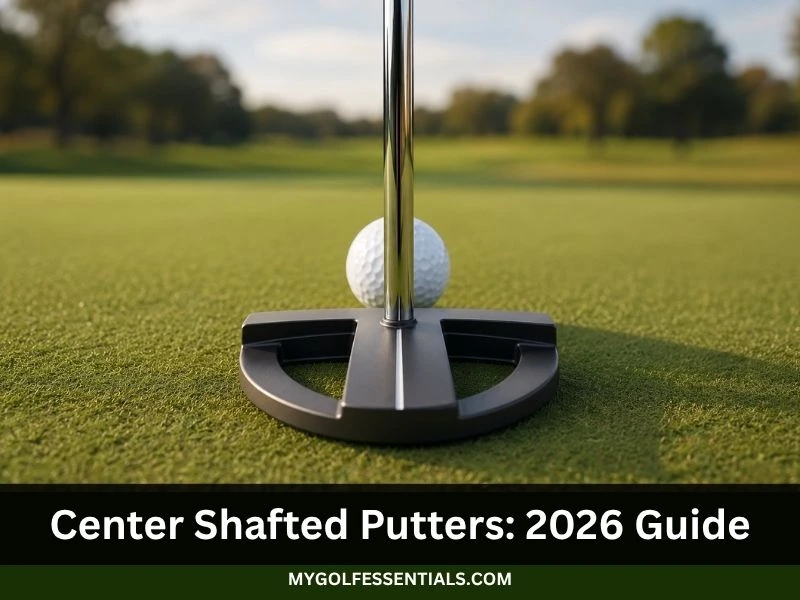
A center shafted putter connects the shaft to the middle of the putter head rather than the heel. That single design choice changes how the club balances, how it looks at address, and how it performs throughout your stroke.
At address, the shaft runs straight through the center of the clubhead. This creates a clean, symmetrical appearance that many golfers find naturally easier to aim. The shaft sits directly behind the ball, giving your eyes a clear visual reference line.
Center shafted putters come in two common head styles:
- Blade putters: Slim and traditional, preferred by players who want precise feedback and a classic look
- Mallet putters: Wider and heavier, offering more forgiveness and stability on off-center strikes
The Odyssey 2-Ball series is one of the most recognized examples, featuring prominent center shaft geometry. C-Groove line also uses this design to enhance alignment and roll. Both appeal to golfers who prioritize consistency over raw feel.
How Does a Center Shafted Putter Work?
Here’s the key mechanical principle: Center shafted putters are almost always face-balanced. To test this yourself, balance the shaft across your finger. A face-balanced putter will have its face pointing straight up toward the sky.
That face-balanced characteristic is the defining feature of center shafted putters. The face naturally resists opening and closing during your stroke. This resistance directly supports a straight back and straight through stroke path, where the putter moves along a single straight line rather than an arc.
Weight distributes evenly across the head because of where the shaft enters. That even distribution stabilizes the clubhead at impact and reduces twisting on off-center strikes. The result is a more predictable, consistent roll every time the face contacts the ball.
What Are the Benefits of Center Shafted Putters?
Center shafted putters deliver real advantages for the right player. Take a look at what this design does across the areas that actually affect your score on the green.
1. Better Face Balance
Face balance keeps the putter face square through the hitting zone. It reduces the natural tendency for the face to rotate open on the backswing and snap closed on the follow-through.
For golfers who miss putts consistently left or right, this matters enormously. The face-balanced design of center shafted putters acts as a built-in stabilizer. It won’t fix every flaw, but it removes face rotation as a variable in your stroke.
2. Improved Alignment at Address
The shaft running through the center of the head creates a natural visual reference at address. Your eyes follow the shaft straight down to the ball, making it easier to aim along your intended line.
Many golfers describe center shafted putters as looking more intuitive at address than traditional designs. The symmetrical setup reduces visual clutter. When alignment feels instinctive, you commit to your target with more confidence rather than second-guessing at the last second.
3. Stable Stroke Path for Straight Putters
Straight-stroke players gain the most from center shafted putters. The face-balanced head moves naturally along a straight path without resistance. Everything about the design supports linear motion.
Players who use heel-shafted putters with straight strokes often fight the club without realizing it. Heel-shafted designs carry toe hang, which nudges the face open and closed in an arc. Center shafted putters eliminate that unwanted influence from the equation entirely.
4. Consistent Roll Across the Face
Even weight distribution across the head produces a more stable impact. Off-center strikes roll more truly because the head doesn’t twist as severely on mishits. Over time, this consistency adds up to better distance control across the green.
Predictable roll builds confidence on the putting surface. When you trust the ball will behave as expected, your focus shifts to speed and line rather than mechanics. That mental shift alone improves performance for many golfers.
5. Simple Setup for Beginners
For new golfers, setup with center shafted putters is refreshingly straightforward. The shaft sits centrally, so there’s no guesswork about where your hands or the head should sit at address.
This simplicity speeds up your pre-putt routine. You step in, find the position quickly, and commit without overthinking. Beginners who overthink their setup tend to rush at impact. Center shafted putters remove one more reason to hesitate before stroking the putt.
What Are the Drawbacks of Center Shafted Putters?
Center shafted putters carry real limitations you should know before making a purchase decision.
Understanding these drawbacks helps you match the right tool to your game:
1. Not Ideal for Arc Strokes
This is the biggest drawback of center shafted putters. Golfers with a pronounced arc stroke, where the putter swings inside on the backswing and tracks back inside on the follow-through, will constantly fight the face-balanced design.
Face balance resists the rotation that arc strokes depend on. This creates tension in the stroke and forces compensations. Arc-stroke players need toe hang, which center shafted putters simply don’t provide.
2. Fewer Models Available
The center shafted putter market is noticeably smaller than the heel-shaft market. Most major manufacturers concentrate their product lines on heel-shafted designs because those cater to the larger arc-stroke population.
Fewer models mean fewer fitting options across length, lie angle, and head weight. You may need to compromise on one specification to secure another. If maximum selection matters to you, this design category does limit your choices.
3. Different Feel That Takes Adjustment
Expect an adjustment period if you’re switching from a heel-shafted putter. The balance point sits differently in your hands. The stroke may feel overly mechanical or stiff during your first few practice sessions.
Give the putter a fair trial on the practice green before drawing conclusions. Most golfers adapt within a few rounds once muscle memory adjusts. Never judge a new putter on its first 18 holes.
4. Limited Tour Use at the Highest Level
Tour professionals rarely use center shafted putters. The reasons are partly personal preference and partly stroke mechanics. Elite players commonly develop arc strokes through years of technical training, which makes heel-shafted designs the natural choice for their game.
That said, the rarity of center shafted putters on tour should not influence your decision. Amateur golfers don’t need to mirror tour choices. Your stroke type drives the right decision, not the equipment choices of professionals.
Center Shafted vs. Heel Shafted Putters: Which One Should You Choose?
This comparison comes down to one word: stroke. Everything else follows from how your putter naturally moves during your putting motion.
Here’s a breakdown of the most important differences between these two designs:
| Feature | Center Shafted Putter | Heel Shafted Putter |
| Shaft Position | Center of head | Heel of head |
| Balance Type | Face balanced | Toe hang |
| Best Stroke Type | Straight back, straight through | Arc stroke |
| Face Rotation | Resists rotation | Encourages rotation |
| Visual Alignment | Symmetrical, natural | Varies by design |
| Model Availability | Narrower selection | Wide selection |
| Tour Popularity | Rarely used | Dominant choice |
Heel-shafted putters carry more toe hang. When you balance the shaft freely, the toe drops down. That built-in weight distribution promotes face rotation through an arc stroke. Center shafted putters fight that rotation.
For arc-stroke players, that resistance creates inconsistency. For straight-stroke players, that same resistance is a performance advantage. Neither design is objectively superior. Both serve specific stroke types well.
Get a putting fitting if you’re unsure which stroke you have. Even a short 15-minute session on a putting board reveals whether you need face balance or toe hang. Matching your design to your stroke matters far more than brand loyalty or price point.
Who Should Use a Center Shafted Putter?
Center shafted putters suit a specific player profile. You’re a strong candidate if any of these descriptions apply to you:
- You putt with a straight back and straight through stroke
- You miss putts consistently in one direction, pushing or pulling them off line
- Alignment gives you trouble and you need a clear visual reference at address
- You’re new to golf and want a forgiving, easy-to-set-up design
- You prefer mallet-style putters, which frequently use center shaft geometry
- You’ve tried face-balanced putters before and found them comfortable
Did You Know? Face-balanced putters perform best when paired with a minimal-arc putting stroke. Matching your putter type to your actual stroke pattern can reduce three-putts immediately. A basic fitting at your local pro shop takes minutes and can save you shots in every round.
Who Should Avoid Center Shafted Putters?
Not every golfer gains from this design. Skip center shafted putters if these descriptions match your game:
- You use a strong arc stroke with natural face rotation through impact
- You rely on toe hang to feel the clubhead throughout the stroke
- Your current heel-shafted putter is working well and your putting stats are solid
- You want access to the widest possible range of models and fitting options
- You’ve tested face-balanced putters before and found them restrictive or unnatural
What Should You Look for When Buying a Center Shafted Putter?
Shopping for center shafted putters involves more than picking the one with the best paint job. Focus on these factors to find the right fit for your game and your stroke.
1. Head Design: Blade vs. Mallet
Blades offer a compact profile with greater feedback on impact. They suit players who want to feel exactly where they struck the ball. Mallets give you more forgiveness and a larger alignment surface across the top of the head.
Center shafted mallets tend to be especially popular because the geometry works naturally with the wider, symmetrical mallet shape. If you’re new to this style, a mallet is often the easier starting point.
2. Length and Lie Angle
Putter length affects your posture and eye position over the ball. Standard putters range from 33 to 35 inches. At address, your eyes should sit directly over or just inside the ball. Incorrect length forces compensations in your posture that affect your stroke path.
Lie angle determines how flat the sole sits on the putting surface. A lie angle that’s too upright or too flat tilts the face and skews your aim. Always confirm lie angle during a proper fitting.
3. Grip Type and Size
Grip size changes how much your wrists contribute to the stroke. Thicker grips reduce wrist action and benefit players who tend to be overly wristy through impact. Standard grips give more feel and tactile feedback. Pistol grips fall somewhere between the two.
Test a few grip styles before committing. The grip is the only part of the putter your hands touch, so it directly shapes how the stroke feels.
4. Alignment Aids
Look for clear, prominent lines or markings across the top of the head. Strong alignment aids speed up your setup and reduce aim uncertainty before every putt. Many center shafted putters feature bold alignment lines because the design philosophy already prioritizes visual setup.
5. Feel and Overall Balance
Roll the putter in your hands at the shop. Does the weight feel right? Does it settle comfortably at address? No specification beats the feeling of a putter you genuinely want to practice with. Personal preference drives consistency, and consistency drives lower scores.
What Mistakes Should You Avoid When Choosing a Putter?
Many golfers repeat the same costly errors when selecting a putter. Watch out for these traps before you spend your money:
- Buying on looks alone. A beautiful putter that fights your stroke will cost you shots round after round.
- Ignoring your stroke type. This is the most critical factor in putter selection. Know whether you have a straight or arc stroke before you walk into the shop.
- Skipping a fitting. Even a short session gives you the data to make a smart decision.
- Not testing on real turf. Shop carpet and actual greens behave completely differently.
- Getting the wrong length. A putter even one inch too long or too short forces awkward posture adjustments that hurt your stroke path.
- Following tour preferences. What works for professionals may not match your stroke or skill level at all.
Final Thoughts
Center shafted putters are a genuine game-changer for the right player. If your stroke travels straight back and straight through, the face-balanced design works with your motion rather than against it.
The mechanics are sound. The face stays square. Alignment feels intuitive. The roll stays consistent. These are real performance advantages backed by physics, not marketing copy.
That said, center shafted putters are not a universal fix. Arc-stroke players will fight the design, and the limited product range narrows your fitting options.
Choose your putter based on your stroke. Get a fitting if you can. Always test on a practice green before buying. The best putter is the one that matches how you naturally move, not the one that looks sharpest in the bag.
Key Takeaways
- Center shafted putters connect the shaft at the center of the head, producing a face-balanced design
- Face balance keeps the putter face square through impact and reduces unwanted rotation
- Golfers with a straight back and straight through stroke benefit most from this design
- The centered shaft creates a natural visual reference that improves alignment at address
- Arc-stroke players often fight the face-balanced nature of center shafted putters
- Fewer models exist compared to heel-shafted designs, which limits your fitting options
- Tour professionals rarely use center shafted putters, but your stroke type matters more than tour trends
- Length, lie angle, grip size, and head design all require proper fitting before you buy
- Always test a putter on a real practice green before making your final purchase
FAQs
Are center shafted putters legal for tournament play?
Yes, center shafted putters are completely legal under USGA and R&A rules. Golf regulations govern shaft angle and overall length, not where the shaft connects to the head. You can use one in any amateur or professional event without restriction or penalty of any kind.
How do I know if I have a straight or arc putting stroke?
The easiest way is to use a putting mirror or see a fitter. If your putter swings naturally inside on the takeaway and returns inside on the follow-through, you have an arc stroke. Minimal face rotation with a straight path signals a straight stroke. Most pro shops can assess this in minutes.
Why are center shafted putters less popular than heel-shafted designs?
Most golfers naturally develop arc strokes, and heel-shafted putters support those strokes better. The putter market reflects that majority. Heel-shafted designs dominate tour play and retail shelves because they match the most common stroke pattern among golfers at every level.