
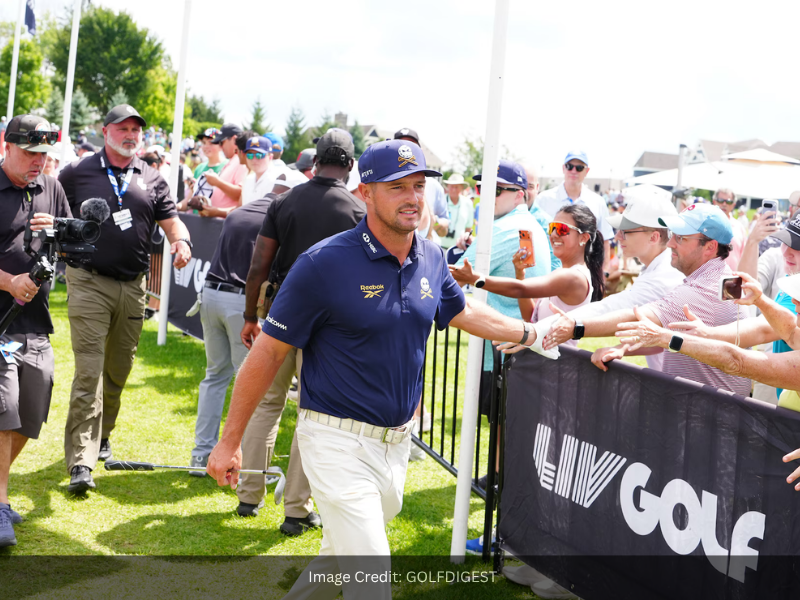
The 2026 LIV Golf season ended in Indianapolis with a result that seemed almost secondary to the bigger question surrounding the league: what comes next?
Michael La Sasso delivered the biggest victory of his young professional career on Sunday, holding off a field that included Jon Rahm and Bryson DeChambeau to win LIV Golf Indianapolis at The Club at Chatham Hills. The 22-year-old HyFlyers GC player closed with a five-under 65 to finish at 18 under and claim his first professional title.
But behind the celebrations was an uncomfortable reality. What had originally been scheduled as the penultimate LIV tournament of the year suddenly became the league’s effective season finale after its planned team championship in Michigan was canceled. The abrupt change has intensified speculation about the LIV Golf and whether the competition can continue in anything resembling its current form.
A season that ended unexpectedly
The cancellation of the Michigan event was a major warning sign. LIV had originally planned to stage its $40 million team championship from August 27-30, but the organization announced that the tournament would no longer take place.
The decision followed months of uncertainty after Saudi Arabia’s Public Investment Fund, which had provided the financial foundation for LIV Golf since its launch, stopped future investment earlier in 2026. LIV Golf has said it has secured a new lead investor and intends to continue operating, but the transition has left the organization facing major financial and structural questions.
That uncertainty was visible in Indianapolis. The event was hastily transformed into a season-ending tournament, while some of the entertainment elements associated with LIV’s high-profile events were reduced or removed.
For a league that originally marketed itself as a revolutionary alternative to traditional professional golf, the contrast was striking.
Rahm wins the season, La Sasso steals the spotlight
Of course, Jon Rahm remained the dominant figure of the 2026 campaign.
Rahm secured his third consecutive individual season championship, reinforcing his position as one of the league’s most successful players since joining LIV. His Legion XIII team also won the Indianapolis team competition, finishing at 44 under and successfully defending its team title.
Yet La Sasso’s victory provided the defining moment of the weekend.
The rookie’s performance against established stars gave LIV a glimpse of the competitive future it hoped to build. His victory was also significant because it arrived at a moment when the league’s institutional future is considerably less certain than its sporting product.
That distinction could become increasingly important. If LIV survives, it will have to demonstrate that its appeal extends beyond the enormous contracts and guaranteed financial incentives that helped attract established stars from the PGA Tour.
The money problem
Money has always been central to the LIV Golf story, and it is now at the heart of the league’s uncertainty.
Reports indicate that LIV is seeking substantial new investment as it attempts to operate without the same level of Saudi backing. CEO Scott O’Neil has discussed a potential structure in which players could hold meaningful equity in the organization, rather than relying solely on the guaranteed payments that helped persuade stars to leave traditional tours.
That creates a difficult proposition.
Players who joined LIV were attracted in part by financial certainty. Moving toward an ownership-based model could offer significant long-term rewards, but it also transfers more risk to the golfers themselves.
For some of the league’s biggest names, that could make the LIV Golf considerably harder to navigate.
What happens to the stars?
Rahm’s position is particularly important. The Spaniard has repeatedly been one of LIV Golf’s most prominent faces, but questions about his future have intensified as the league’s financial situation has changed. His comments after Indianapolis have fueled further speculation about whether he believes the original mission of LIV has been accomplished.
DeChambeau has also acknowledged the challenges facing the organization. Despite his continued support, he has admitted that LIV has significant obstacles ahead.
Meanwhile, the PGA Tour remains a potential destination for players who could eventually decide that the changing economics of LIV no longer justify remaining outside traditional professional golf.
That does not necessarily mean an immediate mass exodus. Contracts, eligibility rules, penalties and negotiations could all shape what happens next.
A complicated legacy
Whatever happens next, LIV has already changed professional golf.
Its arrival forced the PGA Tour to confront player compensation, scheduling, media rights and the value of its biggest stars. It also created a fractured competitive landscape that divided players and fans and produced years of hostility between LIV and established golf organizations.
The question now is whether that disruption can evolve into a sustainable business.
The LIV Golf may depend less on another blockbuster signing than on whether the league can build a viable financial model, retain its leading players and establish a meaningful place within professional golf’s broader ecosystem.
Indianapolis therefore felt less like a conventional season finale than the end of one chapter.
La Sasso’s victory offered a reason to celebrate. Rahm’s championship confirmed the quality at the top. But beyond the final leaderboard, the sport is waiting to discover whether LIV’s next chapter will be a revival, a dramatically smaller operation or the beginning of its final days.
For a league built around challenging golf’s established order, its greatest challenge may now be simply surviving long enough to define its own legacy.