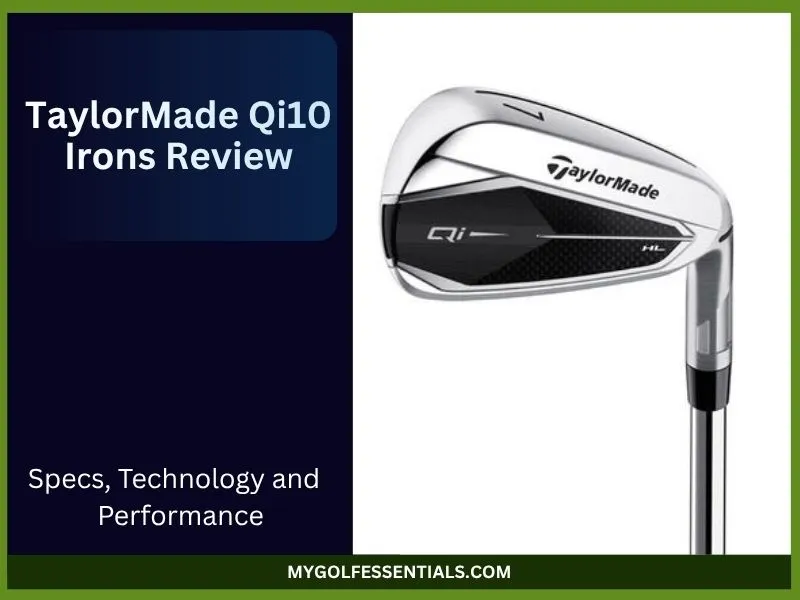
Most golfers miss shots to the right. They lose yards on thin strikes and search for one iron that fights all of that at once. TaylorMade Qi10 irons launched in early 2024 with a direct promise: the straightest distance irons in golf. That is a bold claim.
When independent testing, tour feedback, and real-player data all point in the same direction, it becomes hard to ignore. This review breaks down the technology, performance numbers, and honest trade-offs so you can decide whether these irons belong in your bag.
What Are the TaylorMade Qi10 Irons?
The TaylorMade Qi10 irons are a game improvement iron, released at retail in February 2024. They replaced the Stealth irons, one of TaylorMade’s best-selling models, and sit firmly at the forgiving end of TaylorMade’s iron lineup. The Qi10 name connects these irons to the full Qi10 family of woods, hybrids, and drivers launched at the same time.
A game improvement iron is a club category built for forgiveness and ease of launch. Larger clubheads, bigger sweet spots, and hollow body designs help golfers hit the ball farther and straighter with less-than-perfect strikes. The TaylorMade Qi10 irons push that concept further with five integrated technologies working across the full set.
What Technology Makes the Qi10 Irons So Forgiving?
These technologies do not work in isolation. TaylorMade calls this Integrated System Design, meaning the face, sole, and weight distribution all work together.
Below is a breakdown of each one:
1. Cap Back Construction
Cap Back construction replaces the traditional rear cavity badge with a lightweight carbon panel. This design merges the ball speed benefits of a hollow iron with the feel of a cavity back. Removing mass from the rear and redistributing it lowers the center of gravity for better launch. It also removes the hard badge that kills feel on off-center hits.
2. FLTD CG Technology
FLTD stands for Flighted Center of Gravity, a technology borrowed directly from TaylorMade’s popular P790 irons. The CG sits lowest in the long irons to help the ball launch easily into the air. As you move through the set into shorter irons, the CG progressively rises for better control and stopping power on approach shots. Your 6-iron goes high and far, while your pitching wedge bites and holds.
3. Speed Pocket Technology
The Speed Pocket runs along the sole of the 4 through 8-irons. It flexes at impact to protect ball speed on low-face strikes. Without it, a thin shot loses serious distance. With it, you recover most of your speed even when you catch it below center. TaylorMade has refined this feature across multiple generations, and it remains one of their most proven performance technologies.
4. HYBRAR Echo Dampers
The HYBRAR Echo Dampers sit behind the face in the 4 through 9-irons. Each damper uses ribbed structures matched specifically to the face shape and size of that individual iron.
They absorb vibrations on mishits without cutting into face flex or ball speed. The result is a controlled, clean sound at impact rather than the hollow clang common in older game improvement irons.
5. Organic Face Design
TaylorMade engineered the face thickness of each iron differently based on how that club gets used. This organic face approach adjusts flex zones across the face to reduce gear effect, the twisting spin that pushes shots offline. Thinner sections near the toe and heel help deliver a straighter ball flight even on off-center strikes.
What Are the Full Specs of the TaylorMade Qi10 Irons?
Before buying any iron set, checking the specs is important. The details below come from TaylorMade’s official product information and verified retailer data.
Set Configuration and Price:
- Standard set: 5-iron through PW and SW (7-piece)
- Extended availability: 4-iron through AW
- Steel set price: $1,099
- Graphite set price: $1,199
Stock Shaft Options:
- Steel: KBS Max MT 85 (Regular and Stiff flex)
- Graphite: Fujikura Ventus Blue (Senior, Regular, and Stiff flex)
- Women’s graphite: Fujikura Speeder NX TCS 40
Loft Chart (Confirmed Specifications):
| Club | Loft |
| 6-iron | 24° |
| 7-iron | 28° |
| 8-iron | 32° |
| 9-iron | 37° |
| Pitching Wedge | 43° |
| Approach Wedge | 49° |
| Sand Wedge | 54° |
These are strong lofts. A traditional 7-iron sits around 31 to 34 degrees. The Qi10’s 7-iron at 28 degrees plays closer to what a 5-iron used to be. That strong lofting drives the impressive distance numbers, but it also means you need to rethink your wedge gapping.
How Do the TaylorMade Qi10 Irons Perform on the Course?
Performance is what separates a good iron from a great one. The Qi10 irons deliver across several key categories, though a few areas show real trade-offs worth knowing before you buy.
1. Distance
Distance is the Qi10’s standout strength. Strong lofts combine with fast ball speeds to produce big carry numbers, and independent testing consistently places these irons among the longest game improvement irons of 2024.
One tester at Plugged In Golf reported his 8-iron carrying 15 yards farther than his previous 7-iron gamer. Consistent gapping throughout the set comes from TaylorMade’s Integrated System Design, which tunes each head individually for ideal yardage gaps.
2. Forgiveness
Mishits stay noticeably straighter than most irons in this category. The organic face geometry cuts down on gear effect, and the Speed Pocket protects ball speed on low-face contact.
That said, independent testing shows the Qi10 is not the most forgiving game improvement iron available. Options like the Ping G430 deliver more consistent shot outcomes across the full face. The Qi10 is forgiving, but distance and accuracy are where it truly leads.
3. Accuracy
Shot dispersion is one of the Qi10’s clearest strengths. TaylorMade designed these irons with a subtle draw bias specifically to counter the natural fade tendency of large game improvement irons.
Most oversized clubheads push the CG further from the shaft, making the face harder to close. The Qi10 corrects that. If you fight a slice or a persistent fade, you will notice a real difference in your shot shape.
4. Feel and Sound
The feel lands on the firmer, clickier side of the spectrum. The HYBRAR Echo Dampers reduce the hollow vibration common in hollow-body irons, but the overall impression still leans toward crisp rather than soft.
If you prefer the buttery feedback of a forged iron, these will not fully satisfy. For golfers who prioritize performance over feel, the trade-off is worth it.
5. Launch and Ball Flight
The Qi10 irons launch on a penetrating, mid-to-low trajectory. The FLTD CG gives you solid height in the long irons and control in the scoring clubs. Ball flight is lower than some competitors, which means less spin and less stopping power on firm greens.
Reviewers at Plugged In Golf noted the mid-low spin made it harder to hold approach shots. If you already hit the ball too high with too much spin, this flight profile is a game-changer. If you struggle to get the ball airborne, the standard Qi10 may not be your best fit.
Who Should Play TaylorMade Qi10 Irons?
These irons suit a specific player profile. You will get the most out of TaylorMade Qi10 irons if you fall into one of these groups:
- Your handicap sits between 12 and 28
- You consistently miss shots right (fade or slice)
- You swing a 7-iron above 75mph
- You want maximum distance from a game improvement iron
- You value straight, consistent ball flights over shot-shaping ability
Mid-handicappers who want to pick up yards without switching to a players iron will find these genuinely rewarding. Beginners with developing swings who need a forgiving, high-distance club also fit the target profile well.
Who Should Avoid TaylorMade Qi10 Irons?
Not every golfer fits what these irons do best. Skip the TaylorMade Qi10 irons if any of these describe your game:
- Your handicap sits below 10
- You shape shots intentionally and need workability
- You want a compact, clean look at address
- You prioritize soft, forged-style feedback over raw performance
- You need maximum forgiveness as your single top priority
Low handicappers will find the strong lofts disrupt wedge gapping and the bulkier profile limits their ability to flight and shape the ball. Better players tend to gravitate toward TaylorMade’s P-series irons, which deliver superior feel and workability in a more compact head.
How Do the Qi10 Irons Compare to the Competition?
Head-to-head comparisons reveal where TaylorMade Qi10 irons genuinely lead and where the alternatives close the gap. Below is a look at three key competitors:
Qi10 vs. TaylorMade Stealth Irons
The Qi10 improves on the Stealth in nearly every measurable way. The sweet spot grew 13.9% from the Stealth to the Qi10. The HYBRAR Echo Dampers are entirely new to this generation and bring a noticeable feel upgrade. FLTD CG now runs across the full set with more precise tuning than the Stealth offered.
Distance gains from Stealth to Qi10 are incremental rather than dramatic. If you already play the Stealth well, the upgrade is not urgent. For any new purchase, however, the Qi10 is clearly the stronger iron.
Qi10 vs. Callaway Paradym Irons
Both irons use hollow body construction to maximize ball speed and forgiveness. The Paradym produces a higher, softer ball flight with more spin, which means stronger stopping power on approach shots. The Qi10 hits lower and harder with less spin.
Golfers who struggle to hold greens lean toward the Paradym. Those who prioritize raw carry distance and a penetrating flight lean toward the Qi10. Feel is another factor, as the Paradym tends to produce a softer, more muted impact sensation than the Qi10’s firmer feedback.
Qi10 vs. Ping G430 Irons
This is the most direct battle in the 2024 game improvement category. According to MyGolfSpy’s independent testing, the Qi10 ranked 3rd for distance and 5th for accuracy, while the Ping G430 ranked 16th for distance but climbed to 5th for forgiveness.
Golf Monthly also noted the G430’s 7-iron at 29 degrees creates more spin and better green-holding ability than the Qi10’s 28-degree version. Choose the Qi10 for distance and draw bias. Choose the G430 for forgiveness and stopping power.
Pros and Cons of the TaylorMade Qi10 Irons
Pros
- Ranks 3rd for distance among 2024 game improvement irons
- Subtle draw bias fights slices and persistent fades
- Sweet spot grew 13.9% over the previous Stealth model
- Integrated System Design produces consistent gapping throughout the set
- Clean, minimal aesthetic with a carbon cap back design
- Multiple shaft options cover a wide range of swing profiles
Cons
- Firm, clicky feel at impact is not for soft-feel lovers
- Strong lofts require adjustment to existing wedge gapping
- Ranks only 13th for forgiveness in independent testing
- Lower ball flight with less spin reduces green-holding ability on firm surfaces
- Bulkier head profile limits workability for better players
Are TaylorMade Qi10 Irons Worth the Price?
At $900-$1,099 for a steel set, the TaylorMade Qi10 irons sit in the premium game improvement bracket, competing directly with the Ping G430 and Callaway Paradym. For mid-to-high handicappers who want one of the longest and most accurate game improvement irons of 2024, the value case is strong.
The distance gains alone can shift your scoring clubs down by a club or more on approach shots, and the draw-biased design actively helps golfers who have struggled with left-to-right misses for years.
Value ultimately depends on what you need most. If maximum forgiveness is your top priority, the Ping G430 at a similar price point is worth a close look. If you want the most distance and the straightest ball flight available in a 2024 game improvement iron, the TaylorMade Qi10 irons deserve serious consideration.
Final Thoughts
The TaylorMade Qi10 irons do exactly what they were built to do. They hit the ball far, they keep it straighter than most game improvement irons, and they back that up with five technologies that genuinely work together.
For mid-to-high handicappers who have been fighting a fade, losing yards on mishits, or simply outgrowing their old set, these irons are a serious upgrade worth the investment.
That said, they are not the right iron for every golfer. The firm feel will divide opinions, the strong lofts demand a wedge gapping rethink, and golfers who need maximum forgiveness above everything else should give the Ping G430 a serious look before committing. If you fit the target profile though, the Qi10 irons are one of the strongest game improvement options of 2024 and well worth a fitting session to find out.
Key Takeaways
- Released in February 2024, replacing the TaylorMade Stealth irons
- Built specifically for mid-to-high handicappers in the 12 to 28 handicap range
- Ranked 3rd for distance among 2024 game improvement irons in MyGolfSpy testing
- Subtle draw bias actively fights fades and slices
- Sweet spot grew 13.9% over the previous Stealth model
- Five technologies work together: Cap Back, FLTD CG, Speed Pocket, HYBRAR Dampers, and Organic Face Design
- Strong lofts (7-iron at 28 degrees) require a wedge gapping rethink before buying
- Feel is firm and crisp, not suited for golfers who prefer soft, forged feedback
- Ping G430 beats it for forgiveness; Qi10 wins on distance and accuracy
- Steel set starts at $1,099, solid value if distance and straighter shots are your top priorities
FAQs
Are TaylorMade Qi10 Irons Good for High Handicappers?
Yes, TaylorMade Qi10 irons suit high handicappers well. The large sweet spot, draw-biased ball flight, and Speed Pocket technology forgive off-center strikes and help golfers keep the ball in play. Slower swingers below 75mph with a 7-iron may gain even more from the lighter, higher-launching Qi HL version, which carries weaker lofts for better height and spin.
How Do TaylorMade Qi10 Irons Compare to Other Game Improvement Irons?
TaylorMade Qi10 irons rank among the top options for distance and accuracy in the game improvement category. In 2024 independent testing by MyGolfSpy, they ranked 3rd for distance and 5th for accuracy. For forgiveness specifically, the Ping G430 outperforms them, finishing 5th versus the Qi10’s 13th. Golfers should prioritize the Qi10 for distance and the G430 for consistency.
Do Qi10 Irons Go Farther Than Stealth Irons?
The TaylorMade Qi10 irons produce incremental distance gains over the Stealth model. The sweet spot grew by 13.9%, the Integrated System Design improves gapping, and the refined Speed Pocket boosts ball speed on mishits. The gap is not dramatic but it is real. Golfers upgrading from Stealth irons will find measurable improvement in both distance and accuracy.