Distance loss, back pain, and late-round fatigue are not swing problems. They are strength problems. Many golfers focus only on technique while ignoring the physical power and stability required to swing efficiently. Without strength training, even good mechanics begin to break down, costing you distance and consistency.
Simple strength training at home for golfers solves this issue. You do not need a gym, machines, or heavy weights to build golf-specific strength. This guide shows you the best home workouts, how to structure your training, and bodyweight options that fit any schedule.
Why Golfers Need Strength Training
Strength training is a key component of improving your golf game. While technique and practice matter, having the right muscle strength, stability, and flexibility can make a noticeable difference in performance and injury prevention.
Key Benefits of Strength Training for Golfers:
- Increase Swing Power – Stronger core, legs, and upper body muscles help generate more clubhead speed, leading to longer drives.
- Improve Stability and Balance – Golf requires controlled rotation and weight transfer. Strength training improves balance and reduces the chance of off-center shots.
- Enhance Endurance – Walking 18 holes while maintaining focus and consistent swings demands stamina, which strength training helps build.
- Prevent Injuries – Strengthening muscles around the shoulders, back, and hips reduces stress on joints, lowering the risk of strains or overuse injuries.
- Boost Consistency – Stronger, more stable muscles allow for more repeatable swings, improving both accuracy and scoring.
Even a few targeted strength exercises per week can transform your golf performance, helping you hit farther, swing smoother, and play smarter.
Additional Benefits
- Core stability for spine protection during rotation
- Hip power for swing speed
- Rotational strength for club control
- Shoulder stability to prevent injury
- Leg strength for power transfer
You can build all of this at home. No gym required. Just 20-30 minutes, three times per week.
Without strength training, three problems show up:
- Weak muscles can’t generate clubhead speed.
- You lose 20-30 yards off the tee.
- Your tired body falls apart on the back nine and poor form leads to injuries.
How Can I Do Strength Training at Home
Starting is simple. You need space, time, and the right exercises.
Space Requirements: Clear a 6×6 foot area. Your living room works. A bedroom works. You need enough room to lie down and move your arms.
Time Commitment: Start with 20 minutes, three times per week. Golf-specific training uses compound movements that work multiple muscles at once.
Equipment (Optional):
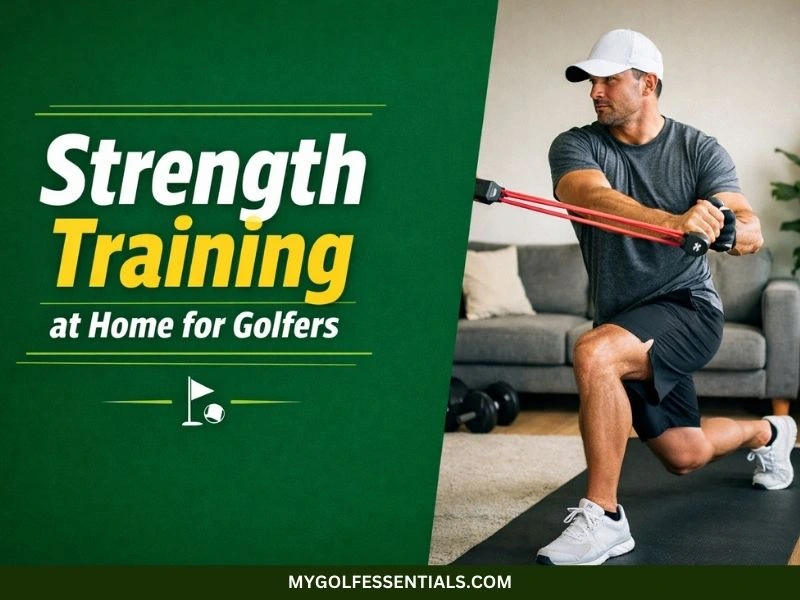
- Resistance bands – for rotational exercises
- Dumbbells – 10-25 lbs depending on strength
- Stability ball – for core work
- Yoga mat – makes floor exercises comfortable
You can build serious strength with zero equipment. Bodyweight exercises like planks, squats, and lunges work perfectly.
Basic Setup: Pick your workout days. Most golfers train Monday, Wednesday, Friday. This allows recovery between sessions. Choose 6-8 exercises targeting your core, legs, and upper body. Do each exercise for 30-60 seconds or 10-15 reps.
Getting Started Tips:
Start lighter than you think. Focus on perfect form first. A proper bodyweight squat beats a sloppy weighted squat.
Track your workouts. Write down exercises and reps. This helps you progress and stay motivated.
What Are the Best Strength Training at Home for Golfers
These exercises target the exact muscles your golf swing uses. Use all 10 exercises and rotate them through your workouts. Each movement builds specific aspects of your swing power, stability, or injury prevention.
Core Exercises
1. Standard Plank
Builds core stability that keeps your spine protected during rotation. Prevents lower back pain and maintains posture through 18 holes.
Start on your forearms and toes with elbows directly under shoulders. Form a straight line from head to heels. Squeeze your glutes and engage your core. Don’t let hips sag or pike up.
Hold 30-60 seconds. Do 3 sets with 30 seconds rest between.
2. Side Plank
Strengthens obliques that control rotational speed. Improves lateral stability during weight transfer.
Lie on your right side and prop up on your right forearm. Stack your feet and lift hips off the ground. Create a straight line from head to feet with your top shoulder pulled back.
Hold 30 seconds, then switch sides. Do 3 sets per side.
3. Bird Dogs
Trains coordination between opposite limbs, exactly like your golf swing. Builds spinal stability and balance.
Start on hands and knees with back flat and core tight. Extend right arm straight forward and left leg straight back simultaneously. Keep hips level without rotating.
Hold 3 seconds at full extension, return to start, and switch sides. Complete 12 reps per side for 3 sets.
4. Russian Twists
Develops rotational power in your obliques. Mimics the twisting motion of your golf swing.
Sit with knees bent and lean back slightly (about 45 degrees). Lift feet 2-3 inches off the ground. Hold hands together at chest level. Rotate torso to the right and touch the floor beside your hip. Rotate left and touch the other side. Complete 20 total twists for 3 sets.
Lower Body Exercises
5. Bodyweight Squats
Builds leg strength that creates ground force in your swing. Stronger legs mean more power transfer from the ground through your body to the club.
Stand with feet shoulder-width apart and toes slightly pointed out. Push your hips back and bend your knees to lower down. Keep your chest up and weight in your heels.
Drive through heels to stand back up. Do 15-20 reps for 3 sets.
6. Reverse Lunges
Develops single-leg strength for better weight transfer during your swing. Improves balance and stability through impact.
Stand tall with feet together. Step your right foot back about 2-3 feet. Lower down until both knees bend to 90 degrees.
Push through your left heel to return to standing. Complete 12 lunges per leg for 3 sets.
7. Glute Bridges
Activates glutes that create powerful hip rotation. Strong glutes generate clubhead speed and prevent the “all arms” swing.
Lie on your back with knees bent and feet flat on the floor hip-width apart. Drive through your heels and lift hips toward the ceiling. Squeeze your glutes hard at the top.
Hold 1 second at the top, then lower slowly. Complete 20 reps for 3 sets.
Upper Body Exercises
8. Push-Ups
Builds chest and shoulder strength for swing control. Engages your core, making it a full-body exercise that improves overall stability.
Start in plank position with hands slightly wider than shoulders. Keep your body straight from head to heels. Lower yourself until chest nearly touches the ground.
Push back up to starting position. Complete 10-15 reps for 3 sets. Drop to your knees if standard push-ups are too difficult.
9. Resistance Band Rows
Strengthens upper back and shoulder stabilizers that support a consistent swing plane. Improves posture and prevents slouching.
Secure a resistance band at chest height (or loop a towel around a sturdy pole). Hold both ends and step back until there’s tension. Pull the band toward your chest while squeezing your shoulder blades together.
Slowly extend arms back to start. Do 12-15 reps for 3 sets.
Rotational Exercises
10. Standing Torso Rotations
Trains the exact rotational movement pattern of your golf swing. Improves core control and rotational speed.
Stand with feet shoulder-width apart and knees slightly bent. Hold your hands together at chest level with elbows bent. Rotate your torso fully to the right while keeping your hips stable.
Return to center, then rotate fully to the left. Complete 15 rotations per side for 3 sets.
These 10 strength training workouts at home give you everything you need. Start with bodyweight versions and add light resistance after 4-6 weeks.
What Equipment Do I Need for Strength Training at Home?
The beauty of home training is how little you actually need. Strength training at home without equipment starts with just your body.
Bodyweight exercises like squats, planks, and push-ups build significant strength for beginners. You can train for months using only your bodyweight before needing any tools.
When You’re Ready to Add Equipment:
Start simple. Don’t buy everything at once.
Week 1-4: Nothing
Use only bodyweight. Master the movement patterns before adding resistance.
Week 5-8: Resistance Bands
Bands add rotational resistance that mimics your golf swing. They’re compact and travel-friendly. Get a set with 3-4 resistance levels.
Week 9-12: Basic Dumbbells
Start with 10-20 lbs depending on your strength. Use them for goblet squats, rows, and overhead work.
Optional Additions:
- Yoga mat – Makes floor exercises comfortable
- Stability ball – Adds challenge to core work
- Doorway pull-up bar – Expands exercise options
Household Substitutes:
A backpack filled with books works for squats. Milk jugs filled with water replace dumbbells. A sturdy chair handles step-ups and tricep dips.
Skip fancy machines, kettlebells, and barbells for home golf training. They’re expensive and unnecessary. Simple equipment delivers better results for golf-specific movements.
How to Create Your Golf Strength Training Program
Use all 10 exercises from the workout section. Train 3 times per week. Rest at least one day between sessions.
Sets and Reps:
Do 2-3 sets of 10-15 reps for each exercise. Rest 60 seconds between sets. This builds strength without excessive fatigue. Quality over quantity always wins.
Sample Weekly Schedule:
Monday:
- Bodyweight Squats – 3×15
- Standard Push-Ups – 3×10
- Bird Dogs – 3×10 per side
- Standing Torso Rotations – 3×15 per side
- Standard Plank – 3×45 seconds
Wednesday:
- Reverse Lunges – 3×12 per leg
- Resistance Band Rows – 3×12
- Russian Twists – 3×20
- Glute Bridges – 3×20
- Side Planks – 3×30 seconds per side
Friday:
- Bodyweight Squats – 3×15
- Standard Push-Ups – 3×10
- Bird Dogs – 3×10 per side
- Standing Torso Rotations – 3×15 per side
- Glute Bridges – 3×20
Each session takes 20-25 minutes including warm-up. This fits into any schedule.
Progression:
Stick with the same exercises for 3-4 weeks. Then add 2-3 more reps per set. After 8 weeks, add light resistance bands or dumbbells. Increase difficulty gradually.
Write down your workouts. Track exercises and reps completed. This keeps you accountable and shows progress.
That’s it. Simple exercises, consistent schedule, steady results.
What Strength Training Mistakes Should Golfers Avoid
Most golfers sabotage their results without realizing it. Here are the biggest mistakes.
1. Training Like a Bodybuilder
Bodybuilders isolate muscles with bicep curls and leg extensions. Golfers need compound movements that train muscles to work together.
Choose exercises involving rotation, balance, and coordination. Skip single-joint isolation work.
2. Ignoring Your Core
Your core is your entire midsection: abs, obliques, lower back, and hips. A weak core means power leaks. Your legs generate force but it dissipates before reaching the club.
Include 2-3 core exercises in every workout. Focus on anti-rotation movements like planks, not endless crunches.
3. Doing Too Much Too Soon
You get excited. You do an hour-long workout. You can barely walk the next day. You skip the next week.
Start with 20 minutes, three times per week. Gradually increase over 4-6 weeks. Consistency beats intensity.
4. Neglecting Flexibility
Strength without mobility creates a stiff swing. Tight hips limit rotation. Stiff shoulders restrict your backswing.
Spend 5-10 minutes on dynamic stretching before workouts and static stretching after. Focus on hip flexors, hamstrings, shoulders, and thoracic spine.
5. Not Resting Enough
Muscles don’t grow during workouts. They grow during recovery. Training every day without rest leads to fatigue and injury.
Take at least one full rest day between strength sessions. Sleep 7-9 hours per night.
6. Using the Wrong Exercises
Not all strength exercises help golf. Some hurt it.
Heavy bench presses tighten your chest and restrict rotation. Behind-the-neck presses strain your rotator cuff.
Choose golf-specific exercises that improve rotation, stability, and functional strength. If an exercise makes your swing feel worse, drop it.
7. Skipping the Warm-Up
You can’t go from sitting at your desk to doing squats. Your body needs preparation.
Always spend 5 minutes warming up. Do arm circles, leg swings, torso rotations, and light cardio.
Final Thoughts
Strength training transforms your golf game. You gain distance, prevent injuries, and play better. The best part? You can do everything at home. No gym required. No expensive equipment needed. Just 20-30 minutes, three times per week.
Start simple. Pick 6-8 exercises from this guide. Follow the sample workout schedule. Track your progress and stay consistent.
Your golf game will thank you. Those extra 20 yards off the tee make a massive difference. That pain-free back nine changes everything. Get started today. Your best golf is waiting.
Key Takeaways
- Strength training adds 20-30 yards to your drives and prevents common golf injuries
- You need only 20-30 minutes, three times per week to see significant results
- Focus on core stability, hip power, rotational strength, and shoulder stability
- Bodyweight exercises work just as well as equipment-based training for beginners
- Progressive overload is key – gradually increase volume, resistance, or density every 2 weeks
- Most golfers benefit from 10-12 reps, 3 sets, with 60-90 seconds rest between sets
- Track every workout to monitor progress and stay motivated
- Consistency beats intensity – showing up regularly matters more than perfect workouts
- Expect noticeable improvements in 3-4 weeks and distance gains around week 6-8
- Always warm up for 5 minutes and include flexibility work to prevent injury
FAQs
How can I do strength training at home for golf?
Clear a 6×6 foot space and start with bodyweight exercises like planks, squats, and lunges. Train 20 minutes, three times per week. Optional equipment includes resistance bands and dumbbells, but they’re not required for beginners.
Can I build golf strength at home without equipment?
Yes, bodyweight exercises like standard planks, push-ups, squats, lunges, and mountain climbers build significant strength for golf. You can create an effective 25-minute circuit using only your body weight.
How long until I see results from golf strength training?
Expect noticeable swing improvements in 3-4 weeks. Distance gains typically show up around week 6-8. Most golfers add 15-24 yards to their drives after 8-12 weeks of consistent training.
How often should golfers do strength training?
Train 2-3 times per week with at least one rest day between sessions. This allows proper recovery while building strength consistently. Most golfers train Monday, Wednesday, and Friday, then play or practice on weekends.