Penalty drop mistakes cost golfers unnecessary strokes every single round. One wrong move turns a one stroke penalty into multiple strokes, but the procedure is simpler than you think.
This guide shows you exactly how to execute golf penalty drop correctly. You’ll learn the step-by-step drop technique, understand your relief options, and avoid common mistakes that add penalty strokes. Let’s get to it.
What Is a Penalty Drop in Golf?
A penalty drop is the procedure you use to put your ball back in play after taking penalty relief. The Rules of Golf require specific steps to ensure fairness and consistency.
Penalty relief in golf comes down to this: when your ball ends up in certain trouble situations, you add penalty strokes and drop a new ball following exact procedures. The drop itself must follow specific rules, or you face additional penalties.
When Penalty Drops Are Required?
You take a penalty drop in situations where free relief doesn’t apply. The difference matters because it affects your score.
Free relief situations (penalty drop doesn’t apply):
- Ball on cart path or paved area
- Ground under repair
- Temporary water on the course
- Embedded ball in fairway (local rule dependent)
- Ball in penalty area (water hazard)
- Unplayable lie you declare
- Lost ball (using local rule alternative)
- Out of bounds (stroke and distance only)
Free relief costs zero strokes. You simply move your ball to the nearest point of relief. Penalty drops cost at least one stroke, sometimes more depending on the situation.
The 2019 Rule Changes
The Rules of Golf changed significantly in 2019. The biggest change affects how to drop a golf ball correctly.
- Before 2019: You dropped from shoulder height while standing upright.
- After 2019: You drop from knee height while standing upright.
This change helps balls stay in the relief area more consistently. Balls dropped from shoulder height bounced and rolled unpredictably. The lower drop height reduces movement and speeds up play.
Why Proper Drops Matter?
Executing the drop correctly prevents additional penalties. Playing from the wrong place after an incorrect drop costs you two strokes.
Common drop violations include:
- Dropping from shoulder height instead of knee height
- Playing from outside the relief area
- Having someone else drop your ball
- Not marking your ball before lifting it
Each violation adds strokes to your score. Learning the correct procedure once saves you strokes for years.
The 3 Most Common Penalty Drop Situations
Understanding when to take a penalty drop starts with recognizing the situations. The following three scenarios account for most penalty drops you’ll encounter:
1. Penalty Areas (Water Hazards)
This is the most common penalty drop situation. Your ball enters an area marked by red or yellow stakes or lines.
How to identify: Red stakes or lines mark penalty areas running alongside your line of play. Yellow stakes or lines mark penalty areas crossing your line of play. Both indicate you’re in a penalty area.
You have multiple relief options when your ball is in a penalty area. We’ll cover the specific procedures later, but water hazard penalty drop rules give you choices based on stake color.
The penalty is one stroke for taking relief. You can also play the ball as it lies with no penalty if the ball is playable.
2. Unplayable Lies
Your ball ends up in a position where you cannot reasonably play it. Maybe it’s wedged against tree roots or buried in thick bushes.
How to identify: You decide if your ball is unplayable. Nobody else can make this decision for you. The Rules of Golf give you complete discretion except in penalty areas or out of bounds.
Common unplayable situations include:
- Ball deep in bushes or thorns
- Ball against fence or immovable object
- Ball position prevents any reasonable swing
- Ball where taking a swing risks injury
The penalty is one stroke. You get three relief options, which we’ll detail in the relief options section.
3. Out of Bounds and Lost Balls
Your ball goes over white stakes or you can’t find it within three minutes. These situations use stroke and distance drop rules.
How to identify: White stakes, white lines, or fences mark out of bounds. Lost balls simply can’t be found within the three minute search limit.
This is the harshest penalty situation. You must return to where you hit the previous shot and play from there. Add one penalty stroke
Penalty Situation Reference
| Situation | How to Identify | Relief Options |
| Penalty Area | Red or yellow stakes/lines | Lateral, back-on-line, stroke-distance |
| Unplayable Lie | Player’s decision | Lateral, back-on-line, stroke-distance |
| Out of Bounds | White stakes/fences/lines | Stroke-distance only |
Step-by-Step: How to Drop a Golf Ball Correctly
The actual drop procedure follows specific steps as follows. Missing any step can result in additional penalties.
Step 1: Determine Your Reference Point
Before you drop, identify where you’re measuring from. The reference point depends on your situation.
- For penalty areas: The reference point is where your ball last crossed the edge of the penalty area. Not where it splashed or came to rest, but where it crossed the boundary line.
- For unplayable lies: The reference point is where your ball lies. Mark this spot before lifting the ball.
- For stroke and distance: The reference point is where you played the previous shot.
Important Note: Mark your reference point clearly. Use a tee, coin, or have a playing partner stand at the spot while you measure.
Step 2: Measure Your Relief Area
Use your longest club to measure the relief area. Most players use their driver with the headcover still on.
- For two club-lengths relief: Lay the club on the ground twice end-to-end from the reference point. This creates a two club-length radius.
- For one club-length relief: Lay the club on the ground once from the reference point.
The relief area extends from the reference point to the measured distance. You can drop anywhere within this area, not closer to the hole.
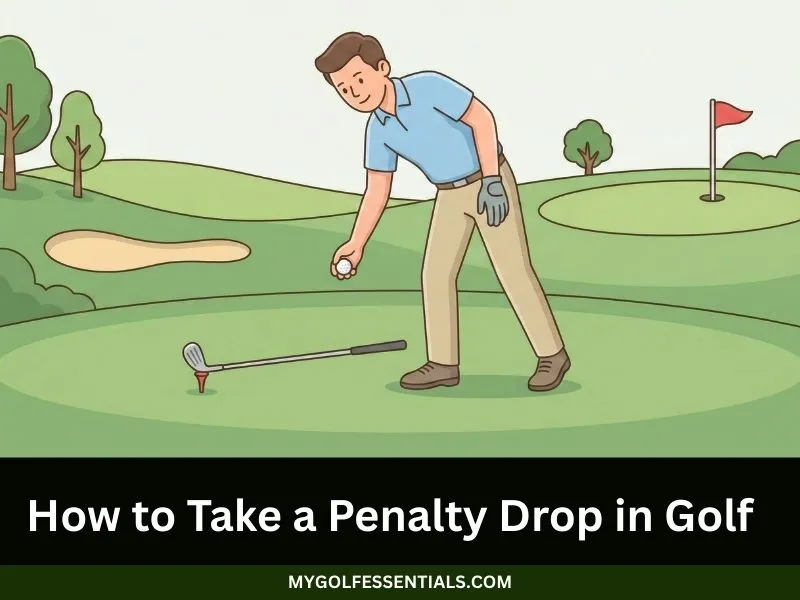
Step 3: Drop From Knee Height
Stand upright and hold the ball at knee height. Let it fall straight down without imparting spin or direction.
The proper drop technique:
- Stand naturally upright
- Hold ball at knee height
- Arm straight down
- Release cleanly
- Ball must fall straight down
The ball cannot touch you or your equipment before hitting the ground. If it does, drop again with no penalty.
Step 4: Check If Ball Stays in Relief Area
After the ball lands, check if it stays in the relief area. The ball must come to rest in the designated area.
- The ball is in play if: It lands in the relief area and stays there, even if it rolls a bit within the area.
- You must drop again if: The ball rolls and comes to rest outside the relief area.
The relief area is the zone you measured. If the ball exits this zone, you must drop again.
Step 5: Apply the Drop, Drop, Place Rule
If your ball doesn’t stay in the relief area after two drops, you place it instead of dropping again.
The procedure:
- First drop: Ball rolls out, drop again
- Second drop: Ball rolls out again
- Place the ball where it first touched the ground on the second drop
This rule prevents endless dropping on slopes. After two attempts, placement ensures you can continue playing.
What are Your Relief Options
Different situations offer different relief choices. Being aware of the following options will help you make smart strategic decisions:
1. Lateral Relief (Two Club-Lengths)
This option gives you two club-lengths of relief measured from your reference point. It’s available for penalty areas and unplayable lies.
How it works: Measure two club-lengths from where your ball crossed the penalty area edge or where it lies if unplayable. Drop anywhere within that measured area, no closer to the hole.
For red penalty areas, you can often use either side of the penalty area. Choose the side that gives you the better angle or lie. Add one penalty stroke.
2. Back-on-the-Line Relief
This option lets you go back as far as you want from the hole. It’s available for penalty areas and unplayable lies.
How it works: Create an imaginary line from the hole through your reference point. You can drop anywhere on this line behind the reference point, going back as far as you choose.
Measure one club-length to either side of any point on that line for your drop zone. This creates flexibility for finding flat ground or avoiding obstacles.
This option works well when lateral relief would leave you with a difficult lie or blocked shot. Add one penalty stroke.
3. Stroke and Distance
This option is always available but usually the least desirable. You return to where you played the previous shot.
How it works: Go back to the spot where you last played. Drop within one club length of that spot, not nearer the hole. If you hit from the teeing area, you can re tee the ball anywhere in the teeing area.
Add one penalty stroke. You effectively lose two strokes because you must replay the shot.
When to use stroke and distance:
- When other options leave you in worse positions
- When you’re already close to where you hit from
- When penalty area location makes other options impractical
How to Measure Your Relief Area Correctly
When taking relief in golf, whether from a water hazard, ground under repair, or an unplayable lie, it’s important to measure your relief area correctly to avoid penalties. Accurate measurement prevents playing from the wrong place, which costs two additional penalty strokes.
Steps to Measure Relief:
1. Identify the reference point
This could be where your ball lies, where it entered a hazard, or a specific point on the course. For penalty areas, the reference point is where your ball last crossed the edge of the penalty area. For unplayable lies, it’s where your ball currently sits. Mark this spot clearly with a tee, coin, or ball marker before lifting your ball.
2. Use the correct distance
Most relief areas are within one or two club-lengths of the reference point, depending on the rule. Use your longest club, typically your driver, to measure. Lay the club flat on the ground from the reference point. For two club-lengths, measure once, mark the spot, then measure again from that mark.
3. Stay no closer to the hole
Your dropped ball must never be nearer the hole than the reference point. The relief area extends from your reference point outward, but excludes any area closer to the hole. This creates a radius where you can legally drop your ball.
4. Drop, don’t place
Lower the ball from knee height without throwing, letting it fall naturally into the relief area. Stand upright and hold the ball at knee height. Release cleanly without imparting spin or direction. The ball cannot touch you or your equipment before hitting the ground.
5. Check lie
Ensure the ball comes to rest in a playable spot within the measured area. If the ball rolls outside the relief area, you must drop again. After two drops that roll out, place the ball at the spot where it first touched the ground on the second drop.
Tip: Carry a measuring tool or use your club to estimate distances. Being precise ensures your relief is legal and prevents unnecessary strokes from penalties.
Correctly measuring your relief area keeps your game fair, accurate, and penalty-free, helping both gross and net scores.
What Are the Common Penalty Drop Mistakes to Avoid
Even experienced golfers make drop errors. These mistakes cost additional penalty strokes. Learning them now prevents future problems.
1. Dropping From Wrong Height
This is the most common mistake since the 2019 rule change. Players drop from shoulder height out of habit.
Dropping from shoulder height or above knee height results in playing from the wrong place. This costs you two additional penalty strokes.
2. Failing to Mark Before Lifting
You must mark your ball’s position before lifting it in most situations. This includes unplayable lies and when checking if your ball is in a penalty area.
Lifting your ball without marking it first costs one penalty stroke. Mark every ball before lifting it unless you’re certain you won’t replace it. Use a coin, tee, or ball marker placed directly behind the ball.
3. Playing From Outside Relief Area
After dropping, you must verify the ball is in the relief area before playing. Some players don’t check carefully.
Playing from outside the relief area is playing from the wrong place. This costs two penalty strokes.
Before playing your shot, confirm the ball is within the measured relief area. If you’re uncertain, measure again.
4. Having Caddie or Partner Drop
Anyone other than the player dropping the ball results in a one-stroke penalty. Always drop your own ball. Your caddie can help measure or mark spots, but you must execute the drop.
5. Not Cleaning Your Ball
This isn’t a mistake to avoid but an opportunity many players miss. You can clean your ball when taking penalty relief.
Take advantage of this. A clean ball performs better and is easier to track in flight.
Final Thoughts
Taking a penalty drop correctly is a fundamental golf skill. The procedure follows simple steps once you understand them.
Remember the key elements: drop from knee height, use your longest club to measure, and ensure you drop within the relief area. The player must always drop their own ball. Golf penalty drop rules changed in 2019 to make the game simpler and faster.
Keep this guide handy during your rounds. Even tour professionals consult rules officials when situations arise. Knowing the fundamentals gives you confidence to handle any penalty situation correctly.
Play smart, drop correctly, and save unnecessary strokes.
Key Takeaways
- Always drop from knee height while standing upright, not shoulder height as the rule changed in 2019.
- The player must drop the ball themselves, never your caddie or playing partner, or face a one-stroke penalty.
- Use your longest club, typically your driver, to measure relief areas for maximum legal distance.
- Penalty areas give you three relief options: lateral (two club-lengths), back-on-line, or stroke and distance.
- Apply the drop, drop, place rule if your ball rolls out of the relief area twice on sloped terrain.
- Always mark your ball before lifting it to avoid a one-stroke penalty in most situations.
- You can clean your ball when taking penalty relief before dropping it back into play.
- Out of bounds allows only stroke and distance relief with no lateral or back-on-line options available.
- Playing from the wrong place after an incorrect drop procedure costs two additional penalty strokes.
- Unplayable lies are entirely your decision to declare when your ball is in trouble, costing one stroke for relief.
FAQs
Do I have to stand outside the relief area when I drop?
No, the Rules of Golf allow you to stand either inside or outside the relief area when dropping your ball, as long as you drop from knee height and the ball comes to rest within the relief area
Can I take a penalty drop closer to the hole?
No, a penalty drop can never be taken closer to the hole. All relief options require the ball to be dropped in a relief area that is the same distance or farther from the hole than the original spot. Dropping closer to the hole is not allowed under any relief option.
What is an illegal drop in golf?
An illegal drop happens when the ball is not dropped according to the Rules of Golf. Common examples include dropping from the wrong height, letting the ball roll outside the relief area, or having someone else drop it for you. Playing from an illegal drop results in penalty strokes.
What happens if my ball keeps rolling out of the relief area?
Use the drop, drop, place rule when your ball won’t stay in the relief area. Drop once from knee height. If it rolls out, drop again from the same spot. If it rolls out a second time, place the ball at the exact spot where it first touched the ground on your second drop.