
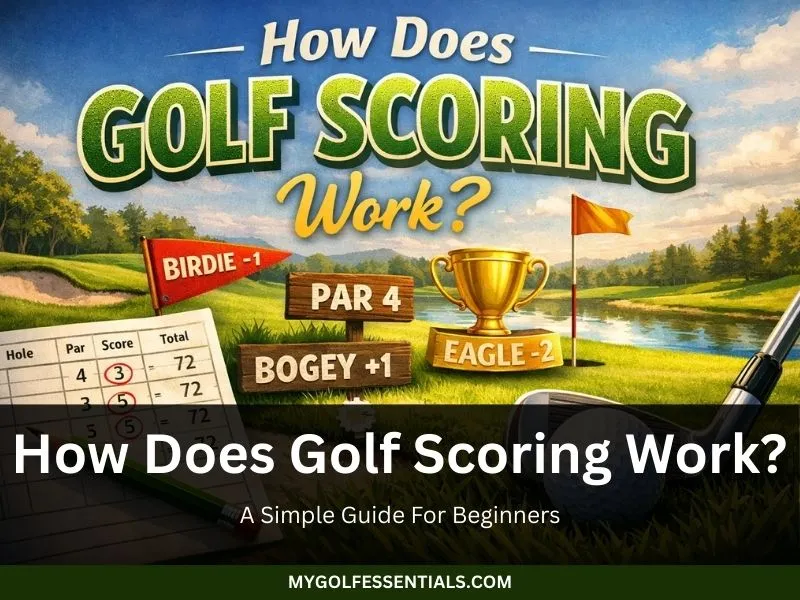
Golf is a weird game. In almost every other sport, you want the highest score possible. But in golf? You want the lowest. If you are new to the sport, staring at a scorecard can feel like solving a puzzle. You hear about birdies, eagles, and bogeys, and it gets confusing fast.
Don’t worry. Once you grasp the basics, golf scoring is actually pretty simple to understand. It is just about counting. This guide will break down how to score in golf, explain the terms, understand penalty rules, and learn exactly how to record your scores like a pro.
By the end, keeping score will feel natural. Let’s get to it.
Golf Scoring Basics: The Fundamentals
Golf scoring works differently than most sports. In basketball or football, you want the highest score, but here, the lowest score wins the game.
Your score represents every attempt to hit the ball. Each swing counts as one stroke. Add them all together, and you get your total score.
Simple, right?
What Counts as a Stroke?
A stroke happens any time you make a forward swing with the intention to hit the ball.
Here is the thing.
If you swing and miss, it still counts as a stroke. This is often called a “whiff.” However, practice swings do not count because you do not intend to hit the ball.
You must also count every putt on the green. A one-foot putt counts the same as a 250-yard drive.
The Ultimate Goal
Your mission is to finish the game with the lowest number of strokes possible. You play 18 holes. You count your strokes for each one. At the end, you add them all up and that total is your score. If you shoot a 72, you beat the guy who shot an 85. Lower is always better.
Recording Scores
You need to write these numbers down. You can use a physical scorecard provided by the course, or you can use a digital app on your phone.
- Do it fast: Record your score immediately after finishing each hole.
- Be honest: This ensures accuracy and prevents arguments later.
What is Par in Golf?
Par is the target score for a hole. It represents the number of strokes an expert golfer is expected to take to complete that hole. You cannot understand golf scoring without understanding “Par.” so, being aware of this concept is really important.
Think of Par like a number line. On that number line, Par is marked as zero. If you take fewer shots, you are on the negative (good) side. If you take more shots, you are on the positive (bad) side.
Par 3, Par 4, and Par 5 Explained
Holes come in different lengths. The length determines the par.
Par 3 Holes:
- Shorter holes (usually under 250 yards)
- Expected strategy: reach green in one shot plus two putts
- Total: 3 strokes
Par 4 Holes:
- Medium-length holes (251 to 450 yards)
- Expected strategy: tee shot plus approach shot plus two putts
- Total: 4 strokes
Par 5 Holes:
- Longer holes (over 450 yards)
- Expected strategy: three shots to reach green plus two putts
- Total: 5 strokes
Notice a pattern? Every par rating assumes two putts on the green.
Total Course Par
When you add up the par for all 18 holes, you get the course par. Most standard courses have a par around 72. Some executive courses might be lower, around 68.
Essential Golf Scoring Terms
Golfers love their bird names. Golf scoring basics involve a lot of terms that sound like a trip to the zoo. These terms just tell you your score relative to par.
Under Par: The Good Scores
Scoring under par is excellent.
- Birdie (-1): This means you finished the hole in one stroke less than par. It’s a great score.
- Eagle (-2): This is two strokes under par. It usually happens on Par 5s if you reach the green fast.
- Albatross (-3): Also called a Double Eagle. This is three strokes under par. It is extremely rare.
- Condor (-4): Four strokes under par. This is basically impossible, like a hole-in-one on a Par 5.
Over Par: The Bad Scores
- Bogey (+1): One stroke over par. Score 5 on a par 4? That’s a bogey. These are normal for beginners.
- Double Bogey (+2): Two strokes over par. Still common among recreational players.
- Triple Bogey (+3): Three strokes over par. Happens to everyone occasionally.
- Even Par (E): Your score matches par exactly. This is excellent golf for most players.
What are Penalty Strokes?
Penalties add strokes to your score. They happen when your ball ends up in trouble. The following are some of the instances you may end up adding penalty strokes:
- Out of Bounds (OB): This is marked by white stakes, it hurts your score. It is a two-stroke penalty (stroke and distance). You must go back to where you hit the shot and hit it again.
- Penalty Areas (Water): If you hit into a lake, it is a one-stroke penalty. You drop a new ball near where it went in and keep playing.
- Lost Ball: If you can’t find your ball after 3 minutes, it is a lost ball. This is a stroke and distance penalty. You add a stroke and go back to replay the shot.
- Unplayable Lie: If your ball is stuck in a cactus or bush, you can declare it unplayable. You take a one-stroke penalty and drop it in a better spot.
What’s The Role of Mulligans
A “mulligan” is a do-over shot without a penalty.
Listen! These are common in casual games with friends. However, they are strictly forbidden in official competitions. If you are learning how golf points are calculated officially, do not use mulligans.
The Golf Scorecard Explained
Your scorecard reveals data beyond raw stroke count. Learning to read it properly helps you understand your game.
Key Scorecard Elements Includes Following:
Hole Index/Stroke Index:
- Ranks holes 1 (hardest) to 18 (easiest)
- Vital for using handicap
- The number 1 handicap hole is where higher-handicap players get extra strokes first
Tee Colours:
- Different distances based on tees played
- Forward tees (often red or gold) for beginners
- Back tees (often black or blue) for professionals
- Choose tees that match your skill level
Gross vs. Net Scores:
- Gross Score: total strokes actually taken
- Net Score: gross score minus handicap
- Net scoring creates fair competition between players of different abilities
Here’s the thing: most scorecards also show yardage, par for each hole, and space to record your shots.
The Handicap System Explained
You might ask how you can possibly compete with a professional golfer. The answer lies in the handicap system, which measures your potential playing ability.
What is a Handicap?
In golf, a handicap is a number used to measure a player’s skill level. It allows golfers of different abilities to compete fairly against each other. The lower the handicap, the better the golfer’s playing skill is considered to be.
A handicap shows how many strokes over par a player is expected to score in a round.
For example, a golfer with a handicap of 10 will usually shoot around 10 strokes above par, while a player with a handicap of 20 will need more strokes to complete the course.
The main purpose of a handicap is to make the game more balanced. It lets beginners and experienced players enjoy competitive matches together by adjusting scores based on skill level. This system is used in casual rounds, club events, and tournaments.
In simple terms, a handicap helps level the playing field and makes golf more enjoyable for everyone, regardless of experience.
Here is a general handicap score range to help you find out your handicap:
- Beginner: handicap of 28-36
- Average recreational player: handicap of 10-28
- Expert/”scratch golfer”: handicap of 0
- Maximum allowed: 54 for both men and women
Common Scoring Formats: How Golf Points are Calculated
In golf, scoring can be done in several different ways depending on the type of game being played. While stroke play is the most common format, many casual rounds, club events, and tournaments use alternative scoring systems to make the game more competitive and enjoyable for players of all skill levels.
Below are the most common scoring formats and how points or scores are calculated in each:
1. Stroke Play:
This is the most common scoring format in golf. Here,
- Every shot over 18 holes added up.
- Lowest total wins.
- Most common format on PGA Tour.
- This scoring system is pretty straightforward – each golfer adds up how many strokes it took them to play the hole.
Example:
If a player completes the round in 82 strokes, their score is 82.
Stroke play can be:
- Gross stroke play: actual strokes taken.
- Net stroke play: strokes taken minus handicap strokes.
Most professional tournaments use gross stroke play, while amateur events often use net scores.
2. Match Play:
Match play focuses on winning individual holes rather than total strokes. Here, you:
- Compete hole-by-hole.
- Win a hole, you’re “1-up”.
- Win more holes than your opponent, and you win the match. For that, it does not matter if your total strokes are higher overall.
- Total stroke count irrelevant.
- Used in Ryder Cup.
Example:
If Player A wins 5 holes and Player B wins 3 holes, Player A is 2 up.
Handicaps are applied by giving extra strokes on certain holes to the higher-handicap player.
3. Stableford: Points-Based Scoring
Stableford is popular in places like Australia. You earn points based on your score relative to par.
The Points System:
- Albatross: 5 points
- Eagle: 4 points
- Birdie: 3 points
- Par: 2 points
- Bogey: 1 point
- Double Bogey or worse: 0 points (called a “wipe”).
The Winner: The player with the highest total points wins. Handicaps are commonly used, making Stableford popular in club competitions.
What is a Good Golf Score for Beginners?
A good golf score for beginners is about 90-100 for a complete game of 18 holes. That means averaging roughly 5 to 5.5 strokes per hole.
For 9 holes, better to aim for 50 or below.
Here’s the breakdown:
- Under 120: Great for absolute beginners
- 90-100: Good progress for developing players
- Breaking 90: Milestone achievement
- 80s: Advanced amateur level
- 70s: Excellent golf
But wait: don’t obsess over score when you’re just starting. Focus on improving your swing, learning course management, and enjoying the game.
A score of around 100 or below on a par-72 course is generally considered good progress for a beginner golfer.
Tips to Improve Your Golf Scoring
Here’s what actually works.
- Practice Your Short Game: Most strokes happen within 100 yards of the green. Putting and chipping save more strokes than long drives.
- Avoid Penalties: Stay in bounds. Avoid water hazards when possible. One penalty can wreck an entire hole.
- Play Smart, Not Aggressively: Course management matters more than power. Sometimes laying up is smarter than going for the hero shot.
- Track Your Progress: Enter scores into the GHIN system or a golf app. Seeing improvement motivates continued practice.
Final Thoughts
Golf scoring seems complex at first but it becomes second nature with practice.
Focus on your own progress, not comparing yourself to pros. Understand the basics of par, strokes, and how handicaps work. Every round is a learning opportunity.
The goal isn’t perfection. It’s an improvement and enjoyment.
Get out there and play. Your scores will drop as your skills develop.
Key Takeaways
- Finish in the fewest strokes possible. Unlike most sports, low scores win in golf.
- Every hole has a target score (Par 3, 4, or 5). Par represents what a skilled golfer should shoot.
- Practice swings don’t count, but every attempt to hit the ball does. “Whiffs” and putts all count.
- Birdie means one under par, eagle is two under, and bogey is one over.
- Beginners can compete fairly with experienced players through extra strokes based on skill level.
- Be aware of OB and water hazard rules. Knowing penalty rules helps you keep an honest score.
- Stroke play counts total strokes, match play is hole-by-hole competition, and Stableford awards points
- Most beginners score between 100-120 for 18 holes.
- Most shots happen within 100 yards of the green. Practicing putting and chipping improves your score faster.
FAQs
What is a birdie, a bogey, and an eagle?
These are terms for your score on a specific hole relative to par. A birdie is one stroke under par (excellent). A bogey is one stroke over par (common). An eagle is two strokes under par (very rare and exciting).
How do I calculate my total golf score?
In standard stroke play, you simply add up the number of strokes you took on each of the 18 holes. This total is your gross score. If you have a handicap, you subtract that number from your gross score to get your net score.
What are the 7 common golf scoring terms?
The key terms are par, birdie, eagle, albatross, bogey, double bogey, and triple bogey. Par is the expected score. Birdie is one under, Eagle is two under, and Albatross is three under. Bogey is one over, Double is two over, and Triple is three over.
What happens if I lose my ball?
If you cannot find your ball within three minutes, it is considered lost. You must take a penalty for stroke and distance. This means you add one penalty stroke and must go back to play your next shot from where you hit the previous one.
What is the average golf score?
Scores vary wildly by skill. A professional might shoot in the low 70s. However, the average golfer usually shoots between 90 and 100 for an 18-hole round. Beginners often score higher, which is completely normal.