
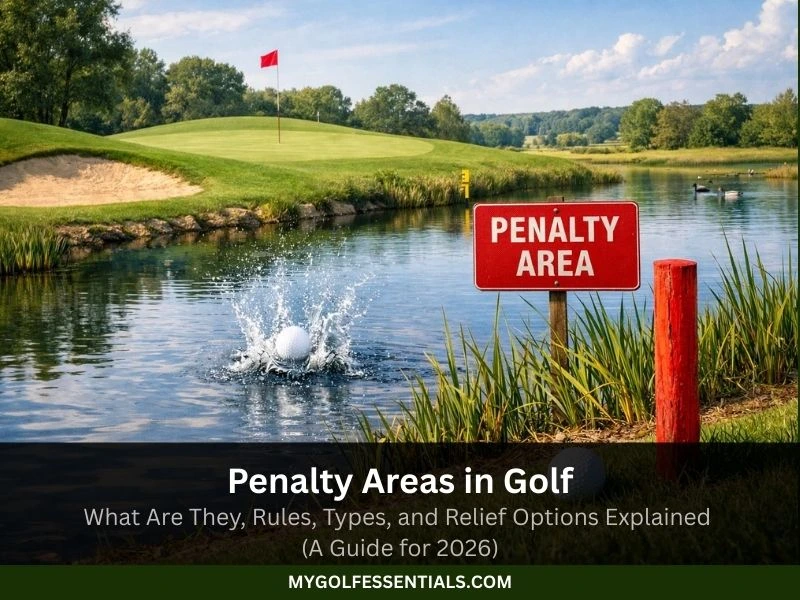
Penalty areas in golf can be tricky, even for experienced players. Knowing what counts as a penalty area, the rules that apply, and your relief options can save you strokes and help you play smarter.
In this guide for 2026, we’ll break down everything you need to know about red and yellow penalty areas, when a ball is considered in trouble, and how to take relief correctly. Whether you’re a beginner or a seasoned golfer, reading this article will give you the confidence to handle penalty areas without losing unnecessary strokes.
What Is a Penalty Area in Golf?
A penalty area is a marked part of the golf course where playing a ball can be difficult or risky. These areas usually include water, thick vegetation, rough ground, or natural features that are hard to play from. When your ball goes into a penalty area, special rules apply, and in most cases, you must add one penalty stroke if you choose to take relief.
When hosting a golf tournament, the penalty areas are clearly marked on the course using red or yellow stakes or lines. The color tells you what type of relief options are available. Unlike out-of-bounds, penalty areas still allow you to play the ball if you think it is safe to do so.
How Penalty Areas Replaced Water Hazards
Before 2019, golf courses used the terms water hazards and lateral water hazards. These terms were removed when the Rules of Golf were modernized to make them easier to understand and apply.
The new term penalty area was introduced to:
- Cover more than just water.
- Simplify the rules for relief.
- Speed up play.
- Reduce confusion for casual and new golfers.
Under the old rules, hazards were treated differently depending on their type. Now, all such areas fall under the penalty area rules, with relief options based mainly on whether the area is marked red or yellow.
When a Ball Is Considered in a Penalty Area
Your ball is considered in a penalty area when any part of the ball touches the penalty area line or is inside the line. The line itself is part of the penalty area, not outside it.
A ball is also treated as being in a penalty area if:
- It is known or virtually certain that the ball came to rest in the penalty area, even if you cannot find it.
- The ball is completely surrounded by the penalty area boundary.
If there is doubt about where the ball ended up, the rules require reasonable evidence before applying penalty area relief. If that certainty does not exist, normal lost ball rules apply.
Why Golf Courses Use Penalty Areas
Golf courses use penalty areas to manage parts of the course where play is difficult, unsafe, or likely to slow the game down. These areas help create a fair challenge while keeping the course playable for golfers of all skill levels.
One key reason is course design. Penalty areas are often placed around water, steep slopes, thick rough, or natural land features. These areas add strategy to each hole by making golfers think carefully about club choice, shot direction, and risk versus reward.
Penalty areas also improve player safety. Some parts of a course may be dangerous to enter due to deep water, rocks, wildlife, or unstable ground. Marking these areas allows golfers to take relief instead of attempting risky shots.
Another important reason is pace of play. Without penalty areas, golfers might spend too much time searching for balls in difficult terrain. Clear markings and defined relief options help players move on quickly and keep rounds flowing smoothly.
Finally, penalty areas allow golf courses to protect natural features. By marking sensitive or hard-to-maintain areas as penalty areas, courses reduce damage to the landscape while still keeping the hole fair and playable.
Types of Penalty Areas in Golf
As mentioned earlier, there are two types of penalty areas in golf, and each one is marked with a different color. The color tells you what relief options are available if your ball ends up in that area.
Let’s find out further about these areas:
1. Red Penalty Areas
A red penalty area is a marked area where taking lateral relief is allowed. These areas usually run along the side of a hole and give golfers more relief options compared to yellow penalty areas.
Red penalty areas are marked with red stakes or red lines, and the line itself is considered part of the penalty area.
Common Examples of Red Penalty Areas Include the Following:
- Lakes or ponds running alongside a fairway.
- Streams or canals along the edge of a hole.
- Thick rough, bushes, or wooded areas.
- Marshy ground or drainage areas.
When Red Penalty Areas Are Used
Red penalty areas are used when it would be unfair or impractical to force a golfer to drop far back from where the ball entered the area. Since these areas often run alongside the hole, lateral relief helps keep play moving and avoids long walk-backs.
2. Yellow Penalty Areas
A yellow penalty area is a marked area where lateral relief is not allowed. Relief options are more limited, and golfers must drop either back on the line or return to the previous shot location.
Yellow penalty areas are marked with yellow stakes or yellow lines.
Common Examples of Yellow Penalty Areas Include the Following:
- Ponds or lakes directly in front of a green.
- Streams crossing the fairway.
- Ditches or water features that cut across a hole.
When Yellow Penalty Areas Are Used and How They Differ from Red Penalty Areas
Yellow penalty areas are used when the penalty area crosses the line of play rather than running along the side. Because of this, lateral relief would give an unfair advantage.
The main difference between yellow and red penalty areas is relief options. Red penalty areas allow lateral relief within two club lengths, while yellow penalty areas do not. This difference affects strategy and shot planning, especially on approach shots and tee shots.
How to Identify a Penalty Area on the Course
Knowing how to spot a penalty area on the course helps you avoid rule mistakes and unnecessary penalty strokes. Golf courses use clear markings to show where penalty areas begin and end.
Here’s how you can identify these areas:
1. Red and Yellow Stakes
Penalty areas are marked with colored stakes placed around the area.
- Red stakes show a red penalty area.
- Yellow stakes show a yellow penalty area.
The color of the stake tells you what type of relief options you have. The stakes themselves are usually placed along the edge of the penalty area to help golfers see the boundary from a distance.
2. Painted Lines and Their Meaning
Some courses use painted red or yellow lines instead of, or in addition to, stakes. These lines mark the exact edge of the penalty area.
It’s important to remember that the painted line is part of the penalty area. If any part of your ball touches the line, the ball is considered inside the penalty area.
When both stakes and lines are present, the painted line takes priority in defining the boundary.
What to Do If Markings Are Unclear
If the markings are missing, faded, or hard to see, you should use your best judgment to decide where the penalty area starts. Look for natural signs such as water, rough ground, or obvious course features that suggest a penalty area.
If you’re playing in a competition, you can also check the local rules or ask a playing partner or course official before taking relief. Making a reasonable and honest decision helps avoid disputes and keeps the game fair.
What Happens When Your Ball Goes into a Penalty Area
When your ball goes into a penalty area, the rules give you a few clear choices. What you decide to do depends on the situation, the type of penalty area, and whether you think the ball is playable.
In most cases, entering a penalty area results in a one-stroke penalty if you choose to take relief. However, you are not always required to take relief.
Here are your options:
1. You Can Play the Ball as It Lies
If your ball is inside the penalty area and you believe you can safely make a shot, you are allowed to play the ball as it lies. There is no penalty stroke for doing this.
That said, you must follow penalty area rules, such as not grounding your club in certain situations and being careful of loose objects. Playing from a penalty area is often risky and can make the next shot more difficult.
2. You Can Take Relief with a One-Stroke Penalty
If you do not want to play the ball from the penalty area, you may take relief by adding one penalty stroke. The type of relief available depends on whether the area is marked red or yellow.
Relief is taken based on the point where the ball last crossed the edge of the penalty area, not where it finally came to rest.
3. If the Ball Is Lost in a Penalty Area
If your ball is lost but it is known or almost certain that it came to rest in a penalty area, you do not need to return to the spot of your previous shot. You can take penalty area relief using the crossing point, with a one-stroke penalty.
This rule helps speed up play and prevents unnecessary walk-backs.
Why This Rule Matters
Knowing what happens when your ball enters a penalty area helps you make better decisions, avoid extra strokes, and keep the game moving. Choosing the right option can save both time and shots on your scorecard.
Relief Options from Penalty Areas
When you decide not to play the ball from a penalty area, the Rules of Golf allow specific relief options. In all cases, taking relief comes with a one-stroke penalty. The option you choose should depend on your position, skill level, and the type of penalty area.
1. Stroke and Distance Relief
Stroke and distance relief means you return to the spot where you played your last shot and play again. You add one penalty stroke and continue from that location.
This option is always available, no matter whether the penalty area is red or yellow.
When This Option Makes Sense
- When the penalty area is very close to the green.
- When there is no safe or useful drop area ahead.
- When your original shot position offers a clear and comfortable next shot.
Although it costs distance and time, this option often gives you the cleanest and safest next shot.
2. Back-on-the-Line Relief
Back-on-the-line relief allows you to drop the ball on an imaginary line that runs from the hole, through the point where the ball last crossed into the penalty area, and extends backward as far as you want.
You may go back any distance on this line, giving you flexibility to find a better lie.
Step-by-Step Placement Rules
- Identify the point where the ball last crossed the edge of the penalty area.
- Draw an imaginary straight line from the hole through that point.
- Choose a spot on that line, as far back as you want.
- Drop the ball and let it come to rest within the allowed drop area.
Once dropped correctly, the ball is back in play with a one-stroke penalty.
3. Lateral Relief (Red Penalty Areas Only)
Lateral relief is available only for red penalty areas. You may drop the ball within two club lengths of the point where the ball last crossed into the penalty area, no closer to the hole.
This option is popular because it allows play to continue near where the ball entered the penalty area.
Common Mistakes Golfers Make
- Measuring from where the ball ended instead of where it crossed the line.
- Dropping closer to the hole than allowed.
- Using lateral relief in a yellow penalty area.
- Measuring club lengths incorrectly.
Avoiding these mistakes helps you take proper relief and prevents extra penalty strokes.
When You Can Play the Ball from a Penalty Area
You are allowed to play the ball from a penalty area without taking relief if you believe the shot can be made safely. This option does not add a penalty stroke, but it comes with certain limits and risks.
Allowed Conditions
You may play the ball from a penalty area as long as:
- The ball is not out of bounds
- The ball is not unplayable due to safety reasons
- There is no local rule requiring mandatory relief
You are allowed to remove loose impediments like leaves or small stones, but you must be careful not to move the ball. You should also follow penalty area rules, which may restrict grounding your club in certain situations.
Risks and Benefits
The following table shows its risks and benefits:
| Benefits | Risks |
| No penalty stroke added to your score | Poor footing or unstable ground |
| Chance to save strokes, especially near the green | Limited swing or blocked follow-through |
| Keeps you closer to the hole | Risk of hitting the ball deeper into trouble |
Playing from a penalty area can work well for confident golfers, but one bad swing can quickly make the situation worse.
Things to Check Before Hitting
Before deciding to play the ball from a penalty area, you should check:
- Whether your stance and swing can be made safely.
- If there are rocks, water, or roots near the ball.
- Whether you can advance the ball toward the target.
- If taking relief would give a better next shot.
Making a smart decision at this stage can help you avoid bigger mistakes and protect your score.
Penalty Areas vs Bunkers and Out of Bounds
Penalty areas are often confused with bunkers or out of bounds, but each has different rules and relief options. Understanding the differences helps you make better decisions and avoid extra strokes.
| Feature | Penalty Area | Bunker | Out of Bounds |
| Definition | Marked area with water, rough, or natural obstacles | Sand-filled hazard | Area outside the course boundary, marked by white stakes or lines |
| Penalty Stroke | 1 stroke if you take relief | No penalty if you play from the bunker; penalty only if unplayable | 1 stroke penalty plus stroke-and-distance required |
| Playing the Ball | Allowed if safe | Must play the ball as it lies | Not allowed; ball is considered out of play |
| Relief Options | Stroke-and-distance, back-on-the-line, lateral (red only) | Unplayable relief allowed (various options) | Only stroke-and-distance from previous spot |
| Markers | Red or yellow stakes/lines | No specific color; sandy area | White stakes/lines |
Penalty Strokes Compared
- Penalty Areas: 1 stroke if relief is taken.
- Bunkers: No penalty if you play; 1 stroke if declaring ball unplayable.
- Out of Bounds: 1 stroke plus stroke-and-distance.
How Relief Options Change
- Penalty Areas: Multiple relief options (stroke-and-distance, back-on-the-line, lateral for red).
- Bunkers: Relief only if ball is unplayable; ball stays in bunker if played.
- Out of Bounds: Only option is to play again from the previous spot (stroke-and-distance).
Knowing these differences ensures you choose the best option for your next shot and avoid unnecessary penalties.
Common Mistakes Golfers Make with Penalty Areas
Even experienced golfers can make mistakes when dealing with penalty areas. These errors often cost extra strokes and slow down play. Here are the most common ones:
1. Confusing Red and Yellow Areas
Many golfers mix up red and yellow penalty areas. Remember:
- Red penalty areas allow lateral relief (two club lengths from the entry point).
- Yellow penalty areas do not allow lateral relief; you can only use back-on-the-line or stroke-and-distance relief.
Using the wrong relief option can result in a rules violation and added penalty strokes.
2. Dropping the Ball Incorrectly
Dropping the ball incorrectly is another frequent mistake. Common errors include:
- Dropping the ball closer to the hole than allowed.
- Measuring from where the ball ended instead of where it crossed the penalty area line.
- Not letting the ball hit the ground first in the proper drop zone.
These mistakes can lead to additional penalty strokes or even a replay of the drop.
3. Taking Free Relief When It’s Not Allowed
Some golfers assume any tricky spot near a penalty area allows free relief. This is not true.
- Relief from a penalty area always comes with a one-stroke penalty.
- Free relief is only allowed in cases like abnormal course conditions (e.g., ground under repair, casual water).
Taking relief incorrectly or without a penalty stroke is a rules violation and can hurt your score if playing competitively.
Avoiding these mistakes helps you save strokes, keep your game fair, and make smarter decisions when your ball enters a penalty area.
Tips to Avoid Penalty Area Trouble
Penalty areas can be costly if not handled carefully. The key is prevention and smart decision-making. Here are practical tips to help you avoid trouble:
- Plan Your Shots Carefully: Before hitting, check the course layout and identify any red or yellow penalty areas. Choose clubs and shot types that minimize risk, especially near water or thick rough.
- Aim for Safer Targets: Instead of always going for the pin or aggressive shots, aim for wider fairways or safer landing zones. It’s often better to take a longer approach than risk a ball in a penalty area.
- Know Your Penalty Area Rules: Understand the differences between red and yellow areas, relief options, and one-stroke penalties. Knowing the rules helps you make smarter decisions if your ball does end up in trouble.
- Use Practice to Improve Accuracy: Working on consistency in your swing and shot direction reduces the chances of balls landing in penalty areas. Focus on controlling distance and aim rather than just power.
- Be Ready for Recovery Shots: Sometimes, you will end up in a penalty area. Knowing how to safely hit from water, rough, or bushes can help you save strokes and prevent bigger mistakes.
- Stay Calm and Make Smart Choices: Avoid risky shots under pressure. A calm, measured approach reduces errors and keeps your score under control. Remember: strategic play beats risky shots near penalty areas.
Using these tips consistently can help you avoid unnecessary strokes, protect your score, and enjoy a smoother round of golf.
Final Thoughts
Penalty areas are an important part of golf that test both your skill and strategy. Knowing what counts as a penalty area, how to identify red and yellow areas, and what relief options are available can make a big difference in your game.
By understanding the rules, avoiding common mistakes, and making smart shot choices, you can minimize penalties and improve your score. Whether you decide to play the ball as it lies or take relief, careful planning and knowledge of the rules will help you navigate penalty areas confidently.
Overall, staying aware, practicing accuracy, and thinking strategically are the keys to handling penalty areas effectively and enjoying a smoother, more controlled round of golf.
Additional Resources to Learn Further About Penalty Areas in Golf:
Key Takeaways
- A penalty area is a marked part of the course, often including water, rough, or difficult terrain, where special rules apply.
- Penalty areas replaced the old water hazard system to simplify the rules and cover more types of trouble areas.
- A ball is considered in a penalty area if it touches or lies inside the marked line or if it is virtually certain to be in that area.
- Red penalty areas allow lateral relief within two club lengths, while yellow penalty areas do not.
- Penalty areas are clearly marked with stakes or painted lines, with the color indicating the type of area and relief options.
- Golfers can choose to play the ball as it lies in a penalty area or take relief with a one-stroke penalty.
- Relief options include stroke-and-distance, back-on-the-line, and lateral relief (red only), depending on the situation.
- Penalty areas differ from bunkers and out-of-bounds, with unique rules for penalty strokes and relief options.
- Common mistakes include confusing red and yellow areas, dropping the ball incorrectly, and taking free relief when not allowed.
- To avoid trouble, golfers should plan shots carefully, aim for safer targets, know the rules, practice accuracy, and stay calm during play.
FAQs
Can I play my ball from a penalty area?
Yes, you are allowed to play your ball from within a penalty area if you can reach it and choose not to take relief. The stroke counts as normal and there is no extra penalty unless you later take relief outside the area.
Can I ground my club and move loose impediments in a penalty area?
Under the modern Rules of Golf, you may ground your club and move or touch loose impediments in a penalty area without penalty. However, you must not improve the conditions affecting the stroke, such as by building a stance or pressing down grass excessively.
Where do I drop if my ball goes into a red penalty area?
For a red penalty area, you have three main options: replay the shot from the previous spot, take back-on-the-line relief, or drop within two club-lengths of where the ball last crossed the edge, no nearer the hole. Each of these relief options costs one penalty stroke.