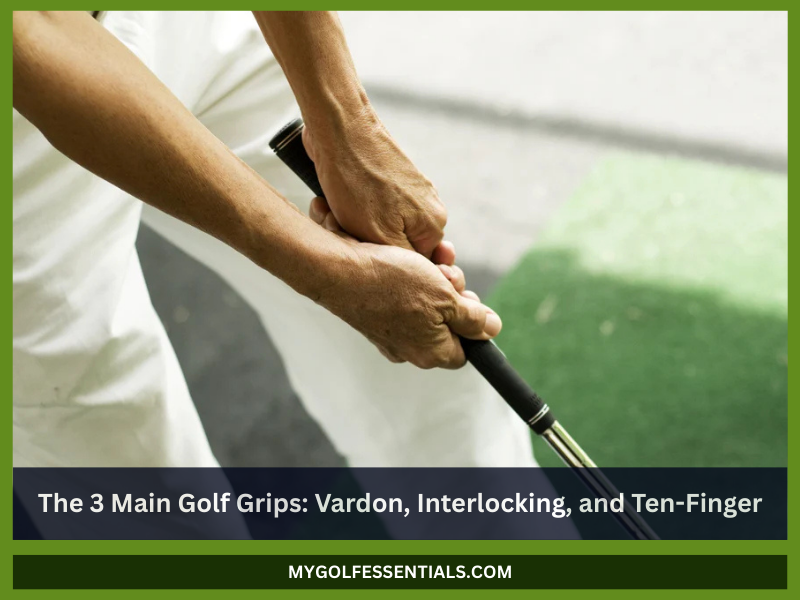
Your golf swing is only as good as the way you hold the club. In fact, Golf Grips are the foundation of every great shot, w hether you’re driving off the tee or sinking a putt.
The right grip can make your swing feel smoother, improve your accuracy, and even add distance to your shots. Get it wrong, and you might struggle with slices, hooks, or inconsistent ball contact.
In this article, we’ll break down the three main golf grips, the Vardon grip, the Interlocking grip, and the Ten-Finger grip, so you know exactly how each works, their pros and cons, and who they’re best for.
Whether you’re a beginner searching for the best golf grip for beginners or an experienced player fine-tuning your golf grip techniques, you’ll find simple, practical advice to help you choose and master the grip that suits your game best.
Ten-Finger Golf Grip
The Ten-Finger Golf Grip, also known as the “baseball grip,” is exactly what it sounds like, all ten fingers are in direct contact with the club. Imagine holding a baseball bat, but instead of swinging for a home run, you’re lining up your golf shot. This grip gives your hands equal influence over the club, making it one of the simplest golf grip techniques to learn.
How to Do It
- Place your lead hand (left for right-handed players) at the top of the grip with the thumb pointing down the shaft.
- Position your trailing hand just below, making sure the fingers wrap around the grip without overlapping or interlocking.
- Cover the lead-hand thumb with the fingers of your trailing hand for extra stability.
It’s straightforward, comfortable, and doesn’t require much fine adjustment—perfect for those just starting out.
Pros
- Very natural feel, especially for players with a baseball or softball background.
- Encourages strong wrist action, which can help generate power.
- Less complicated to learn than other golf grips.
Cons
- Hands may work independently, leading to inconsistent shots.
- Too much wrist action can hurt accuracy.
Best For
This grip is a favorite among:
- Beginners who need a quick, comfortable start.
- Juniors with smaller hands and developing strength.
- Golfers with weaker hands or arthritis who want less strain.
While the Ten-Finger grip offers simplicity and power, it’s not always the most accurate, so what’s the go-to choice for control and precision? That’s where the Vardon grip steps in.
Vardon Grip (Overlapping Grip)
The Vardon grip, or “overlapping grip,” is the most widely used in professional golf. Named after legendary golfer Harry Vardon, it places the trailing hand’s little finger between the index and middle finger of the lead hand. This subtle connection helps unify the hands, improving control over the club face.
How to Do It
- Begin with a basic grip in your lead hand.
- Position your trailing hand so the little finger rests in the groove between the lead hand’s index and middle finger.
- Ensure your thumbs align naturally down the grip, creating a comfortable, stable hold.
This method keeps the hands connected without locking them together, balancing control and flexibility.
Pros
- Promotes excellent shot control.
- Allows for smooth wrist hinge during the swing.
- Comfortable for players with larger hands.
- Used by the majority of tour professionals.
Cons
- Can slightly reduce power compared to the Ten-Finger grip.
- May feel awkward for beginners or players with smaller hands.
Best For
The Vardon grip is ideal for:
- Intermediate to advanced golfers wanting precision.
- Players with larger hands seeking a natural fit.
- Anyone aiming to model their grip after the pros.
The Vardon grip can elevate your control, but what if you want the locked-in security of connected fingers with a more compact feel? That’s where the Interlocking golf grip comes into play.
Interlocking Golf Grip
The Interlocking golf grip is a popular choice among players who want their hands to feel locked together as one unit. In this grip, the trailing hand’s little finger weaves between the index and middle fingers of the lead hand.
This creates a tight bond between both hands, helping to keep the clubface square through impact. Many famous players, including Jack Nicklaus and Tiger Woods, have used this grip, proof of its reliability.
How to Do It
- Start with a basic lead-hand grip, thumb pointing down the shaft.
- Position your trailing hand just below, but instead of resting the pinky on top, thread it between the lead hand’s index and middle fingers.
- Wrap your fingers comfortably around the grip, keeping both thumbs pointing in line with the shaft.
This method may feel strange at first, but with practice, it can feel natural and very secure.
Pros
- Keeps hands connected and working as one.
- Excellent control, especially during the downswing.
- Great for players with smaller hands who need a firmer grip.
Cons
- Can restrict wrist movement, making it harder to generate certain shots.
- May cause discomfort for players with large hands or joint issues.
Best For
- Golfers with smaller hands who want stability.
- Players looking for maximum connection between both hands.
- Those who value control over pure power.
While the Interlocking grip offers unmatched unity, choosing the right grip ultimately depends on more than just hand size, it’s about finding what complements your swing style and comfort. That’s why the next section will help you decide which of the golf grips is truly your best fit.
Choosing the Right Grip and Final Tips
Selecting the perfect grip can shape the way you play for years to come. While there’s no one-size-fits-all answer, here’s a quick guide:
- Ten-Finger Grip: Best for beginners, juniors, and players wanting more power and an easy learning curve.
- Vardon Grip: Ideal for those seeking better control, consistency, and a professional-style hold.
- Interlocking Grip: Perfect for smaller hands and golfers who want their hands to act as a single unit.
Final Tips for All Golf Grips
- Keep your grip pressure light but firm, squeezing too hard can restrict your swing.
- Hold the club more in your fingers rather than the palms for better feel and control.
- Test each grip on the driving range before committing to one.
- Don’t be afraid to adjust, your ideal grip may change as your game develops.
The right grip doesn’t just hold the club, it unlocks your full potential on the course. Once you master the grip that feels most natural, every swing will start to feel more confident, powerful, and consistent.
Conclusion
Your grip is the bridge between your body and the golf club, and mastering it can completely change the way you play. Whether you choose the Ten-Finger Golf Grip for its simplicity, the Vardon grip for its proven control, or the Interlocking golf grip for its hand unity, the right choice will depend on your comfort, hand size, and playing style.
The beauty of golf is that there’s no single “perfect” grip, only the one that works best for you. Take the time to try each option, pay attention to how your shots feel, and don’t rush the process.
With the right grip in place, every swing will feel more connected, more confident, and more in control. And that’s when you’ll start to see your scores drop and your love for the game grow.
Key Points
- Golf grips are the foundation of a good swing, affecting control, accuracy, and power.
- The Ten-Finger Golf Grip (baseball grip) has all ten fingers touching the club and is easy for beginners to learn.
- Ten-Finger grip pros: natural feel, good power, simple to master.
- Ten-Finger grip cons: hands can act independently, leading to less control.
- The Vardon grip (overlapping grip) is the most used by professionals, giving strong control and comfort for larger hands.
- Vardon grip pros: better control, smooth wrist hinge, professional standard.
- Vardon grip cons: can slightly reduce power, awkward for smaller hands.
- The Interlocking golf grip locks the trailing pinky between the lead hand’s fingers, giving secure hand connection.
- Interlocking grip pros: keeps hands working together, good control, great for small hands.
- Final tip: Keep grip pressure light but firm, hold the club in the fingers, and test all three grips to find what works best for you.
FAQs
Do golf grips affect distance?
Yes. Your grip influences how efficiently you transfer power from your swing to the ball. A poor grip can cause mishits, slices, or hooks that cost distance, while a secure, well-fitted grip can add yards by improving contact and clubface control.
Should all golfers use the same grip?
Not necessarily. Hand size, flexibility, swing speed, and comfort all affect which grip works best. Professionals often fine-tune their grip style to suit their unique game rather than sticking to a single universal choice.
How tight should you hold a golf grip?
Aim for a light but firm pressure, often compared to holding a tube of toothpaste without squeezing any out. Too much tension can restrict your swing; too little can cause the club to twist in your hands.
Can changing your golf grip fix a slice?
In many cases, yes. Adjusting grip strength (rotating your hands slightly stronger or weaker) can help square the clubface at impact, which may correct a slice or hook.