Skip to content
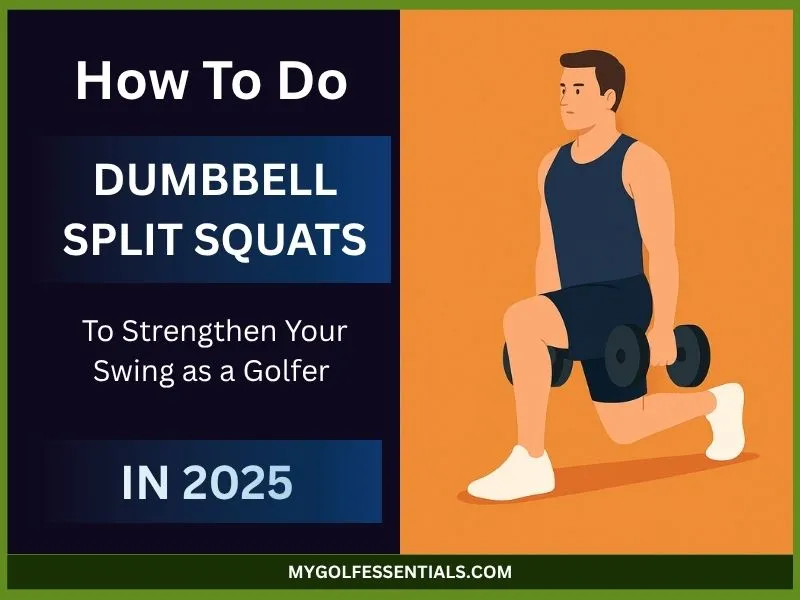
If you’re serious about improving your golf game in 2025, building lower-body strength and stability is key. Dumbbell split squats are one of the best exercises to help golfers like you develop balance, power, and control for a smoother, more consistent swing.
In this article, you’ll learn how to do dumbbell split squats correctly, why they matter for your swing, and how to progress safely for maximum results. Keep reading to take your golf performance to the next level!
What Are Dumbbell Split Squats?
Dumbbell split squats are a lower-body strength exercise that targets the legs, hips, and core. In this movement, you position one leg forward and the other behind you, bending both knees to lower your body while holding dumbbells at your sides. It looks similar to a lunge, but the stance remains fixed throughout the set.
Unlike regular squats that engage both legs at once, split squats work each leg individually. This helps correct imbalances and builds better coordination.
Here’s how the setup looks:
- One foot forward, one foot back (about 2–3 feet apart).
- Dumbbells held by your sides, arms straight.
- Lower your body by bending the front knee until the back knee nearly touches the floor.
- Keep your chest up and core tight throughout the movement.
Split squats can also be done with the back foot elevated on a bench (called a Bulgarian split squat), which increases the challenge.
Why Golfers Should Do Dumbbell Split Squats
Golf swings rely on balance, lower-body strength, and control—exactly what dumbbell split squats are designed to improve. Whether you’re an amateur or a low-handicap player, this exercise helps transfer strength and power into your game.
Here’s why they matter for golfers:
- Improves single-leg stability: During your golf swing, you shift weight from your back leg to your front leg. Split squats train each leg independently, helping build better control and stability.
- Builds core and hip strength: A strong core and stable hips keep you grounded during the swing, especially when generating rotation. Split squats engage both deeply.
- Reduces imbalances: Many golfers favor one side. Split squats help even out strength differences between your lead and trail leg.
- Enhances posture and balance: The upright position and slow control improve posture and balance, both crucial for a smooth swing path.
- Translates to more power in your drive: Stronger legs mean more force from the ground up, allowing you to generate more clubhead speed without losing control.
By incorporating dumbbell split squats into your training, you not only build muscle but also develop a more efficient, powerful, and consistent golf swing.
What Muscles Are Worked by Dumbbell Split Squats?
Dumbbell split squats are a lower-body powerhouse movement that activates multiple muscle groups at once. For golfers, this is a great way to build functional strength that supports balance, posture, and rotational power.
Main Muscles Targeted
These are the primary muscles responsible for powering the movement:
- Quadriceps (front of the thigh): The quads do most of the work as you push through your front foot to return to a standing position. They help with straightening the knee and stabilizing your leg during your swing.
- Gluteus Maximus (buttocks): The glutes help drive the upward motion and provide hip stability. Strong glutes are essential for generating force from the ground during your downswing.
- Hamstrings (back of the thigh): The hamstrings assist in controlling the movement, especially as you lower yourself. They also help maintain knee and hip alignment during the golf swing.
Secondary Muscles Engaged
While not the primary focus, these muscles assist with balance, stabilization, and posture throughout the movement:
- Core (abs and obliques): Your core works to keep your torso upright and prevent tipping forward. This mimics the control needed during a powerful but balanced swing.
- Adductors (inner thighs): These help stabilize the legs and hips, particularly when you’re balancing on one leg.
- Calves (gastrocnemius and soleus): These muscles assist with balance and support as you move through the range of motion.
- Lower Back (erector spinae): Helps maintain a neutral spine throughout the movement, which is crucial for posture and injury prevention.
By training these muscles regularly, golfers can improve leg drive, rotational control, and balance, all key elements for a smoother, stronger swing.
How Dumbbell Split Squats Improve Your Swing
Merely possessing upper-body strength or flexibility is insufficient for achieving a powerful golf swing, as the foundation of such a swing originates from the ground up. Dumbbell split squats help you build the lower-body control and strength that translate directly into a more stable, consistent, and explosive swing.
Here’s how doing this exercise helps you improve your swing:
- Builds Stability in Each Leg: Golf is a rotational sport, but it relies heavily on your legs to anchor that rotation. Dumbbell split squats improve single-leg strength and balance, which helps you stay stable as you load into your back leg and transition to your front leg during the swing.
- Improves Weight Transfer: During a proper swing, your weight shifts from your trail leg to your lead leg. Split squats mimic this movement pattern by forcing each leg to work independently, training your body to control weight shifts more smoothly and efficiently.
- Strengthens Hip Drive and Power: Your hips generate much of the rotational force behind your swing. Split squats engage your glutes and hip muscles, building the power needed to rotate faster and hit farther, without losing balance or breaking form.
- Enhances Core Control and Posture: As you perform the movement with dumbbells, your core works to keep your torso upright and aligned, just like during a swing. This helps reduce swaying, early extension, and loss of posture on the course.
- Boosts Lower-Body Endurance: Fatigue can lead to sloppy swings late in a round. By building endurance in your legs and hips, split squats help you maintain swing mechanics throughout all 18 holes.
Whether you’re looking to gain power off the tee or improve consistency in your irons, adding dumbbell split squats to your training routine gives your swing a strong, stable base to build from.
How to Perform Dumbbell Split Squats Correctly
Doing dumbbell split squats with proper form is key, not just to avoid injury, but to get the most benefit for your golf swing. Good form ensures you’re targeting the right muscles and building the stability and control needed on the course.
Required Equipment
- A pair of moderate-to-heavy dumbbells.
- A flat surface (mat or gym floor).
- Optional: a bench or step for Bulgarian-style split squats (more advanced).
Setup
Before you begin, make sure your setup is right:
i. Choose dumbbells that challenge you but still allow proper technique. If you’re wobbling or leaning forward, lighten the load.
ii. Position your feet in a split stance: one foot forward, one foot behind you.
- Beginners: keep the rear foot on the ground.
- Advanced: place the back foot on a bench or step for added intensity.
iii. Keep shoulders back, chest lifted, and core tight.
iv. Hips should face forward. Don’t let them twist or tilt to one side.
Step-by-Step Guide
Follow these simple steps to perform the movement correctly:
| Step | What to Do | Key Focus |
| 1. Get into position | Stand in a split stance with one foot forward and the other behind | Front foot flat, back foot on ground or bench |
| 2. Hold dumbbells | Hold a dumbbell in each hand, arms straight by your sides | Palms facing your body |
| 3. Engage your core | Keep your torso upright and your core muscles tight | Avoid leaning or arching your back |
| 4. Lower your body | Bend your front knee to 90° while lowering the back knee close to the ground | Stay balanced, don’t let the back knee touch hard |
| 5. Drive upward | Push through your front heel to return to standing position | Keep the motion smooth and controlled |
| 6. Switch sides | After completing reps on one leg, switch to the other | Start with the weaker leg for better balance over time |
When done properly, this move not only builds strength but also trains your body to stay stable and grounded, giving your swing the solid foundation it needs.
What to Do Next: Progressing over time
Once you’ve nailed the basic dumbbell split squat with good form, it’s time to start making it more challenging. Progression is key for building more strength, improving balance, and continuing to see results in your golf game.
Here are a few ways to safely step things up:
- Increase Dumbbell Weight Gradually: As your legs and core get stronger, slowly add more weight. Make sure your form stays tight and controlled. Never compromise technique just to lift heavier.
- Try Bulgarian Split Squats: Once you’re comfortable, raise the difficulty by elevating your back foot on a bench or step. This variation increases the range of motion and puts more load on the front leg, great for building single-leg strength and hip mobility.
- Add Instability for More Balance Work: Performing split squats on a balance pad, wobble disc, or foam surface challenges your stabilizer muscles even more. This mimics the instability of the golf course and helps you stay more controlled during your swing.
Keep progressing one step at a time. Even small upgrades, like a few extra pounds or a deeper squat, can make a big difference in how your lower body supports your game.
How to Add Dumbbell Split Squats to Your Golf Workout
To get the most benefit from dumbbell split squats, it’s important to include them as part of a well-rounded golf strength routine. That means warming up properly, combining with other golf-specific exercises, and finishing with a solid warm-down.
Start With a Warm-Up
Prepare your body with 5–10 minutes of dynamic stretching and light mobility work. Focus on the hips, quads, hamstrings, and ankles. Good warm-up options include:
- Bodyweight lunges
- Hip circles
- Leg swings
- Glute bridges
Sample Golf Workout Plan (Lower-Body Focus)
| Exercise | Sets | Reps | Rest |
| Dumbbell Split Squats | 3–4 | 8–12 per leg | 60–90 seconds |
| Dumbbell Romanian Deadlifts | 3 | 10–12 | 60 seconds |
| Cable or Band Pallof Press | 3 | 10 per side | 30–45 seconds |
| Single-Leg Glute Bridges | 3 | 10 per leg | 30–45 seconds |
| Seated Rotational Medicine Ball Toss | 3 | 10 per side | 45 seconds |
Tip: If you’re just starting, go lighter with 2–3 sets and 10–15 reps. Build up slowly over time.
Pair With Other Golf-Specific Movements
Split squats are powerful on their own, but even better when combined with:
- Core stabilization (Pallof press, dead bugs).
- Rotational power drills (medicine ball slams, twists).
- Hip mobility work (spiderman stretches, 90/90 rotations).
End With a Warm-Down
After your workout, cool down with:
- Light cardio (e.g., walking for 5 minutes).
- Static stretches for the quads, glutes, hamstrings, and hips.
- Foam rolling to reduce tightness and improve recovery.
Adding dumbbell split squats 2–3 times a week can significantly improve your lower-body strength and swing performance. The key is consistency and combining strength with mobility and control.
Track and evaluate progress
To get the most out of dumbbell split squats, you need to track your progress over time. This helps you see what’s working and where to improve, both on the course and in the gym.
1. Measure Strength Gains
Keep track of how much weight you’re lifting and how many reps you’re completing. Small, steady increases show that your muscles are getting stronger.
- Track reps and sets: Can you do more reps with good form?
- Track dumbbell weight: Are you lifting heavier over time without losing control?
2. Watch for On-Course Improvements
You don’t need advanced tools to see progress. Your body will tell you.
Look out for:
- Better balance during your swing.
- Less sway or early extension.
- More powerful, controlled drives.
- Improved weight transfer from back leg to front leg.
These are signs your training is transferring directly to your golf game.
3. Perform the Split Squat Strength Test
A good benchmark used by the Titleist Performance Institute (TPI) is the split squat strength test. Here’s how it works:
- Use a barbell or dumbbells.
- Perform a split squat with your rear foot elevated.
- Your goal: lift 1.5× your bodyweight on your front leg (combined dumbbell/barbell weight).
Important Note: If you’re new, don’t rush into testing. Focus on form and controlled progress first.
Tracking results(not just in the gym, but on the course) keeps you motivated and ensures your training is moving in the right direction.
Tips for Best Results
To get the most from dumbbell split squats and avoid injury, keep these key tips in mind:
- Use Proper Weight: Choose dumbbells that challenge you but don’t force you to sacrifice good form. It’s better to start lighter and build up gradually.
- Focus on Form and Control: Move slowly and deliberately. Maintaining balance and posture is more important than speed or heavy weight.
- Progress Slowly: Increase your weight or reps step by step. Consistency over time beats pushing too hard and risking injury.
- Listen to Your Body: If you feel sharp pain or excessive discomfort, stop and rest. Muscle soreness is normal, but pain is a warning sign.
Following these tips will help you build strength safely and translate your training into a stronger, more stable golf swing.
Where to Find Quality Exercise Equipment To Do Dumbbell Split Squats?
Having the right equipment can make your dumbbell split squats more effective, safer, and comfortable, especially when you’re training to improve your golf swing.
Below are some top gear recommendations, chosen for their durability, ease of use, and value for golfers focused on lower-body strength and balance.
These tools will help you perform the exercises in this guide with better control, support, and consistency.
Our Equipment Recommendations
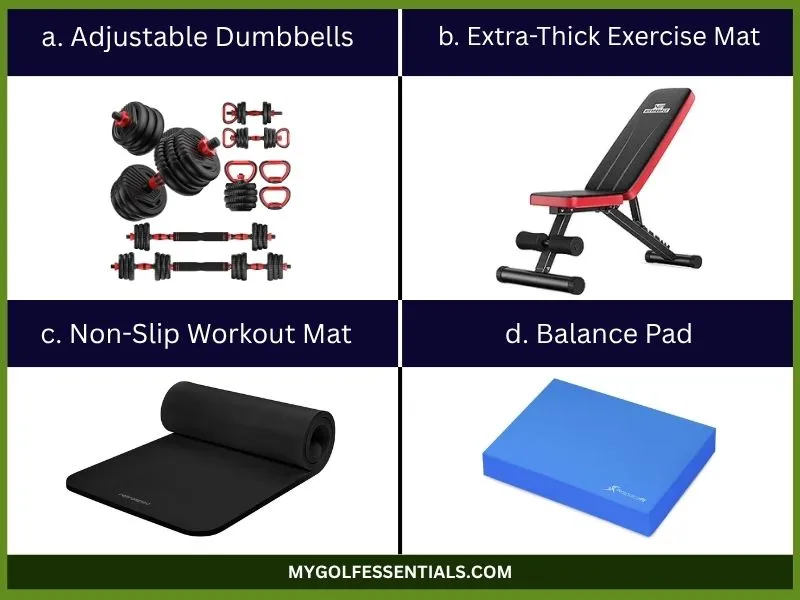
| Product | Why It’s Good | Check Out |
| Adjustable Dumbbells | Ideal for progressive training, space-saving design and multiple weight options | Check Out on Amazon |
| Flat Exercise Bench | Great for doing Bulgarian split squats with rear foot elevated | Check Out on Amazon |
| Non-Slip Workout Mat | Provides grip and cushioning; protects joints and flooring during heavy movements | Check Out on Amazon |
| Balance Pad | Adds instability to challenge balance and coordination during split squats | Check Out on Amazon |
Additional Equipment (Optional but Helpful)
These extras aren’t required but can improve your overall training experience:
- Workout Gloves – Useful for maintaining grip on dumbbells, especially during longer sessions.
- Foam Roller – Helps with warm-ups and muscle recovery after leg-intensive days.
- Wall Mirror or Camera – Useful for checking your form and alignment during split squats.
- Fitness App or Timer – Helps track your rest time and monitor progress over weeks.
- Training Journal – Keeps your workout plan and progression organized.
You don’t need a full gym setup to make progress. With a solid pair of dumbbells, a stable surface, and a few optional tools, you can consistently train your legs and improve your golf performance, right from home or a small space.
Common Mistakes and How to Avoid Them
Even minor form errors can diminish the advantages of dumbbell split squats, or, more critically, result in injury.
Here’s a quick guide to the most common mistakes golfers make with this exercise and how to fix them:
| Mistake | Fix |
| Too much forward lean or rounding | Keep your chest up and eyes forward |
| Front knee crossing over the toes | Step out wider to keep your knee aligned |
| Dropping the entire rear foot | Keep only your toes on the ground or bench |
| Using dumbbells that are too heavy | Lower the weight until you can maintain good form |
Avoiding these mistakes ensures you’re training the right muscles and reducing unnecessary strain, helping you build power and stability where it counts most: in your swing.
Final Thoughts
Dumbbell split squats are more than just a leg exercise. They’re a powerful tool for any golfer looking to improve balance, strength, and control in their swing. By working each leg individually, this movement builds the foundation needed for better weight transfer, posture, and rotational power on the course.
With proper form, progressive overload, and the right equipment, dumbbell split squats can fit easily into your golf training routine. They’re simple to learn, highly effective, and backed by both sports science and practical results. Whether you’re teeing off for distance or looking to stay strong through all 18 holes, this exercise can help you get there.
Stick with it, track your progress, and stay consistent, your swing will thank you.
Key Takeaways
- Dumbbell split squats work one leg at a time, helping to fix imbalances and improve coordination, crucial for a balanced golf swing.
- The main muscles targeted are the quadriceps, glutes, and hamstrings, while the core, calves, and lower back provide stability.
- Split squats improve single-leg strength and balance, which helps golfers stay grounded during their swing.
- Better weight transfer and hip power developed through this exercise lead to more controlled and powerful drives.
- Proper form is essential. Keep your torso upright, core tight, and knees aligned to avoid injury and get the full benefit.
- Start with moderate weights and progress slowly by increasing load or trying Bulgarian variations (rear foot elevated).
- Add instability (e.g., a balance pad) to challenge your control and mimic golf course conditions.
- Pair split squats with golf-specific exercises like Pallof presses and rotational drills for a complete lower-body workout.
- Track progress with reps, weight, and performance on the course, such as improved swing balance and reduced sway.
- Avoid common mistakes like leaning forward, using too much weight, or poor knee alignment to maximize results safely.
FAQs
Are Dumbbell Split Squats good for beginners?
Yes, dumbbell split squats are suitable for beginners, especially when starting with bodyweight and progressing to dumbbells. They require less stabilization than lunges and can be modified for stability.
What is the difference between a split squat and a lunge?
A split squat is a static exercise where your feet stay in place, while a lunge involves stepping or moving your feet. Split squats require less stabilization and are easier for beginners.
Can dumbbell split squats help with knee pain?
Yes, they can help by strengthening each leg individually, which addresses muscular imbalances that may contribute to knee pain.
How can I make dumbbell split squats more challenging?
You can increase the weight, slow down the movement, add pauses at the bottom, or try advanced variations like the goblet or front split squat.